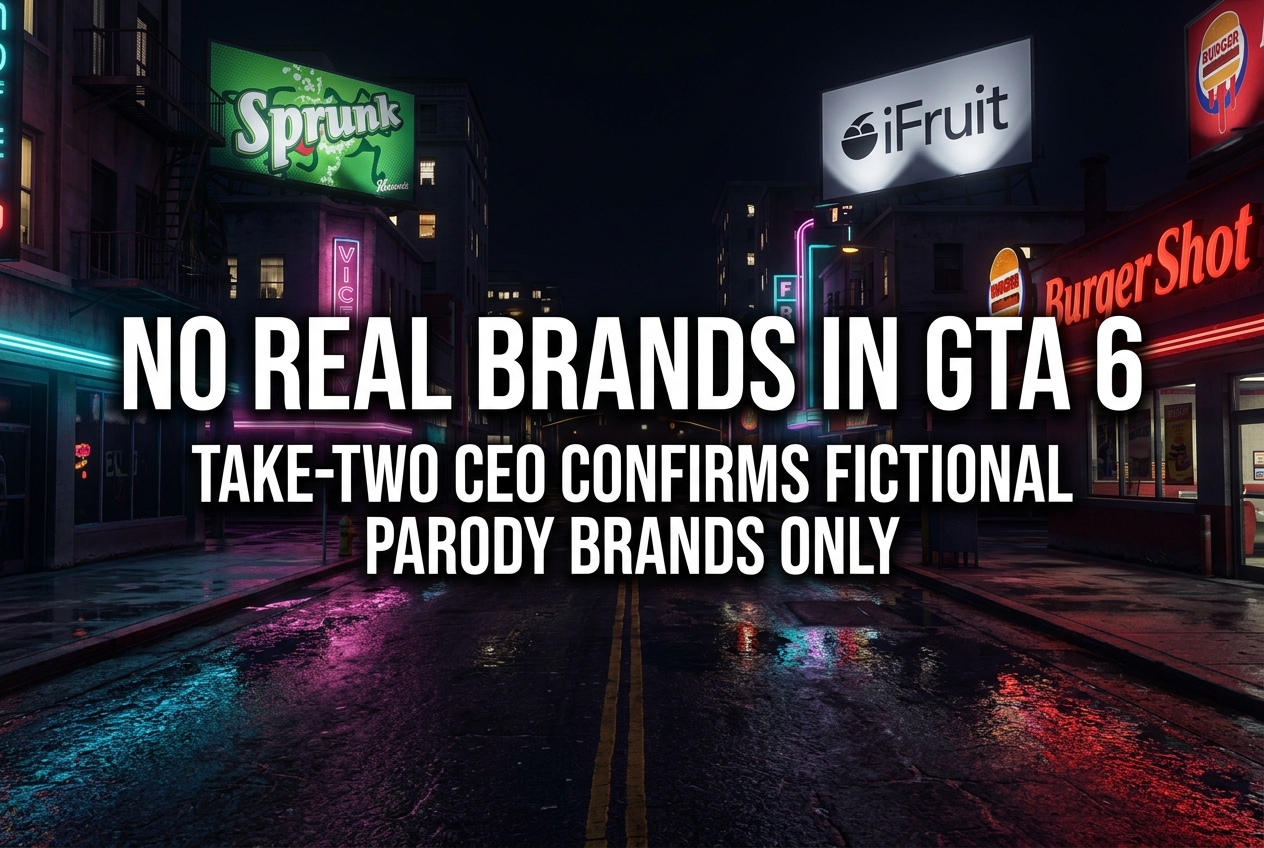
Take-Two CEO Strauss Zelnick confirmed at iicon 2026 that GTA 6 will feature no real-world brand partnerships or product placement. The game’s fictional universe, built on satirical parodies like Sprunk, iFruit, and Burger Shot, will remain fully intact when Vice City launches on November 19, 2026.
Take-Two Interactive CEO Strauss Zelnick has confirmed that GTA 6 will not feature any real-world product placement or brand partnerships. Speaking at the iicon 2026 conference in Las Vegas, Zelnick told Variety’s Jenny Maas: “We need to be true to the underlying intellectual property and we need to be true to our consumers. It’s a fictional world and everything in it is fictional. So we’re not even at risk of doing brand partnerships because all the brands are made up. And I think that keeps us pure.” The game is set to launch on November 19, 2026 for PS5 and Xbox Series X|S, following a franchise that has already sold over 465 million copies worldwide, with GTA V alone reaching 225 million.
Why Zelnick Calls In-Game Ads “Unfair”
This is not the first time the Take-Two CEO has addressed the advertising question. Back in March 2026, Zelnick stated that he finds it “very difficult to believe that we would want to have interstitial advertising in a game that someone paid 70 or 80 bucks for,” calling the idea unfair. At iicon, he went further by referencing an unnamed TV show as an example of product placement gone wrong, arguing that pushing brand deals too aggressively can become a “disaster.”
While Take-Two’s NBA 2K franchise does include real-world advertisements in basketball arenas, Zelnick noted that these placements are a minor revenue contributor and fit the sports simulation context. For a satirical open-world game like GTA, the calculus is entirely different. The fictional brand universe is not just a creative choice; it is the creative foundation.
How Fictional Brands Define the GTA Experience
The Grand Theft Auto series has built its identity on sharp parody of American consumer culture, media, and corporate life. Brands like Sprunk (Sprite), Burger Shot (Burger King), Cluckin’ Bell (KFC), Weazel News (Fox News), and Lifeinvader (Facebook) are not background decoration. They are woven into radio ads, TV broadcasts, mission design, and environmental storytelling across every game in the series.
GTA 5’s mission “Friend Request” is a perfect example. Players infiltrated the offices of social media company Lifeinvader and planted a bomb in a prototype phone to assassinate its founder. That kind of narrative freedom is only possible because the brands are fictional. A real corporation would never agree to be portrayed this way, and the resulting legal complications would make it impossible for Rockstar to write with the same satirical edge.
Which Fictional Brands Are Returning in GTA 6?
Dozens of classic GTA parody brands have already been spotted in trailers and screenshots. iFruit, the long-running Apple parody, returns with an upgrade: a new Apple Pay spoof called Fruit Pay. Jason, Lucia, and Boobie are all seen using iFruit phones. eCola (Coca-Cola) is back with the tagline “deliciously infectious.” Weazel News helicopters fly over Vice City. Redwood Cigarettes (Marlboro/Winston) and Pisswasser (Budweiser) are confirmed to return as well.
Sprunk has not yet appeared in any trailer, but the community widely interprets this as a deliberate tease rather than an omission. The brand is considered too iconic to leave out. The same applies to Cluckin’ Bell and Burger Shot, which are expected to surface once the game launches.
New Parody Brands Joining Vice City
Rockstar has added a substantial lineup of new fictional brands for GTA 6. Fizz parodies Fanta. Jesters parodies Pringles. John Samuel Tennessee Whiskey parodies Jack Daniel’s. Sahara, a direct Amazon parody, appears to have a significant role in the game world, serving as the naming sponsor of the Vice City Narcos’ home arena (parodying the Miami Heat’s Kaseya Center). Eris (Nike) appears on Lucia during a training scene, and Sessanta Nove (Louis Vuitton) is the brand on Lucia’s bikini in the iconic rooftop shot from the first trailer.
Perhaps most intriguing are the hidden domain registrations discovered under Take-Two’s name servers by leaker Tez2. These included WhatUp.app (WhatsApp), RideMe.app (Uber/Lyft), BuckMe.app (Patreon), BrianAndBadly.com (Morgan & Morgan law firm), and LeonidaGov.org (a fictional state government site). Take-Two quickly deleted the domains after they surfaced, which the community took as indirect confirmation of their legitimacy. Parodies of TikTok and Spotify are also widely expected, though their in-game names remain unknown.
What Would Real Brands Actually Break?
Industry analyst Matthew Ball has argued that “eventually, advertising does reach all addressable surface areas” in gaming. Some analysts even suggested that Vice City’s urban landscape could function as a massive digital billboard, generating millions in ad revenue. But Rockstar operates under a fundamentally different creative philosophy.
You cannot effectively mock a brand that is paying for space in your game. If a real Starbucks sign sat next to a Rockstar-written parody of corporate greed, the satire would collapse. Gaming history is full of cautionary tales: Death Stranding’s aggressive Monster Energy integration, NBA 2K’s Jake from State Farm moments, Battlefield 2142’s targeted ad spyware controversy, and Alan Wake’s Energizer and Verizon billboards all generated significant backlash. For a franchise as culturally significant as GTA, the risk-reward equation heavily favours keeping brands fictional.
GTA 6 Pricing and the No-Ad Promise
Zelnick has not confirmed an exact price for GTA 6, but he has signalled that it will feel “very reasonable” relative to the value delivered. Industry consensus points to a standard edition in the $70 to $80 range, with premium and collector’s editions going higher. Zelnick’s March 2026 comment explicitly linking a $70-80 price tag to the expectation of no in-game ads establishes a clear consumer contract: a full-price game should deliver a full, ad-free experience.
With GTA Online still generating over a million dollars per day after 13 years, and GTA V having shipped 225 million copies, Take-Two has no financial pressure to chase advertising revenue inside GTA 6. The franchise’s organic earning power far outweighs anything product placement could offer.
Marketing Is About to Begin
At the same iicon event, Zelnick reiterated that GTA 6’s marketing campaign will start “soon,” tightening the window from the “summer” timeline he gave investors in February 2026. His quip that “a lot of people will be calling in sick on November 19th” was widely interpreted as a strong signal that the release date is locked in. Pre-orders, a third trailer, and detailed gameplay previews are all expected to follow once the marketing push begins.
For ongoing coverage of GTA 6 developments, you can check GamerMarkt’s GTA 6 marketing timeline breakdown.
What This Means for Players
GTA 6 will arrive on November 19, 2026 with a fully fictional brand ecosystem intact. No real-world logos on billboards. No branded loading screens. No corporate partnerships diluting the satirical tone that has defined Grand Theft Auto for over two decades. Instead, Vice City’s neon signs, radio spots, and storefronts will be populated entirely by Rockstar’s own creations, each one a pointed commentary on the real world it mirrors.
Rockstar’s commitment to this approach, confirmed directly by Take-Two’s CEO, is a clear statement that artistic integrity still takes priority over incremental revenue. When players step into the new Vice City later this year, they will find a world designed to make them laugh, think, and play without ever feeling like they have been sold something by a real corporation.