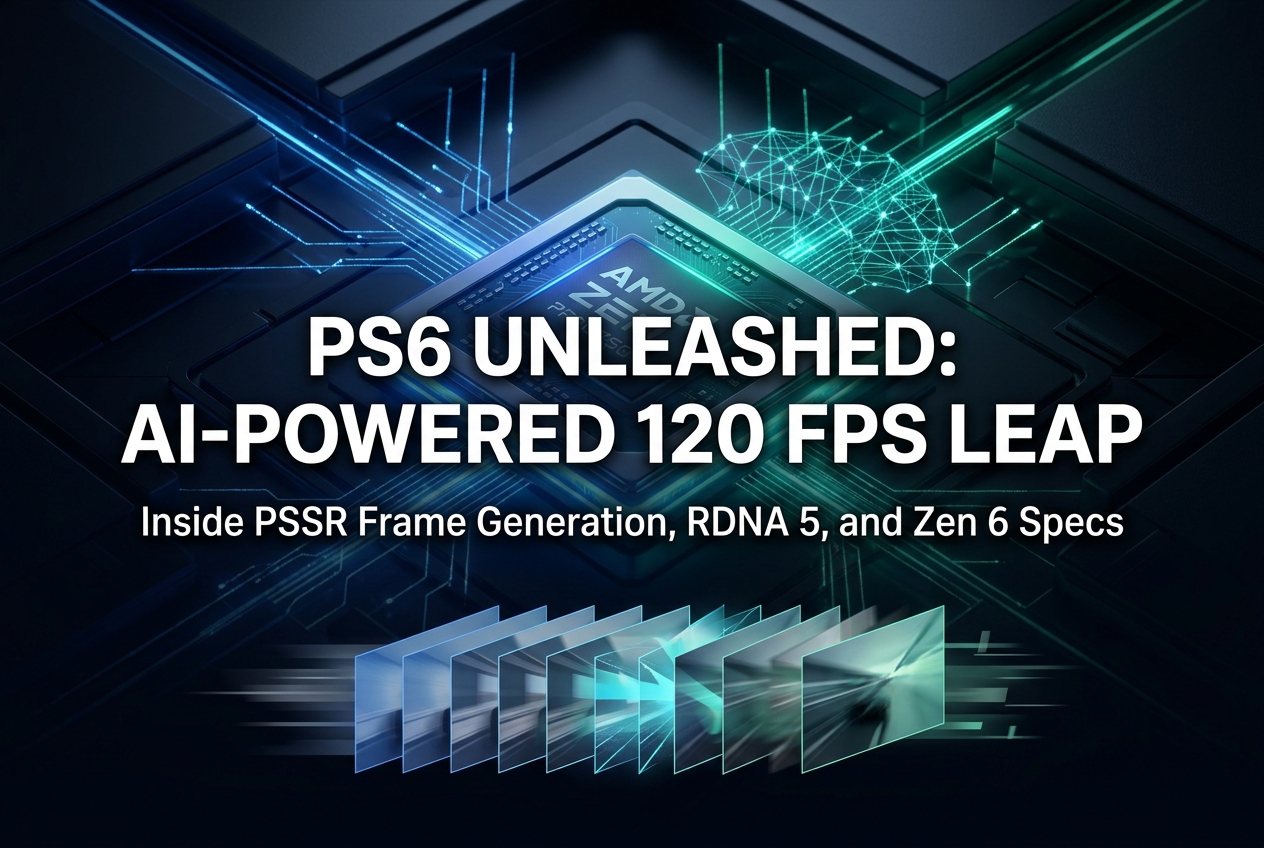
Sony has confirmed AI-powered PSSR Frame Generation is coming to PlayStation platforms. With AMD Zen 6, RDNA 5, and up to 12x ray tracing improvement, the PS6 targets 4K 120 FPS as the new console gaming standard.
Sony has officially confirmed that AI-powered frame generation is coming to PlayStation hardware. In a detailed interview with Digital Foundry, PlayStation lead system architect Mark Cerny revealed that an equivalent frame generation library will appear on PlayStation platforms, developed through the Project Amethyst collaboration with AMD. The technology will not ship in 2026, which strongly points to the PlayStation 6 as its true destination.
What Mark Cerny Actually Said About PSSR and Frame Generation
Mark Cerny, the architect behind the PS4, PS5, and PS5 Pro, provided the most concrete confirmation yet of Sony’s frame generation roadmap. According to Cerny, the new PSSR 2.0 uses “the same core co-developed algorithm as FSR Redstone’s Upscaling,” while FSR Frame Generation is also built on co-developed (or “co-engineered”) technology between Sony and AMD.
His exact words carry significant weight: “I’m very happy with how that work is progressing, and an equivalent frame generation library should be seen at some point on PlayStation platforms.” He then added that no more releases are planned for 2026. Industry analysts and tech outlets, including Igor’s Lab and Tom’s Hardware, interpret this as a near-certain confirmation that frame generation will debut with the PS6 rather than arriving as a late PS5 Pro feature.
How Frame Generation Works and Why It Matters for Consoles
Frame generation uses machine learning algorithms to analyze two consecutive rendered frames and then synthesize a new frame to insert between them. This effectively doubles or even triples perceived smoothness without requiring the GPU to render each additional frame from scratch. On PC, NVIDIA’s DLSS 4 and AMD’s FSR 4 have already demonstrated the potential of this technology, pushing frame rates to match high-refresh-rate monitors.
The challenge for consoles is input latency. A synthetic frame does not exist in the game’s logic: it is a visual interpolation. This can create a disconnect where the game looks like it runs at 120 FPS but responds with the delay of a 30 FPS title. Sony’s approach mirrors its PSSR development philosophy: a hardware-accelerated solution using dedicated AI silicon, designed to minimize this lag rather than relying on a purely software-based workaround.
PS6 Hardware Specs: What the Leaks Reveal
Multiple credible leaks, primarily from Moore’s Law Is Dead and corroborated by outlets like TweakTown, Beebom, and Notebookcheck, paint a detailed picture of the PlayStation 6’s internal hardware. Codenamed “Orion,” the console is built around a custom AMD APU manufactured on TSMC’s 3nm process node.
| Component | PS6 (Orion) Specs |
|---|---|
| CPU | AMD Zen 6 (7-8 Zen 6c cores + 2 Zen 6 LP cores) |
| GPU | Custom AMD RDNA 5, 52 active CUs (54 CU design) |
| Compute Performance | 34-40 TFlops |
| RAM | 30 GB GDDR7 (up to 40 GB supported) |
| Memory Bandwidth | 640 GB/s (160-bit bus, 32 Gbps GDDR7) |
| Ray Tracing vs PS5 | 6-12x improvement |
| Rasterization vs PS5 | 2.5-3x improvement |
| Manufacturing | TSMC N3 (3nm) |
| Backward Compatibility | PS5 and PS4 games |
These specs position the PS6’s raw rasterization performance roughly between an RX 7900 XT and an RX 9080 in today’s GPU terms. However, when factoring in PSSR AI upscaling and frame generation, the effective performance jump over PS5 is estimated at 4-8x, comparable to the generational leap between PS4 and PS5.
Can PS6 Actually Deliver 4K 120 FPS With Ray Tracing?
Sony is reportedly targeting 4K output at 120 FPS with ray tracing enabled as the PS6’s headline feature. This will not be achieved through brute-force native rendering. Instead, the strategy relies on PSSR to upscale from a lower internal resolution while the GPU allocates more resources to ray tracing calculations.
The math works out convincingly. With 6-12x ray tracing performance over PS5 and 2.5-3x rasterization improvement, combined with next-generation AI upscaling and frame generation, hitting 4K 120 FPS in most titles becomes genuinely feasible. Path tracing, which traces every light ray in a scene for photorealistic lighting, could shift from a luxury feature to a default rendering mode on PS6 hardware.
PSSR 2.0 Is Already Live on PS5 Pro
While the frame generation component is reserved for the future, PSSR 2.0 launched on PS5 Pro in March 2026. The update brings improved image quality to titles including Silent Hill 2, Silent Hill f, Dragon Age: The Veilguard, Control, Alan Wake 2, Final Fantasy VII Rebirth, Nioh 3, Rise of the Ronin, and Monster Hunter Wilds. Users can enable the feature through Settings, then Screen and Video, then Video Output, by toggling the PSSR Enhanced Mode option.
This update serves as a proof of concept for the broader Project Amethyst collaboration. The improvements in hair detail, texture quality, and lighting stability demonstrate what the co-developed AMD algorithm can achieve, even on existing PS5 Pro hardware with its more limited ML capabilities.
PS6 Release Date: 2027, 2028, or Later?
The PS6 release window remains one of the most debated topics in the gaming industry. The strongest evidence points to a late 2027 holiday launch, with Sony reportedly entering mass production in mid-2027. Leakers like Moore’s Law Is Dead maintain this timeline is still on track. However, several factors could push the date to 2028 or even 2029.
Global semiconductor demand, driven largely by AI datacenter expansion, has created fierce competition for TSMC’s advanced nodes. GDDR7 memory pricing is another concern, with the RAM supply situation flagged as a “major concern” by industry analysts. Former PlayStation executive Shuhei Yoshida has publicly stated that a 2028 launch “feels right,” while Bloomberg has reported Sony may be considering a delay.
On the pricing front, per-unit manufacturing costs could reach $760, with analysts warning that next-gen consoles might retail for up to $1,000. Sony’s recent PS5 price increases across multiple regions, adding $100-150 to existing models, signal that cost pressures are already reshaping the company’s pricing strategy. For more context on this, GamerMarkt covered the PS5 price increases in detail.
The PS6 Handheld: Codenamed Canis
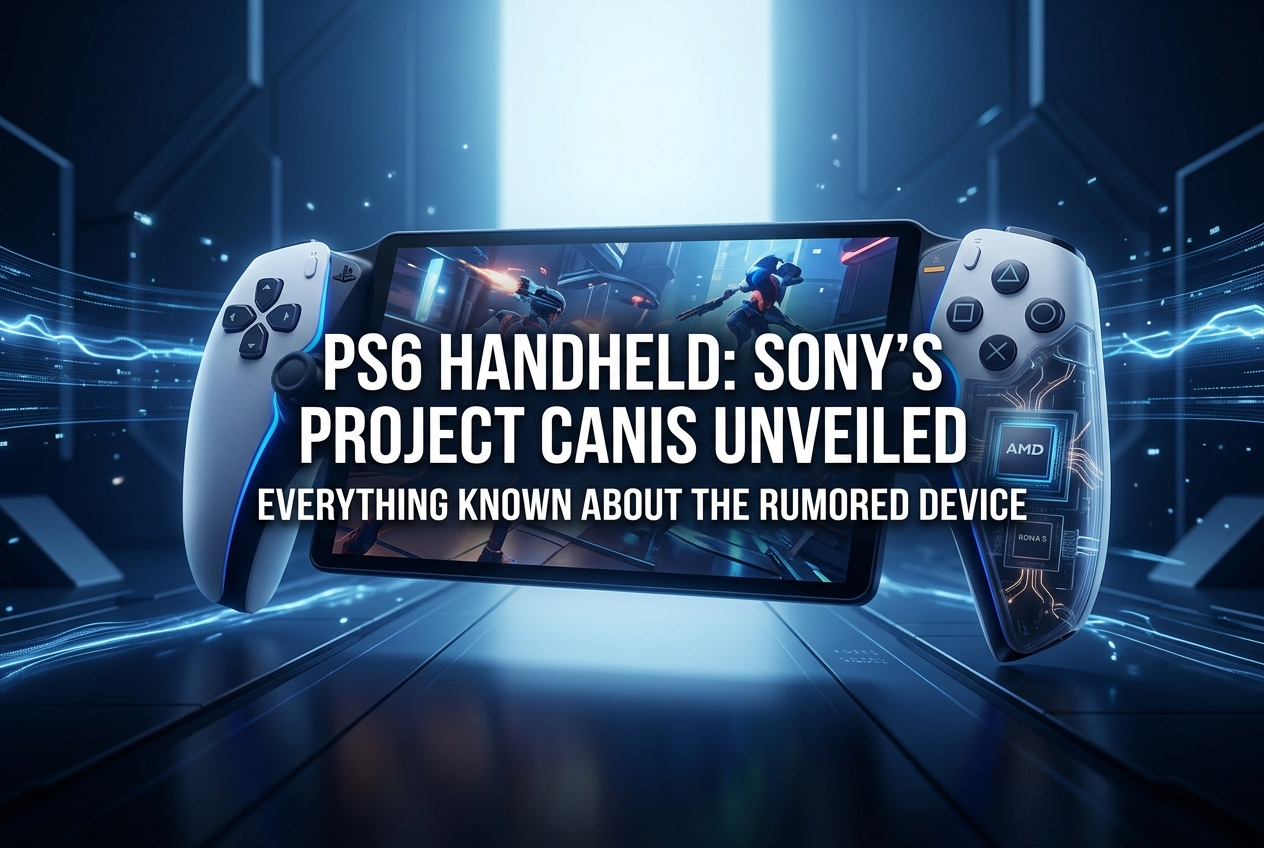
Sony is reportedly developing a handheld companion to the PS6 home console, codenamed “Canis.” This portable device would feature 4 Zen 6c cores, 16 RDNA 5 compute units, and 24 GB LPDDR5X memory, targeting a 15W power envelope. It would be backward compatible with PS5 and PS4 games, giving it an enormous library advantage at launch over competitors like the Steam Deck and ROG Ally X.
The Canis handheld is expected to support a docked mode for TV output, creating a hybrid ecosystem similar to Nintendo’s Switch approach but with significantly more processing power. The rumoured three-model PS6 lineup (standard, handheld, and potentially a Pro variant) represents a major strategic shift for Sony’s hardware division.
PS6 vs Xbox Project Helix: AI Elegance vs Brute Force
Microsoft’s next-gen console, codenamed Project Helix (also referred to as Magnus), is rumoured to pack a larger GPU with 68 compute units on a 408 mm² die and a 192-bit memory bus. On paper, that gives Xbox a raw power advantage over PS6’s 52-CU, 280 mm² GPU.
Sony’s counter-strategy is clear: leverage AI. By investing heavily in PSSR frame generation, advanced upscaling, and dedicated neural processing hardware, Sony aims to close or eliminate the perceived performance gap through intelligent software rather than larger silicon. This approach mirrors the broader industry trend where AI-driven rendering is increasingly valued over raw teraflop counts.
What Gamers Typically Want to Know
Will frame generation add noticeable input lag on PS6?
Frame generation inherently introduces some latency because synthetic frames are visual interpolations, not gameplay-driven renders. However, Sony’s hardware-accelerated approach should minimize this. Crucially, the PS6 is expected to maintain a 60 FPS base before frame generation kicks in, which dramatically reduces artefacts and input delay compared to interpolating from a 30 FPS base.
Is PSSR frame generation the same as FSR 4?
Not exactly. PSSR and FSR share a co-developed core algorithm through the Project Amethyst partnership, but PSSR is optimised specifically for PlayStation’s custom silicon. Think of it as a console-native implementation of the same underlying ML technology rather than a direct port of AMD’s PC solution.
Will PS5 Pro ever get frame generation?
Mark Cerny confirmed no further releases are planned for 2026. While a stripped-down version for PS5 Pro remains theoretically possible, most analysts expect frame generation to launch exclusively with PS6 as a key selling point for the next generation.
Will PS6 support backward compatibility?
Yes. Leaked specs consistently indicate PS5 and PS4 backward compatibility for both the home console and the Canis handheld, ensuring a massive game library from day one.
How much will the PS6 cost?
Manufacturing estimates suggest around $760 per unit. Retail pricing is rumoured between $599 and $699, though some analysts have warned prices could approach $1,000 depending on component costs and market conditions at launch.