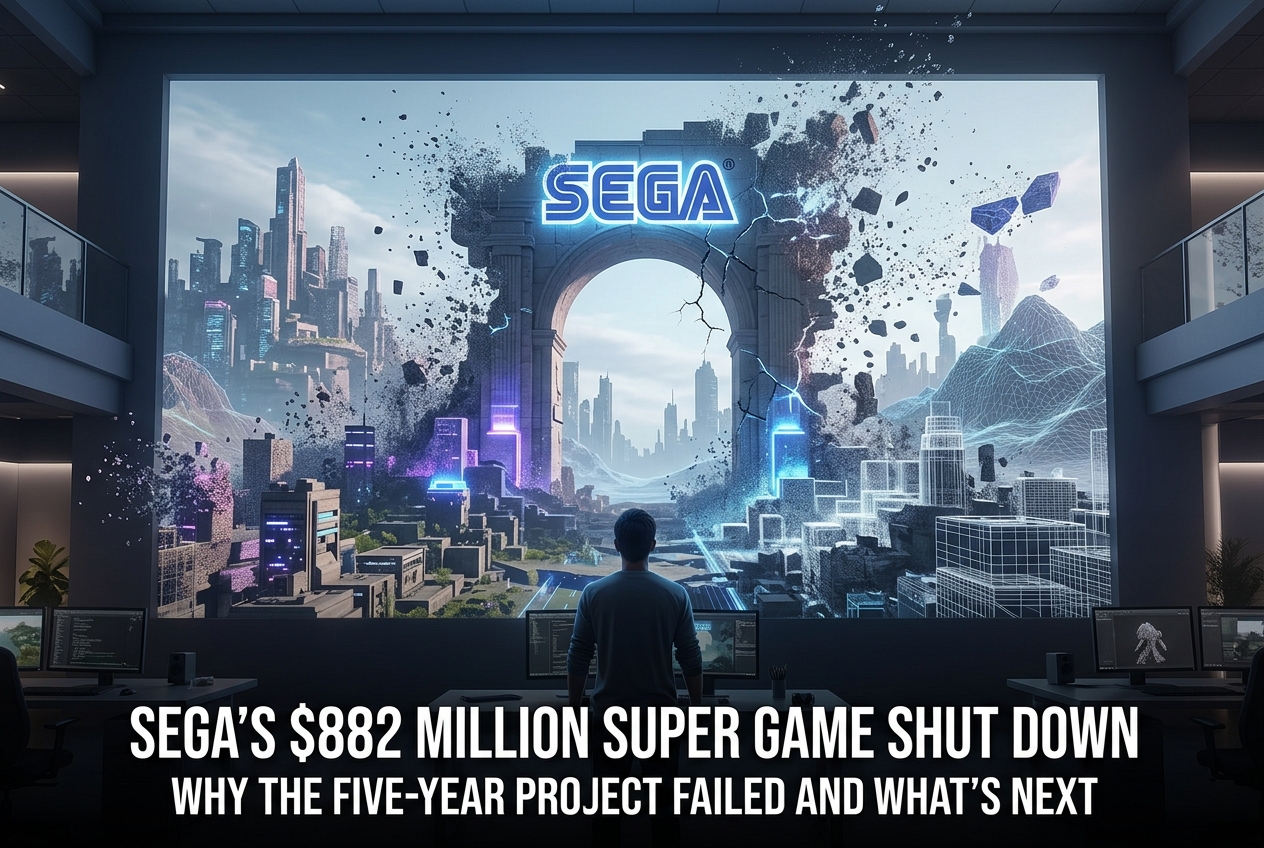
SEGA’s mysterious Super Game initiative, announced in 2021 with an $882 million budget, has been officially cancelled. The decision came in SEGA’s FY2026 financial report after F2P failures, Rovio struggles, and intensifying market competition.
SEGA has officially killed its Super Game project, ending a five-year initiative that was supposed to redefine the company’s future. The cancellation appeared in SEGA Sammy’s fiscal year 2026 financial results on May 12, 2026, tucked into a single line on slide 32: “Decided to cancel Super Game. No additional costs associated with the cancellation.” The project originally carried a budget of approximately 100 billion yen ($882 million), making this one of the largest quiet cancellations in recent gaming history.
What Was Super Game Supposed to Be?
SEGA first announced the Super Game initiative in May 2021, describing it as a plan to create titles that would go “beyond the traditional framework of games.” The company promised “large-scale, global” online experiences that would stand “head and shoulders above normal games.” In November 2021, SEGA and Microsoft announced a strategic alliance to build the project using Microsoft’s Azure cloud platform.
The keywords SEGA used to define the project were “Global,” “Online,” “Community,” and “IP Utilization.” The company drew on its experience with Phantasy Star Online 2 and hinted at involving its major franchises. At various points, the project flirted with NFTs, Web3, and metaverse concepts before those trends cooled off. SEGA’s former president Yukio Sugino said in late 2023 that the Super Game was targeting a March 2026 launch and projected lifetime sales of at least 100 billion yen (roughly $600 million at the time).
Despite five years of investor presentations, no gameplay footage, screenshots, or concrete details were ever shown to the public. The Super Game existed entirely in corporate slides.
Why SEGA Pulled the Plug
In a statement provided to Game File, SEGA explained the decision in measured terms: “In light of intensifying market competition, the emergence of competing titles based on similar concepts, and our business conditions, we made the decision to discontinue the development of Super Game during the fiscal year ending March 2026.”
Several factors converged to force SEGA’s hand:
- Sonic Rumble Party flopped. Launched in November 2025 as a free-to-play Fall Guys-style party game, it reportedly earned less than $250,000 in its first ten days and never recovered. SEGA’s financial report labelled it a “weak performance.”
- The Rovio acquisition backfired. SEGA purchased the Angry Birds developer for $776 million in 2023. Rovio consistently underperformed, leading SEGA to record approximately $200 million in impairment losses. The financial report bluntly states SEGA “did not achieve the creation of economic value through collaboration with Rovio.”
- Hyenas was the first warning sign. Creative Assembly’s multiplayer extraction shooter, widely believed to be the first Super Game title, was cancelled in September 2023 after SEGA deemed it unprofitable. The $200 million project never shipped.
- SEGA posted a net loss. The company reported a net loss of 5.7 billion yen ($31.6 million) for the fiscal year ending March 31, 2026, driven in part by Rovio impairment charges and underperforming new releases.
SEGA’s Free-to-Play Pivot
The Super Game cancellation is part of a broader strategic overhaul. SEGA explicitly stated in its financial presentation that it has “lowered the priority of F2P” game development. Over 100 developers who were working on free-to-play projects have been reassigned to “Full Game development teams focusing on mainstay IPs.”
This shift reflects the harsh reality of the live-service market in 2026. While the GaaS sector is projected to exceed $200 billion globally, the revenue is dominated by a handful of established titles like Fortnite, Genshin Impact, and Destiny 2. Breaking into this space with a new IP has become extraordinarily expensive and risky, as multiple high-profile failures across the industry have demonstrated. SEGA is far from the only publisher retreating from this model; Ubisoft, Square Enix, and Sony have all scaled back similar ambitions in recent years.
Classic Franchise Revivals Are Still Alive
The most important takeaway for players is that SEGA’s classic IP revival projects remain unaffected. Announced at The Game Awards 2023, these reboots are still actively in development. So far, only Shinobi: Art of Vengeance has shipped (released August 2025), but several major titles are confirmed to be coming:
- Crazy Taxi: A reboot (not a remake) reportedly targeting a 2027 release, with development confirmed for PC, consoles, and Nintendo Switch 2.
- Jet Set Radio: A reboot being built in Unreal Engine 5, previously rumoured for a 2026 launch window.
- Golden Axe: A new entry in the classic beat-em-up series.
- Streets of Rage: A 3D reboot reportedly titled Streets of Rage Revolution.
- Virtua Fighter 6: Being developed by Ryu Ga Gotoku Studio.
SEGA also confirmed that Alien: Isolation 2 is still in development at Creative Assembly, built on Unreal Engine 5 and led by original director Al Hope. A teaser trailer titled “False Sense of Security” dropped in April 2026.
Stranger Than Heaven and the Immediate Pipeline
While the Super Game is dead, SEGA’s near-term release slate looks strong. Ryu Ga Gotoku Studio’s Stranger Than Heaven, set in the Yakuza universe across five historical eras, was confirmed for a Winter 2026 launch on PS5, Xbox Series X/S, and PC. The game will also be available on Xbox Game Pass.
SEGA’s financial presentation revealed plans to release at least four full games in FY2027 (ending March 2027) and four or more in FY2028. The company is leaning hard into its proven IPs: Sonic, Yakuza/Like a Dragon, Persona, Total War, and the revived classic arcade franchises. This is a deliberate return to the formula that made SEGA Metacritic’s highest-rated publisher in 2024, driven by Metaphor: ReFantazio, Shin Megami Tensei V: Vengeance, and Like a Dragon: Infinite Wealth.
The SEGA Universe Initiative
In April 2026, SEGA launched a new brand initiative called “SEGA Universe” under the slogan “No Old, Stay Gold.” Unlike the Super Game’s vague promises, SEGA Universe has a clearer mission: revitalise classic IPs not just as games, but across entertainment formats including animation and other media.
On the film side, SEGA has an aggressive slate that includes Sonic the Hedgehog 4, The Angry Birds Movie 3, and adaptations of OutRun, Golden Axe, Shinobi, and Streets of Rage. The Sonic film trilogy alone has grossed over $1 billion worldwide, giving SEGA strong financial motivation to expand its transmedia presence.
What the Cancellation Means for the Industry
SEGA’s decision to walk away from a nearly $1 billion initiative is a significant moment for the gaming industry. It reinforces a pattern that has been building for years: the live-service gold rush is over for most publishers. Building a successful GaaS title requires not just massive investment but also the ability to compete against deeply entrenched competitors with established player bases.
The fact that SEGA managed to cancel the project with “no additional costs” suggests the initiative never progressed far beyond the research and development phase. This is both a blessing and a cautionary tale. SEGA avoided a catastrophic financial hit but invested five years of strategic focus and investor confidence into something that never materialised.
For players, this is arguably good news. The resources, developers, and creative energy that were tied up in an undefined mega-project are now flowing into games people actually want. Crazy Taxi, Jet Set Radio, Virtua Fighter, and Alien: Isolation 2 are all tangible projects with clear identities. SEGA’s pivot back to premium, full-price games built around beloved IPs is exactly the kind of course correction that many in the gaming community have been asking for.
Key Questions Around This Decision
Was the Super Game ever a single title?
Not exactly. SEGA described it as an umbrella initiative that could encompass multiple AAA online titles. The company planned to develop several “Super Games,” though it remains unclear whether only one project was cancelled or the entire concept was scrapped. The financial report’s phrasing suggests the whole initiative is dead.
Does this affect the Microsoft Azure partnership?
SEGA has not commented on the status of its Azure development partnership with Microsoft. The alliance was specifically tied to the Super Game initiative, so its future relevance is uncertain. However, Microsoft and SEGA continue to collaborate on other fronts, including Stranger Than Heaven launching on Xbox Game Pass.
Will Rovio recover?
SEGA’s financial presentation indicates Rovio will “prioritise rebuilding first.” The Angry Birds developer has been hit hard by impairment write-downs and underperformance. Whether SEGA can recoup its $776 million investment remains a major open question for the company’s long-term financial health.
Is the live-service model dead at SEGA?
Not entirely, but it has been significantly deprioritised. SEGA still operates existing online titles and has not ruled out future GaaS projects. However, the immediate strategic direction is clearly focused on premium, full-game releases. The company’s own words state that F2P development priority has been “lowered,” which falls short of a complete exit from the model.