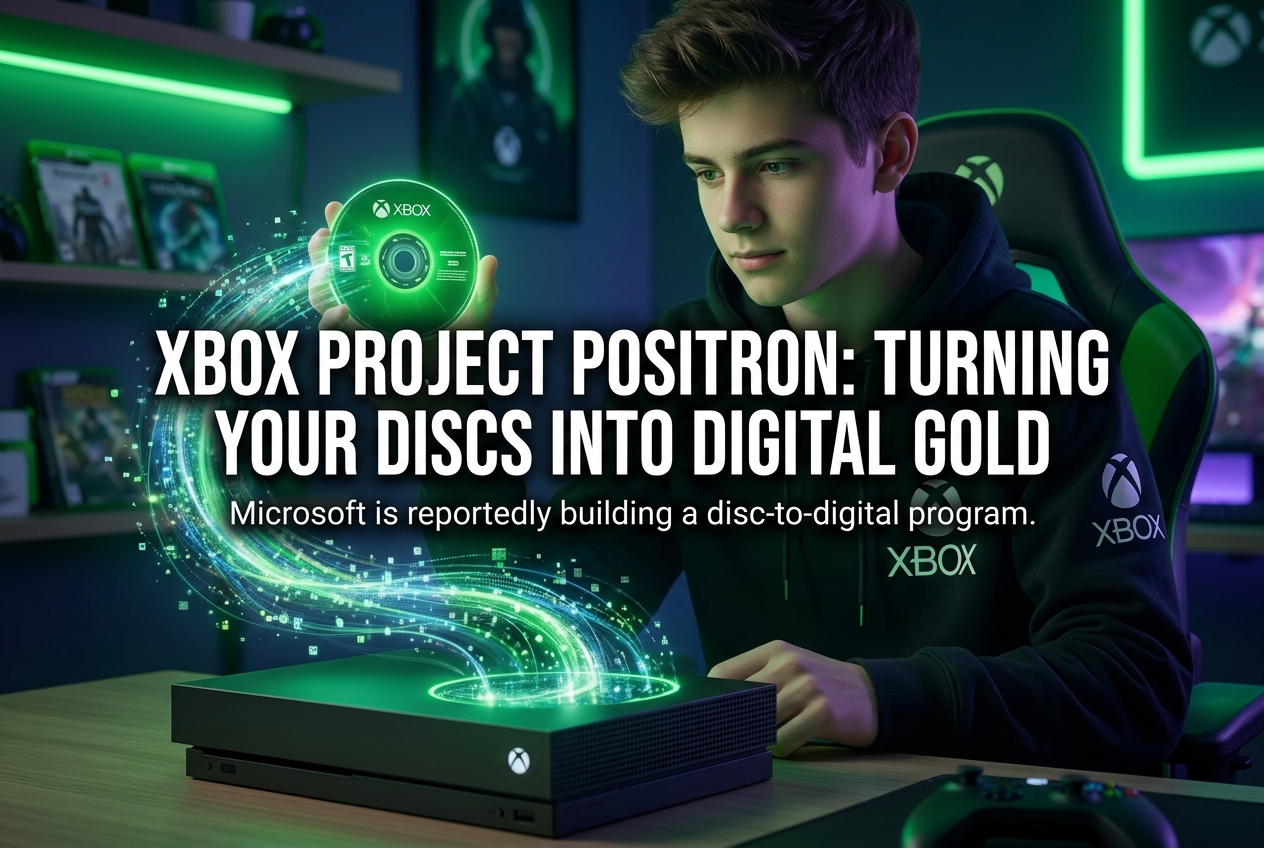
Microsoft is reportedly working on Project Positron, a disc-to-digital program that would let Xbox players convert their physical game collections into digital licenses. The initiative is closely tied to the upcoming all-digital Xbox Helix console, expected to ship developer kits in 2027.
Microsoft is developing a system codenamed “Project Positron” that could convert physical Xbox game discs into digital licenses. The program was first reported by Jez Corden at Windows Central on May 13, 2026, after references to “Disc2Digital” were discovered inside recent Xbox Insider builds. With PlayStation reporting an 85% digital game sales ratio in its latest fiscal quarter, the move signals that physical media’s role in console gaming is rapidly approaching its end.
What Is Project Positron?
Project Positron is a codename found in Xbox PC app updates that references a disc-to-digital entitlement system. According to Windows Central’s sources, the program would allow players who own physical Xbox game discs to register them as digital licenses tied to their Microsoft accounts. This would let those games run on hardware that lacks a disc drive.
Details remain extremely limited. The project is in its early stages, and there is no guarantee it will ship as a consumer-facing feature. Windows Central’s Jez Corden explicitly warned readers to “take this with a huge pinch of salt and a healthy dose of speculation.” However, the discovery within official Insider builds gives the leak more credibility than a typical rumour.
Why Is Microsoft Building This Now?
The answer is Project Helix. Microsoft’s next-generation console, officially revealed at GDC 2026, is being designed as a console-PC hybrid powered by a custom AMD SoC. The system will play both Xbox console games and PC games natively, with alpha developer kits shipping to studios in 2027. Crucially, all indications suggest Helix will not include a built-in disc drive.
Microsoft has a strong financial incentive to go disc-free. Unlike Sony, which is a member of the Blu-Ray Disc Association, Microsoft must pay licensing fees to use Blu-Ray technology in its hardware. Removing the disc drive eliminates that cost entirely. Combined with the industry-wide shift toward digital distribution, dropping physical media is an increasingly practical decision.
But Microsoft also cannot afford to alienate the portion of its player base that still owns physical game collections. Project Positron appears designed as a bridge: a way to bring disc-owning players into the Helix ecosystem without forcing them to abandon their existing libraries.
How Could the Conversion Work?
Windows Central outlined two plausible scenarios for how Project Positron might function in practice:
- Permanent one-time conversion: A player inserts their disc into an existing disc-drive-equipped Xbox (such as the Series X), and the system permanently registers the game as a digital license on their account. The disc would then be rendered unusable to prevent duplication.
- Temporary verification via external drive: Players connect a USB-based Blu-Ray drive to a disc-less system like Xbox Helix. While the disc is inserted, the system grants temporary digital access. Removing the disc revokes the entitlement.
Both models come with significant challenges. A permanent conversion requires Microsoft to invalidate the physical disc remotely, which raises questions about how that deactivation would be enforced. A temporary system avoids the piracy concern but offers less convenience. Microsoft will also need publisher cooperation, since third-party rights holders would need to approve any system that generates new digital entitlements from existing physical copies.
The Xbox One DRM Lesson From 2013
Microsoft attempted something conceptually similar during the Xbox One reveal in 2013. The original plan tied physical discs to user accounts and granted both physical and digital licenses simultaneously. However, the system restricted used-game sales and required periodic online check-ins. The backlash was immediate and severe, forcing Microsoft to reverse the entire policy before launch. The reversal also killed a planned family-sharing feature that would have allowed up to 10 people to access a shared digital library.
The key difference in 2026 is context. When Xbox One launched, digital game sales were still a minority of the market. Today, PlayStation’s digital ratio has hit a record 85% in a single quarter, and Microsoft’s is believed to be even higher. Game Pass, Steam, and mobile gaming have normalised digital-first purchasing for an entire generation of players. A disc-to-digital program now reads less as a restriction and more as a preservation tool.
What We Know About Xbox Project Helix
Understanding Positron requires understanding the hardware it is being built for. Here is what Microsoft has officially confirmed and what credible leaks suggest about Project Helix:
| Feature | Detail |
|---|---|
| Processor | Custom AMD SoC (rumoured Zen 6-based, 11 cores) |
| GPU | RDNA 5 architecture (rumoured 68 compute units) |
| Memory | 48 GB GDDR7 (rumoured, 192-bit bus) |
| Ray tracing | “Order of magnitude” leap over current generation |
| Game compatibility | Xbox console games and PC games natively |
| Backward compatibility | Four generations of Xbox games targeted |
| Dev kits | Alpha hardware to developers in 2027 |
| Consumer launch | Expected 2028 (not officially confirmed) |
| Disc drive | Very likely absent; fully digital system expected |
The Xbox Play Anywhere catalogue already spans over 1,500 games, and Microsoft has framed Helix as the culmination of its strategy to unify Xbox and Windows ecosystems under a single platform. Xbox Mode on Windows 11 began rolling out in select markets in April 2026, further blurring the line between console and PC.
What This Means for Players With Physical Collections
Disc-to-digital conversion unlocks capabilities that physical media simply cannot offer. Digital license holders can access their games through Xbox Cloud Gaming, use Xbox Play Anywhere to play across devices, and avoid the need to swap discs. For players sitting on large physical libraries built over two decades of Xbox hardware, Positron could preserve that investment in a meaningful way.
However, the programme also raises legitimate concerns. If conversion permanently deactivates a disc, the used-game market takes a direct hit. Collectors who value physical media for its tangible, resellable nature may not find the trade-off worthwhile. There are also open questions about whether all physical games would be eligible or whether the system would be limited to titles already on the backward-compatibility list, which Microsoft stopped expanding in 2021.
The Bigger Picture: Physical Media’s Decline
Project Positron is not happening in isolation. The entire games industry is moving decisively toward digital distribution. Sony’s PlayStation 5 Slim shipped with a detachable disc drive, signalling that even the market’s physical-media champion sees discs as optional. Steam and the broader PC gaming ecosystem abandoned optical drives years ago. Modern PC cases often do not even include a bay for one.
Game Pass, PS Plus, and similar subscription services have further accelerated the shift. When players can access hundreds of games for a monthly fee, the incentive to buy and store physical discs weakens considerably. Microsoft’s own Game Pass ecosystem, which now includes partnerships with Discord Nitro and is reportedly expanding into China via a separate “Project Saluki” tier, positions digital access as the core of Xbox’s business model going forward.
Questions Players Are Already Asking
When will Project Positron be available?
No launch date has been announced. The project is in its early stages. If it materialises, the most likely window is alongside or shortly after the Project Helix console launch, which is expected around 2028 based on the 2027 developer-kit timeline.
Will it work with all Xbox disc games?
This has not been confirmed. It is reasonable to expect the programme would be limited to titles within the existing backward-compatibility catalogue. Microsoft has pledged to keep “games from four generations of Xbox playable,” but the specifics remain unclear.
Can Xbox Series S owners use this?
Potentially, if the system supports external USB Blu-Ray drives for verification. The Series S has no built-in disc drive, so an external solution would be necessary. This scenario has been speculated but not confirmed.
What happens to the physical disc after conversion?
If the conversion is permanent, the disc would almost certainly be deactivated to prevent licence duplication. If the system uses temporary verification, the disc would remain functional but would need to stay inserted during play. Publishers are unlikely to agree to a model that lets one disc generate unlimited free digital copies.
Is this confirmed by Microsoft?
No. Microsoft has not officially acknowledged Project Positron. The information comes from Xbox Insider build references and Windows Central’s sourcing. Until Microsoft makes a public announcement, the programme should be treated as a credible but unconfirmed report.
Looking Ahead
Project Positron represents Microsoft’s attempt to solve one of the most practical challenges of the all-digital future: what happens to the games people already own on disc. Whether it ships as a permanent conversion tool, a temporary verification layer, or something entirely different, the intent is clear. Microsoft wants every Xbox player, including those with shelves of physical games, to transition smoothly into the Helix era.
For gamers keeping a close eye on the evolving digital landscape, platforms like GamerMarkt offer a wide range of digital gaming products, from game credits to EPIN codes, making it easy to stay connected to the digital ecosystem that is rapidly becoming the industry standard.