
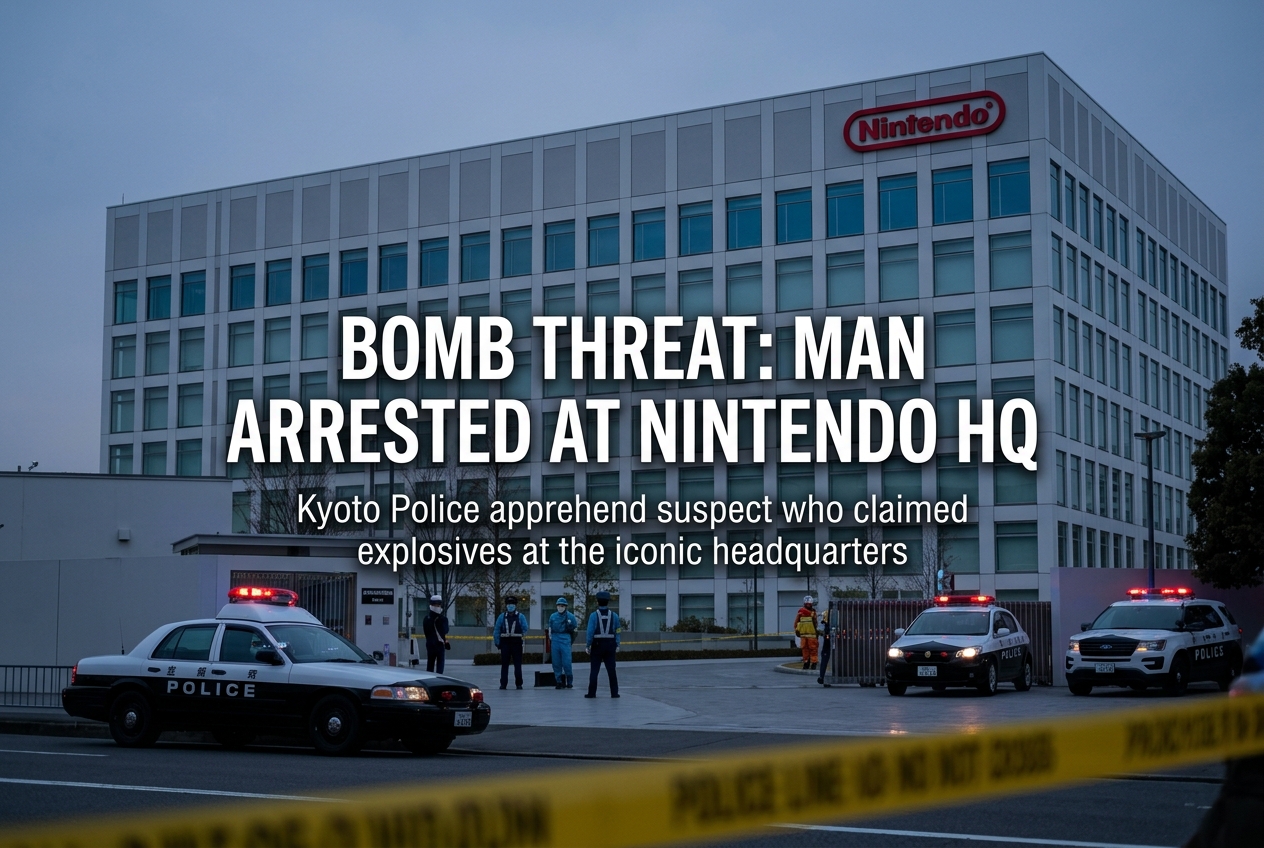
Kyoto police arrested a 27-year-old unemployed man on May 12, 2026, after he sent threatening letters claiming to have planted multiple bombs at Nintendo’s headquarters. No explosives were found, but the suspect has admitted to the charges.
Kyoto Prefectural Police arrested a 27-year-old unemployed man on May 12, 2026, for sending bomb threat letters to Nintendo’s headquarters in Kyoto, Japan. The suspect, who lives in Hekinan City in Aichi Prefecture (approximately 150 kilometres from Kyoto), mailed threatening envelopes to Nintendo’s head office in Minami Ward. He has admitted to the charges, though police are still investigating his motive. No explosives were found at the premises.
What Did the Threat Letters Say?
According to multiple Japanese outlets including Kyoto Shimbun and KTV News, the threatening envelope arrived at Nintendo’s headquarters on March 16, 2026. The letter contained several alarming statements: “I’m going to blow you all up,” “My plans cannot be thwarted,” and a claim that the sender had “already planted multiple bombs at Nintendo Co., Ltd.”
Nintendo immediately contacted police after receiving the envelope. Officers were dispatched to search both the interior and surroundings of the headquarters building, but found no explosive devices, suspicious packages, or injured individuals. Despite the lack of physical evidence, the threat caused significant disruption to Nintendo’s operations and triggered a nearly two-month investigation.
How Was the Suspect Caught?
The investigation ran from mid-March through to the arrest on May 12. Kyoto’s Minami Police Station traced the letters back to an unemployed man residing in Ishibashi-cho, Hekinan City, Aichi Prefecture. He was arrested on suspicion of “forcible obstruction of business” (kyōsei-teki gyōmu bōgai), a charge under Article 234 of the Japanese Penal Code that covers a wide range of harassment, threats, and disruptive behaviour directed at places of business.
Under Japanese law, this offence carries a penalty of up to three years’ imprisonment or a fine of up to 500,000 yen. Since the suspect does not appear to have been in possession of or concealed any actual explosives, he faces the obstruction charge rather than more severe weapons-related offences. However, given the gravity with which bomb threats are treated in Japan (particularly in Kyoto following the 2019 Kyoto Animation arson attack), prosecutors are expected to pursue the case aggressively.
Why Does Japan Take These Threats So Seriously?
The heightened response to bomb threats in Japan, especially those targeting businesses in Kyoto, is directly linked to the Kyoto Animation arson attack of July 18, 2019. In that devastating incident, a man set fire to Kyoto Animation’s Studio 1 building, killing 36 people and injuring 34 others. The attack remains one of the deadliest acts of mass violence in modern Japanese history and fundamentally changed how Japanese authorities approach corporate threats.
During an earlier Nintendo threat trial, a company employee’s deposition was read in court, stating that “the Kyoto Animation arson and murder case flashed through my mind and terrified me.” This testimony underscores why even threats that turn out to be empty are treated with maximum seriousness by law enforcement and cause genuine distress among employees.
Nintendo’s History of Threat Incidents
This is the third known threat-related case targeting Nintendo since 2022, highlighting a worrying pattern for the gaming giant.
2022: Threatening letters to executives. A female office worker from Tokyo was arrested for mailing a death certificate (complete with a date of death and description of fatal injuries) along with a threatening letter to a Nintendo executive. She stated she held “no direct grudge” against the company.
2023-2024: 39 threat messages over three months. Kenshin Kazama, a 27-year-old local government official from Hitachi City Hall, sent 39 threatening messages through Nintendo’s official website inquiry form between August and November 2023. His messages included bomb threats, death threats aimed at Splatoon Koshien tournament attendees, and statements such as “I’ll make you regret bringing such a shitty game into this world.” The threats forced Nintendo to postpone the Splatoon Koshien 2023 National Finals (scheduled for December 2023) and cancel the major Nintendo Live 2024 Tokyo event entirely. Kazama was arrested in April 2024, and the Kyoto District Court sentenced him to one year in prison, suspended for four years, citing “persistent and vicious” conduct. His stated motive was frustration from repeatedly losing in online Nintendo games.
2026: The current case. A different 27-year-old man sent bomb threat letters in March 2026 and was arrested on May 12. His motive remains unknown.
A Growing Problem for the Gaming Industry
Threats against major gaming companies are not unique to Nintendo. In 2023, visitors were evacuated from HoYoverse’s Genshin Impact Summer Festival in response to a bomb threat. Following the Kyoto Animation attack, companies such as Square Enix, Animate, and Khara (the studio behind Evangelion) also received threats referencing the arson. Security experts note that threats targeting gaming companies are rising globally, with high-profile corporations like Nintendo inherently more exposed due to their massive public-facing presence.
Nintendo is currently in one of its strongest commercial periods. The Switch 2 has sold 19.86 million units worldwide as of March 31, 2026, outperforming the original Switch’s launch trajectory. Yet this very visibility makes the company a more prominent target for individuals seeking to cause disruption or express grievances, whether rational or not.
What Happens Next?
The suspect is currently in custody, and the building has been confirmed safe. Investigators continue to probe his exact motive. Nintendo has not issued a public statement regarding this specific arrest. Further details are expected as the case moves through Japan’s legal system.
All three known threat cases targeting Nintendo share a notable pattern: the perpetrators had no direct connection to the company. Their motives ranged from unexplained to stress-related, highlighting a disturbing trend of misdirected hostility toward one of the world’s most recognisable gaming brands.
Key Questions About the Incident
Were any actual explosives found at Nintendo’s headquarters?
No. Police thoroughly searched the building and surrounding area after receiving the threat on March 16, 2026. No explosive devices or suspicious objects were discovered.
What charges does the suspect face?
He has been charged with forcible obstruction of business under Article 234 of the Japanese Penal Code. This offence carries a maximum sentence of three years’ imprisonment or a fine of up to 500,000 yen.
Why did the arrest take two months?
The investigation required tracing the threatening letters back to the sender. The suspect lived in Hekinan City, Aichi Prefecture, roughly 150 kilometres from Kyoto, and it took investigators from mid-March to May 12 to identify and apprehend him.
Has Nintendo commented on the arrest?
As of May 14, 2026, Nintendo has not released an official public statement regarding this particular incident.
Is this related to the previous Nintendo Live cancellation threats?
No direct link has been established. The 2023-2024 threats were carried out by Kenshin Kazama, who was convicted separately. This appears to be an unrelated case involving a different individual, though the parallel of a 27-year-old suspect is a notable coincidence.