
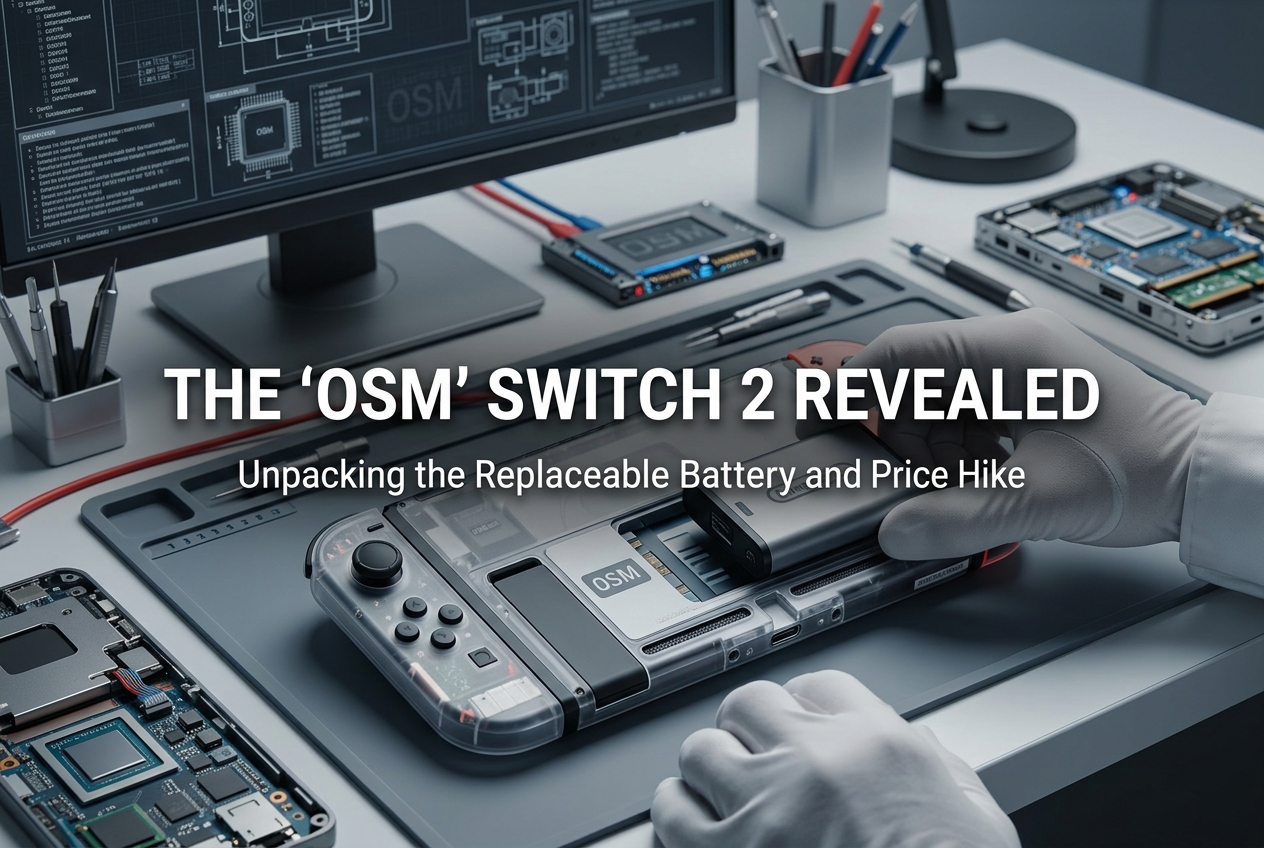
Nintendo has confirmed a revised Switch 2 with a user-replaceable battery for the EU, marked by the mysterious OSM code. Combined with a September 2026 price hike and surging R&D spending, the Switch 2 hardware story is far from over.
Nintendo has confirmed it will release a revised Switch 2 console with a user-replaceable battery in the European Union before February 2027. The console, which launched globally on June 5, 2025 and sold 19.86 million units by the end of March 2026, is getting its first official hardware revision to comply with EU Regulation 2023/1542. The revision will carry the code “OSM” on its packaging, solving a mystery that fuelled months of speculation about a potential Switch 2 Lite or OLED model.
What Is the OSM Code and Where Did It Come From?
In January 2026, a Bluesky user named Sky spotted an unused model code labelled “OSM” in the source code of Nintendo’s Account Portal. The standard Switch 2 hardware uses the code “BEE” (e.g., BEE-001 for the console, BEE-012 and BEE-014 for Joy-Con 2 pairs), while older Switch models used HAC, HDH, and HEG. OSM did not match any known hardware. When the portal was queried with the OSM identifier, it returned a standard Switch 2 image rather than an error, confirming it was a legitimate registered product code.
Wayback Machine data indicated that Nintendo registered the OSM entry between September 9 and September 16, 2025, just months after the console’s launch. The gaming community quickly speculated it could stand for “Ounce Small Model” (suggesting a Lite variant) or relate to an OLED revision. Some even suggested it referred to “Oshaberi Super Mario,” a talking flower toy Nintendo had in development.
The Real Answer: EU Battery Regulation Compliance
In early June 2026, Nintendo quietly updated its European corporate compliance page and confirmed the truth. The OSM code designates future EU-compliant Switch 2 models built with user-replaceable batteries. The full regulatory text on Nintendo’s page references Regulation (EU) 2023/1542, which requires that batteries integrated into portable consumer appliances sold in the EU “must be easily replaceable by end-users at any time during the lifetime of the product” starting February 18, 2027.
Currently, replacing the Switch 2’s 5,220 mAh lithium-ion battery is a multi-step teardown process. According to iFixit’s disassembly report, the battery is secured with strong adhesives and sits near the console’s active cooling pathway. The OSM revision will redesign the internal layout to make battery access straightforward for consumers, though Nintendo has not yet detailed exactly how: whether through a removable back panel, simplified screw access, or another mechanism.
Will This Only Apply to Europe?
According to a March 2026 report from Nikkei Asia, Nintendo plans to limit the replaceable battery revision to Europe. Japan and the United States will continue selling the current sealed-battery design unless consumer repair demand grows significantly enough to justify a global change. Nintendo’s own June compliance update aligns with this approach: OSM is described as an EU packaging marker, not a worldwide product refresh.
However, several industry observers and Nintendo Life commenters have pointed out that manufacturing two separate SKUs is costly. Nintendo may eventually adopt the compliant design globally to simplify production, as it did with previous silent hardware revisions. The UK’s situation is also uncertain post-Brexit, though most analysts expect it to receive the EU-compliant model since Nintendo typically ships uniform hardware across the PAL region.
Does This Affect Joy-Con 2 and Pro Controllers?
Yes, potentially. The Joy-Con 2 controllers (BEE-012, BEE-014) and the Switch 2 Pro Controller also use BEE-series model numbers and contain internal lithium-ion batteries. Nintendo’s compliance statement covers “current products with model numbers starting with BEE,” which means all of these accessories could receive OSM-compliant revisions with user-replaceable batteries as well. No separate timeline for controller revisions has been announced.
The September 2026 Price Increase
The OSM revision arrives against the backdrop of a confirmed global price hike. Nintendo announced in May 2026 that the Switch 2’s recommended retail price would rise across major markets, effective September 1, 2026. The increases are driven by surging memory component costs linked to AI infrastructure demand and broader market conditions.
| Region | Current Price | New Price (Sep 1, 2026) | Increase |
|---|---|---|---|
| United States | $449.99 | $499.99 | +$50 (~11%) |
| Canada | $629.99 CAD | $679.99 CAD | +$50 CAD (~8%) |
| Europe | €469.99 | €499.99 | +€30 (~6%) |
| Japan (from May 25) | ¥49,980 | ¥59,980 | +¥10,000 (~20%) |
Japan’s price increase already took effect on May 25, 2026 and also impacted legacy Switch hardware: the Switch OLED jumped from ¥37,980 to ¥47,980, the standard Switch from ¥32,978 to ¥43,980, and the Switch Lite from ¥21,978 to ¥29,980. Nintendo Switch Online subscription prices also rose in Japan. For the US, Canada, and Europe, the hike takes effect on September 1, giving buyers a roughly four-month window to purchase at the lower price.
Are Switch 2 Lite or OLED Models Actually Coming?
The OSM mystery being solved does not rule out additional Switch 2 variants. Nintendo’s fiscal year 2026 financial results revealed that research and development expenses surged 23.7% year-over-year, reaching ¥177.8 billion compared to ¥144.6 billion in FY 2025. This is significant because similar R&D jumps preceded previous hardware revisions: spending grew from roughly ¥69.6 billion in 2019 to ¥84.1 billion in 2020, a period that saw the Switch Lite launch in September 2019 and preceded the Switch OLED’s October 2021 debut.
Bloomberg reported in 2025 that Samsung had pitched Nintendo on equipping a future Switch 2 revision with an OLED display and a 5 nm processor, noting Samsung had production capacity for 20 million units in the first year. Separately, a prototype device claimed to be a Switch 2 OLED appeared on Chinese second-hand platform Xianyu, though its authenticity was never verified. Most analysts believe any Lite or OLED revision would arrive no earlier than 2027, following the original Switch’s pattern of releasing variants two to four years after the base console.
Should You Wait for the OSM Model?
The OSM revision changes one thing: how easily you can swap the battery. It does not upgrade the processor, screen technology, storage, RAM, or any gameplay-relevant feature. Nintendo performed a similar stealth revision on the original Switch in 2019, improving battery life and patching a chipset vulnerability while keeping the external design identical. The OSM model is expected to follow the same philosophy.
If you live in Europe and plan to keep your Switch 2 for many years, waiting for the OSM revision could be worthwhile for long-term repairability. But if you are outside the EU, there is currently no confirmation the replaceable-battery model will reach your region. With the September 2026 price increase approaching, buying the current model at the lower price may be the better financial decision for most players.
Key Questions Players Are Asking
Will the OSM model look different?
Almost certainly not in any obvious way. Nintendo’s compliance statement mentions only packaging codes and model numbers as distinguishing features. The console’s dimensions, screen, and overall design are expected to stay the same. Some commentators speculate it could be marginally thicker to accommodate a removable battery mechanism, and the battery capacity could be slightly smaller, but nothing has been confirmed.
Can existing Switch 2 owners upgrade?
Nintendo has not announced any trade-in, upgrade, or exchange programme. If your current Switch 2 battery degrades over time, Nintendo’s customer service offers paid battery replacement. The OSM model would require a new purchase.
How long does the Switch 2 battery last?
The current Switch 2 offers approximately 2 to 6.5 hours of battery life depending on the game and usage. The 5,220 mAh battery charges fully in about 3 hours while the console is in sleep mode. Whether the OSM revision will alter these figures is unknown.
When exactly will the OSM model be available?
Nintendo has not given a specific launch date. The EU regulation deadline is February 18, 2027, meaning compliant units must be on shelves by that date. Given Nintendo’s usual lead times for hardware production and distribution, a late 2026 or early 2027 European launch seems likely.
Will the price increase apply to the OSM model too?
Almost certainly. The September 2026 price hike applies to all Switch 2 SKUs in affected regions. Since the OSM model will launch after the increase takes effect, it will carry the higher €499.99 European price tag (or whatever the final regional pricing is) rather than the original €469.99.
The Bigger Picture
The Switch 2’s first year has been a commercial success by any standard, with nearly 20 million units shipped in ten months. But between a global price increase driven by memory shortages, a mandatory EU hardware revision, and R&D spending patterns that mirror pre-revision cycles from the original Switch era, the hardware story is clearly still evolving. For now, the only confirmed new model is the OSM battery revision for Europe. Everything else, whether a Switch 2 Lite, an OLED variant, or a global rollout of the replaceable battery, remains speculation. Nintendo has a track record of making hardware moves quietly, so the next announcement could come with little warning.