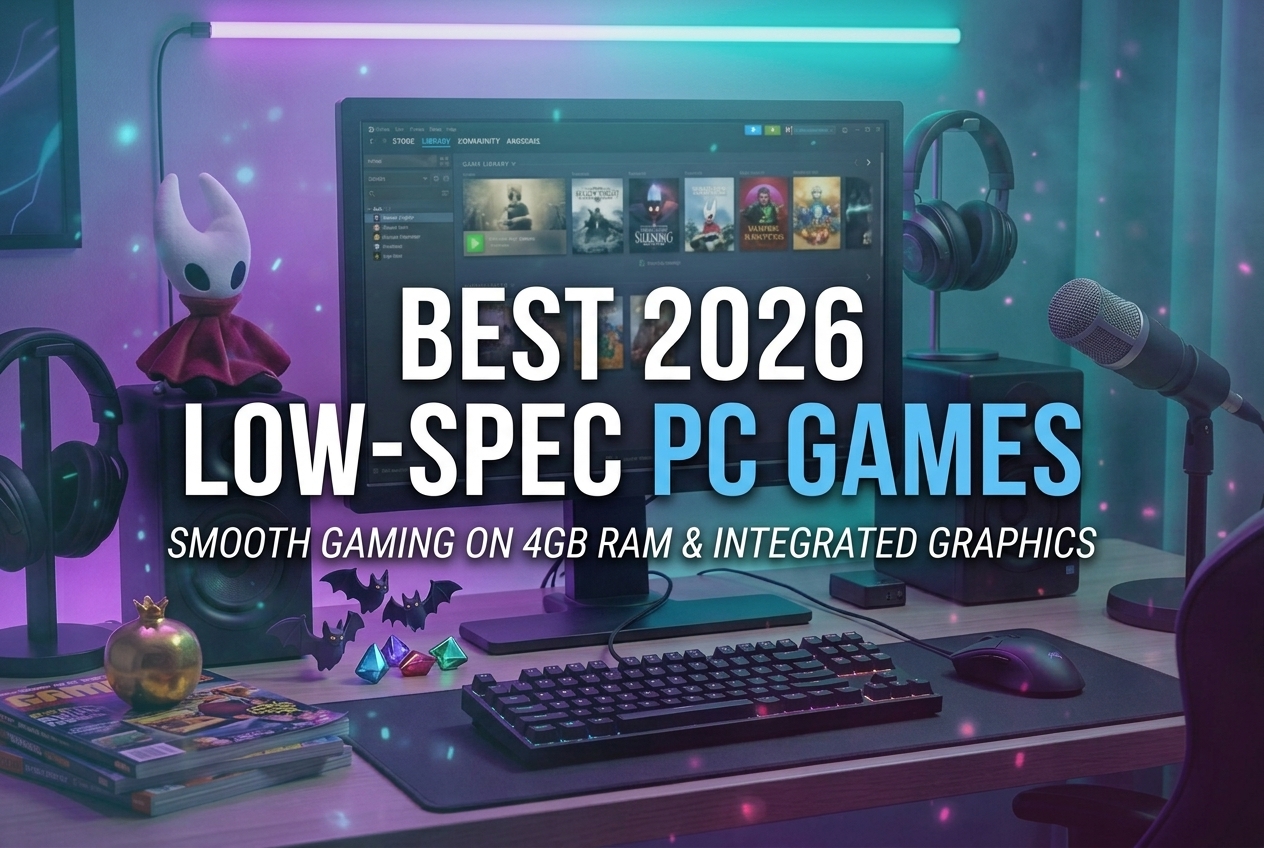
Not every great PC game needs a high-end rig. Discover the best low-spec titles you can play smoothly in 2026, from Vampire Survivors to Hollow Knight: Silksong.
Dozens of outstanding PC games run perfectly on budget hardware in 2026, proving that a powerful graphics card is not a requirement for hundreds of hours of quality entertainment. Whether you own an ageing office laptop with integrated Intel UHD graphics, a desktop running 4 GB of RAM, or anything in between, the titles below deliver genuinely rewarding gameplay without asking your system to break a sweat.
This guide covers the strongest picks across multiple genres, explains what makes each game light on resources, and shares practical tips for squeezing extra performance from modest hardware.
Why Low-End PC Gaming Is Bigger Than Ever
Two trends keep low-spec gaming relevant. First, the indie development scene continues to favour stylised art directions (pixel art, hand-drawn 2D, low-poly 3D) that look beautiful without demanding teraflops. Second, older AAA titles that once needed top-tier rigs now sit comfortably within the capabilities of even entry-level processors and integrated GPUs. The result: a library of playable games that grows every year, not shrinks.
Steam alone lists thousands of titles that run on Intel HD 4000 or AMD Radeon Vega 3 graphics. If your machine can handle basic web browsing, chances are it can handle at least a handful of genuinely excellent games from the list below.
Vampire Survivors: The Ultimate “Potato PC” Hit
Vampire Survivors needs just 1 GB of RAM and a DX11-capable GPU. That is all. Despite those featherweight requirements, it delivers one of the most addictive gameplay loops in recent memory. Waves of monsters flood the screen while your character auto-attacks and you focus purely on movement and build decisions. A single run lasts about 30 minutes, but unlocking new characters, weapons, and evolutions can keep you busy for well over 100 hours. The game costs very little and takes up under 1 GB of storage, making it the easiest recommendation on this list.
Stardew Valley: Relaxation That Runs Everywhere
ConcernedApe’s farming RPG asks for a 2 GHz processor, 2 GB of RAM, and a GPU with 256 MB of VRAM. In practice, almost any laptop manufactured after 2010 can run it. Beneath the charming pixel art sits a remarkably deep simulation covering farming, mining, fishing, cooking, and relationship building. Updates continue to add content years after launch, and multiplayer co-op lets you share the farm with friends. If you want a low-spec game that genuinely never gets old, Stardew Valley is the answer.
Hollow Knight: A Metroidvania Masterpiece on Modest Hardware
With its hand-drawn 2D art, Hollow Knight creates an atmosphere richer than most 3D blockbusters. The minimum spec calls for an Intel Core 2 Duo E5200, 4 GB of RAM, and a GeForce 9800 GTX+ with 1 GB of VRAM. Tight platforming, challenging boss fights, and a sprawling interconnected map add up to 40+ hours of exploration. Its sequel, Hollow Knight: Silksong, launched in September 2025 with similarly accessible requirements (i3-3240, 4 GB RAM, GTX 560 Ti) and a brand-new kingdom to explore.
Hades II: Roguelike Brilliance, Minimal Demands
Supergiant Games built a reputation for gorgeous art that barely taxes hardware. Hades II continues that tradition. The full release arrived in September 2025, earning near-universal praise and running above 144 FPS on low-end systems according to multiple benchmarks. Fast-paced combat, mythological storytelling, and deep progression systems make every run feel fresh. If your PC handled the original Hades, it will handle the sequel with room to spare.
Slay the Spire 2: Deck-Building on a Dual-Core
The sequel to one of the best card games on PC launched into early access on March 5, 2026, and sold three million copies in its first week. Minimum requirements: a dual-core 2.0 GHz CPU, 4 GB of RAM, and a DirectX 12-compatible GPU with 1 GB of VRAM. Four playable characters, a new co-op mode for up to four players, and a refreshed visual engine keep the strategic depth sky-high without raising the hardware floor. At just 4 GB of storage, it fits on almost any drive.
Terraria: Endless Exploration, Tiny Footprint
Often described as “2D Minecraft,” Terraria is far more than that label suggests. Mining, building, crafting, boss battles, and class progression fill easily 200+ hours. It requires a 3.0 GHz dual-core CPU, 4 GB of RAM, and a 256 MB GPU. The download is only 700 MB. With continuous free updates spanning over a decade, Terraria offers one of the best value-per-gigabyte ratios in gaming history.
Portal 2: A Puzzle Classic That Ages Like Fine Wine
Valve’s Source engine was designed with scalability in mind, and Portal 2 is the proof. Originally built to run smoothly on 2011 hardware, it now maxes out on virtually any modern budget PC. Physics-based puzzles, razor-sharp writing, and a brilliant co-op campaign make this one of the highest-rated games on Steam. If you somehow missed it, now is the perfect time.
Team Fortress 2: Multiplayer That Never Gets Old
Nearly two decades after launch, TF2 remains a flagship free-to-play shooter for low-spec systems. The Source engine keeps frame rates high on ancient hardware, nine distinct character classes keep the meta interesting, and the community-driven economy adds an extra layer of engagement. For a multiplayer FPS experience that costs nothing and asks little from your PC, TF2 is hard to beat.
Valheim: Viking Survival Without the GPU Meltdown
Valheim’s lo-fi, pixelated textures layered over atmospheric lighting create a unique visual identity that scales down gracefully. A GTX 1050 Ti or RX 570 handles it at 60 FPS, but even older cards can manage at lower settings. Building, exploration, boss fights, and co-op with up to ten players combine into one of the best survival games of recent years. Ongoing updates continue to expand the procedurally generated world.
Into the Breach: Strategy on a Shoestring
From the creators of FTL, Into the Breach is a turn-based tactics game that plays like chess with giant mechs. Its minimalist isometric art means it runs comfortably on even low-wattage ultrabooks and entry-level laptops. Each session is short enough for a commute break, but the strategic depth and unlockable mech squads keep pulling you back in.
More Low-Spec Gems Worth Your Time
- Undertale – A narrative RPG with minimal graphics and a story that stays with you long after the credits roll. Needs just 512 MB RAM.
- Dead Cells – A roguelike action-platformer with fluid combat. Runs on a GTX 460 and 4 GB RAM.
- Hotline Miami – Top-down, hyper-violent action requiring only 512 MB RAM and a 1.2 GHz CPU.
- Mount & Blade: Warband – Open-world medieval sandbox that asks for a Pentium 4 and 512 MB RAM.
- Euro Truck Simulator 2 – A surprisingly relaxing trucking sim that plays well on a GTS 450 and 4 GB RAM.
- Valorant – Riot’s tactical shooter is designed to run on Intel HD 4000 integrated graphics with 4 GB RAM, making it one of the most accessible competitive shooters in 2026.
- League of Legends – Still one of the most-played games worldwide, with minimum requirements as low as an i3-530 and 2 GB RAM.
How to Squeeze More Performance From a Budget PC
Even the lightest games benefit from a few system-level tweaks:
- Update your GPU drivers. Integrated graphics from Intel and AMD receive regular updates that can noticeably improve frame rates in supported titles.
- Lower in-game resolution. Dropping from 1080p to 720p can nearly double your FPS with a minimal visual trade-off on a small screen.
- Close background apps. Browser tabs, chat clients, and updaters quietly eat RAM. Kill them via Task Manager before launching a game.
- Switch Windows power plan to “High Performance.” On laptops especially, the default balanced mode throttles the CPU to save battery.
- Upgrade to an SSD. A basic SATA SSD costs very little and eliminates loading-screen waits across almost every game.
Where to Find Accounts and In-Game Items
If you play competitive titles like Valorant or League of Legends on a budget rig, you may be interested in premium accounts or in-game currency. GamerMarkt’s Steam account marketplace lets you browse verified listings for accounts loaded with game libraries, while the Valorant Points page offers quick VP top-ups. Transactions are protected by an escrow system with 24/7 support, so you can shop without worry.
Things Players Often Wonder
Can I game on 4 GB of RAM in 2026?
Yes. The majority of games listed here run on 4 GB or less. Titles like Vampire Survivors (1 GB), Undertale (512 MB), and Hotline Miami (512 MB) barely scratch 4 GB. Even newer releases such as Slay the Spire 2 and Hollow Knight: Silksong list 4 GB as their minimum.
Do I need a dedicated graphics card?
Not always. Integrated graphics like Intel UHD 620 or AMD Radeon Vega 8 handle many 2D and older 3D titles at playable frame rates. For heavier games such as Valheim or Valorant, a dedicated GPU (even a GT 1030 or GTX 750 Ti) makes a visible difference.
What are the best free low-spec games?
Team Fortress 2, Valorant, League of Legends, Brawlhalla, Warframe, and Rocket League are all free-to-play and run on modest hardware. Each one offers hundreds of hours of content without spending a cent.
Is it worth upgrading an old PC just for gaming?
Adding an SSD and maxing out RAM (8 GB if your motherboard allows) are the two cheapest upgrades with the biggest impact. A used GTX 750 Ti or GTX 1050 can be found for very little and opens up a much larger library of playable titles.
Where can I safely buy game accounts or in-game currency?
Platforms like GamerMarkt provide verified seller listings, escrow-based payment protection, and round-the-clock customer support for buying and selling game accounts and digital products across titles like League of Legends, Valorant, and Steam.