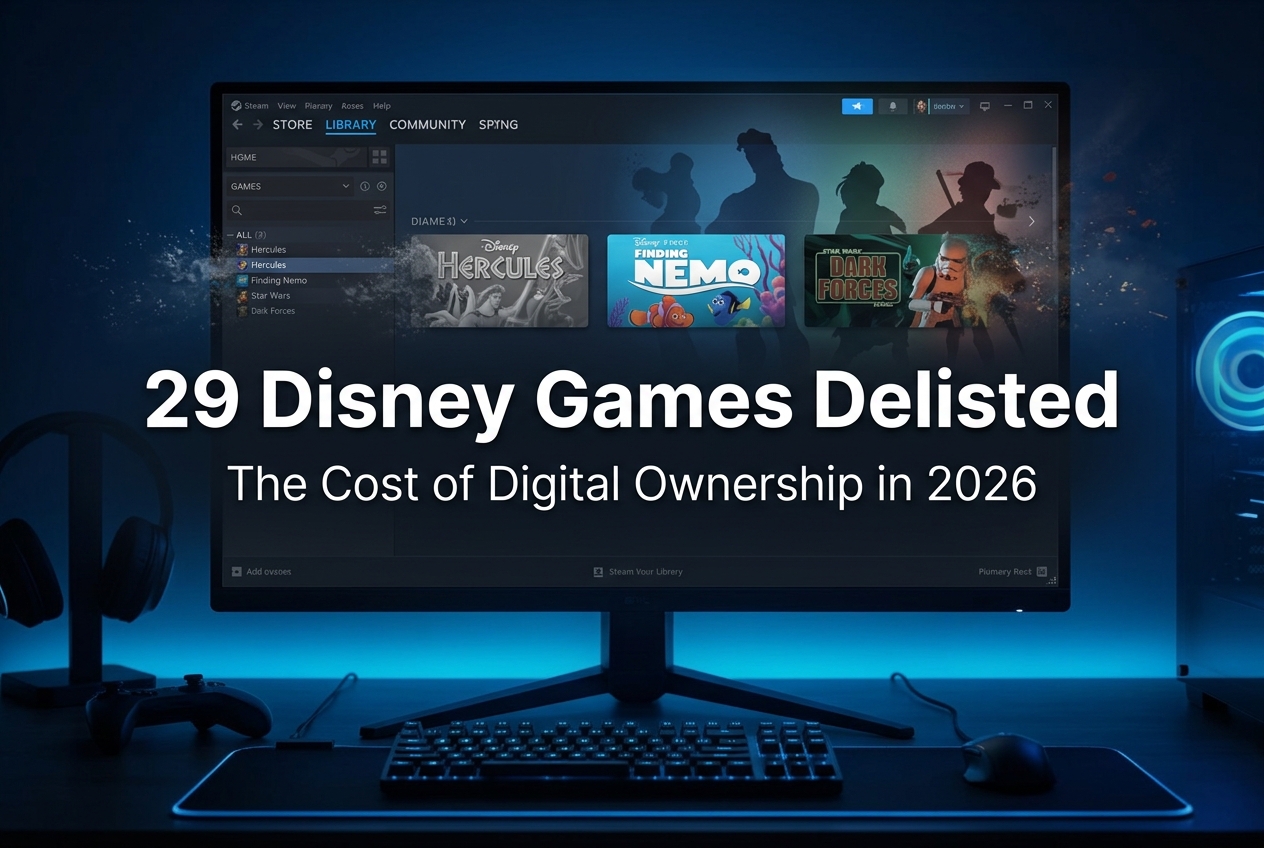
Disney silently removed 29 games from Steam in 2026, from Hercules and Finding Nemo to Star Wars: Dark Forces. The move reignites the digital ownership debate and sends the value of rare Steam accounts climbing.
Disney has removed a total of 29 games from Steam in 2026, all without warning or explanation. The first wave hit in January, delisting 14 titles including Disney’s Hercules, Finding Nemo, and Toy Story Mania. On April 14, 2026, a second wave pulled 15 more, this time reaching into the Star Wars catalogue with Dark Forces (1995) and Rebellion. As tracked by SteamDB and first flagged by deals tracker Wario64, every removal happened silently. Disney has offered zero public comment on why nearly thirty games disappeared from the world’s largest PC gaming storefront.
The Full List of Delisted Disney Games
The January 2026 wave removed these 14 titles: Afterlife, Armed and Dangerous, Disney’s Chicken Little: Ace in Action, Disney Fairies: Tinker Bell’s Adventure, Disney’s Hercules, Disney Planes, Disney The Princess and the Frog, Disney Winnie the Pooh, Disney Pixar Cars: Radiator Springs Adventures, Disney Pixar Finding Nemo, Disney Pixar Toy Story Mania, Lucidity, Phineas and Ferb: New Inventions, and Stunt Island.
The April 2026 wave added 15 more: Disney High School Musical 3: Senior Year Dance, Disney Pixar Brave: The Video Game, Disney Bolt, Disney’s Treasure Planet: Battle of Procyon, Disney Alice in Wonderland, Disney’s Chicken Little, Disney Tangled, Disney G-Force, Disney Universe, Disney Princess: My Fairytale Adventure, Disney Pirates of the Caribbean: At World’s End, Planet of the Apes: Last Frontier, Star Wars: Rebellion, Star Wars: Dark Forces (Classic, 1995), and Outlaws + A Handful of Missions (Classic, 1997). The games span decades of releases, from 1992’s Stunt Island to 2018’s Planet of the Apes: Last Frontier.
Why Is Disney Pulling Games From Steam?
Disney has given no official explanation, but several theories have gained traction in the gaming press. The strongest involves Disney’s $1.5 billion equity investment in Epic Games, announced in February 2024. Under that deal, Disney and Epic are collaborating on an “all-new games and entertainment universe” connected to Fortnite, using Unreal Engine and spanning Disney, Marvel, Star Wars, and Pixar IP.
Both Kotaku and PC Gamer have speculated that the Steam delistings could be a precursor to Disney games becoming Epic Games Store exclusives. The removal of Star Wars titles specifically strengthens this theory, since Disney owns the Star Wars IP outright and licensing expiration is not a plausible factor. As Kotaku noted, “Perhaps part of the deal will force many (or all?) of Disney’s PC games to become Epic Store exclusives in the near future.”
Alternative explanations include catalogue cleanup ahead of remastered bundles (Disney did exactly this in 2019 when it pulled Aladdin and The Lion King before releasing the Disney Classic Games Collection) and simple cost reduction on legacy support. However, 29 titles spanning wildly different franchises, studios, and eras make a unified remaster plan unlikely.
Can You Still Play Delisted Disney Games?
Yes, if you already own them. Steam’s standard policy for delisted titles allows existing owners to continue downloading and playing games from their library. This applies to all 29 Disney games removed so far. The delisting only blocks new purchases; it does not revoke access for people who bought the games before they disappeared.
According to SteamDB analysis cited by ExpertBeacon, roughly 85-90% of all games ever delisted from Steam remain accessible to existing owners. Only about 10-15% have been fully removed from user libraries, typically due to server-dependent games where the publisher shut down essential infrastructure. Single-player Disney titles like Hercules or Finding Nemo are very unlikely to face that scenario.
However, you cannot gift, trade, or purchase new copies through the Steam store. Third-party key resellers may still have stock, but prices spike dramatically once a game is confirmed delisted.
The Digital Ownership Problem
Disney’s mass delisting puts a spotlight on a fundamental issue in digital gaming: you don’t own your games. When you buy a game on Steam, you purchase a licence to access it, not the game itself. Valve made this explicit in late 2024 when it added a checkout notice stating, “A purchase of a digital product grants a license for the product on Steam.”
This change was prompted by California Assembly Bill 2426 (AB 2426), signed into law by Governor Newsom in September 2024 and effective from January 1, 2025. The law prohibits digital sellers from using terms like “buy” or “purchase” unless they clearly disclose that the transaction grants only a revocable licence. Violations can result in civil penalties of up to $2,500 per transaction.
For European gamers, EU consumer protection directives provide some additional safeguards around digital content, but the core reality remains the same: a publisher can request delisting at any time, and your continued access depends on the platform honouring your licence. GOG’s Preservation Program offers a stronger commitment, pledging to maintain compatibility for delisted games indefinitely, but Steam makes no equivalent guarantee.
How Delisted Games Affect Steam Account Value
When a game disappears from the Steam store, its scarcity increases immediately. Third-party key prices can surge from a few pounds to hundreds or even thousands. GamingBible reported that Dark Souls: Prepare To Die Edition keys now sell for around £650, Fable 3 keys hover around £150, and Driver: San Francisco keys reach roughly £118 on reseller markets.
The same dynamic applies to Disney’s delisted titles. After the January 2026 wave, key prices on grey-market sites reportedly jumped from 500-1,000 rubles to 17,000-20,000 rubles for certain titles. This price inflation directly increases the value of any Steam account that already contains those games.
For the account marketplace, this creates a tangible opportunity. A Steam account carrying Hercules, Armed and Dangerous, Finding Nemo, or Star Wars: Dark Forces in its library is objectively more valuable now than it was in December 2025. Collectors, nostalgia-driven gamers, and preservation-minded buyers all create demand for accounts with rare libraries.
Buying and Selling Steam Accounts With Rare Games
If your Steam library contains delisted Disney games or other rare titles, your account’s market value may be significantly higher than you expect. The key factors that determine a Steam account’s worth include total game count, the presence of rare or delisted titles, profile level, achievements, and in-game items.
Platforms like GamerMarkt provide a secure environment for buying and selling Steam accounts. Sellers can create detailed listings highlighting their game library, including any rare or delisted titles. Buyers benefit from a verified seller system (requiring email, ID, phone, and bank account verification), a secure escrow transaction model, and a 7-day warranty period that covers post-purchase issues.
When listing a Steam account that contains delisted games, it is worth specifically mentioning those titles in the description. Delisted games are a major selling point for collectors, and clear information helps attract serious buyers. On the buying side, verifying which games are included before purchasing is essential, and GamerMarkt’s listing detail pages allow buyers to review account contents and seller reputation before committing.
What Could Happen Next?
With 29 games already gone and no official statement from Disney, further delistings are a real possibility. Disney Infinity Gold editions (1.0, 2.0, and 3.0) remain on Steam for now but could be at risk. Disney Dreamlight Valley and major Marvel titles appear safe, but the pattern of unannounced removals makes certainty impossible.
The Epic Games partnership is the biggest variable. If Disney is indeed consolidating its PC game distribution around Epic’s ecosystem, more Steam removals could follow, potentially affecting higher-profile titles. The reported extraction shooter and broader Disney entertainment universe on Epic’s platform could reshape where Disney games live on PC for years to come.
Meanwhile, the contrast with other publishers is stark. Games Workshop brought Warhammer classic titles back to Steam during the same week Disney pulled more games from it. GOG continues to expand its Preservation Program. The industry is moving in two directions simultaneously: toward greater preservation and toward greater publisher control over distribution.
Things Worth Knowing Before You Act
Will the delisted Disney games come back? Possibly, but there is no guarantee. Disney’s 2019 Aladdin and Lion King delisting was followed by a remastered collection. However, the scope of 29 diverse titles makes a single remaster bundle extremely unlikely. An Epic Games Store re-release is more plausible but unconfirmed.
Were GOG versions also affected? Yes. Reports confirmed that the January 2026 titles were also removed from GOG.com simultaneously, indicating a publisher-level decision rather than a Steam-specific one.
Can I still redeem a key for a delisted game? Generally yes, if you have a valid unredeemed key. Steam typically allows key activation for delisted titles. However, there are risks: some developers have been known to revoke keys after delisting, and grey-market keys carry inherent fraud risks.
Does owning delisted games make my account more valuable? Absolutely. Scarcity drives value in any market. A Steam account with multiple delisted titles, especially well-known ones like Hercules or Star Wars classics, commands a higher price on account marketplaces. If you are considering selling, platforms like GamerMarkt offer a safe way to list and transact with verified buyers.
Should I buy Disney games on Steam before more disappear? If there are Disney titles still available on Steam that you want to own, buying sooner rather than later is a reasonable precaution. The pattern of silent removal means there may be no last-chance warning.
Disney’s 2026 Steam purge is more than a footnote about old movie tie-in games. It is a case study in the fragility of digital ownership, the rising value of rare game libraries, and the shifting power dynamics between publishers, platforms, and players. For anyone who buys, sells, or simply cares about their Steam library, the lesson is clear: digital games are only yours for as long as someone else decides they are.