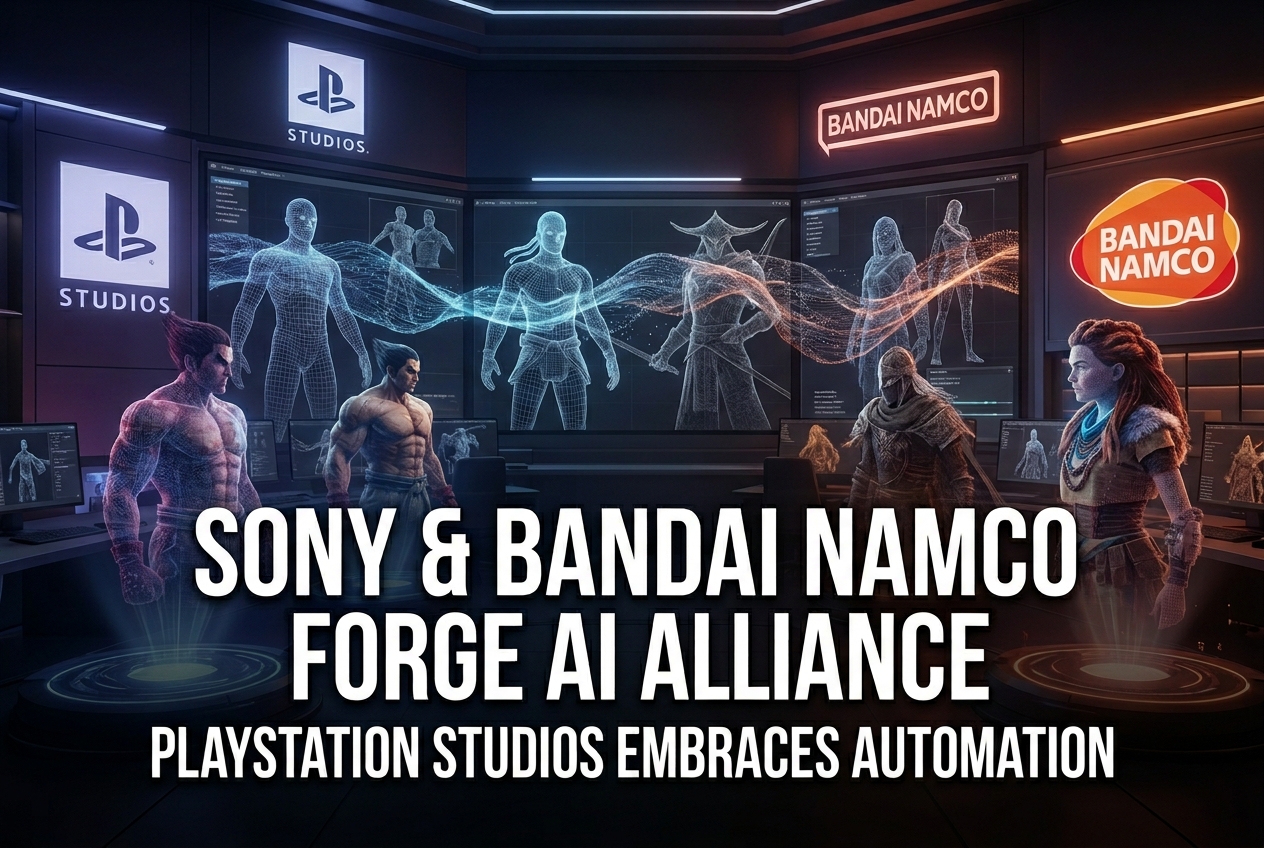
Sony and Bandai Namco have launched a collaborative pilot initiative focused on generative AI. From the Mockingbird animation tool to PSSR technology and PS5’s steep sales decline, here is everything players need to know.
Sony and Bandai Namco Holdings have announced a collaborative pilot initiative focused on generative AI and future technologies. Revealed during Sony Group’s fiscal year 2025/2026 corporate strategy presentation on May 8, 2026, the partnership targets video production and game development workflows. Sony Group CEO Hiroki Totoki described AI as “an amplifier of human imagination and a catalyst for new possibilities.” The announcement comes as PS5 lifetime shipments reached 93.7 million units, while fourth-quarter sales dropped 46 percent year-over-year to just 1.5 million units.
What Does the Sony and Bandai Namco AI Initiative Actually Cover?
The collaborative pilot focuses on how generative AI can enhance creativity and optimize production speed. Totoki reported “massive gains in speed and productivity per person” during initial work, while acknowledging that “a lack of consistency and controllability” remains the biggest challenge for professionals demanding precision. Bandai Namco’s involvement signals that animation, cinematic production, and content workflows are primary areas of interest.
This AI initiative sits within a much broader strategic relationship between the two companies. In July 2025, Sony signed a strategic business alliance agreement with Bandai Namco and acquired approximately 2.5 percent of Bandai Namco’s shares (16 million shares) for roughly 68 billion yen, approximately $464 million. That deal focused heavily on anime and manga IP expansion, content distribution, and merchandising.
Separately, in May 2025, Sony and Bandai Namco jointly invested 10 billion yen in Gaudiy, a Web3 and AI startup that operates the Gaudiy Fanlink community platform. Gaudiy acquired MyAnimeList, the world’s largest anime and manga community with 19.5 million registered users, in 2025. The Gaudiy partnership covers five key themes: global IP expansion, creator nurturing, data integration, blockchain technology via Sony’s Soneium platform, and generative AI research and application. Bandai Namco and Gaudiy have already begun using generative AI image technology within the official GUNPLA (Gundam model kits) community Builders’ Note.
Mockingbird: The AI Tool Already Inside PlayStation Studios
Sony Interactive Entertainment president and CEO Hideaki Nishino provided concrete details about how AI is already being used across PlayStation’s first-party studios. The standout example is Mockingbird, an internally developed tool that generates facial animations from performance capture data. Studios confirmed to be using Mockingbird include Naughty Dog (The Last of Us, Uncharted, Intergalactic) and San Diego Studio (MLB: The Show).
According to Nishino, “animation work that would have taken hours can now be completed in a fraction of a second” with Mockingbird. The tool processes 3D facial models based on captured performance data, automating what was previously a highly manual process. Importantly, Nishino stressed that Sony is “not replacing human performers, but rather optimizing how we process the data from these live captures.”
Beyond facial animation, Sony’s teams have developed another AI tool for the “labor-intensive process” of animating hair. This system is trained on videos of real hairstyles and generates 3D models with hundreds of individually rendered hair strands that respond with physically accurate motion. These practical applications free development teams to spend less time on repetitive manual tasks and more on creative design decisions.
Can AI Really Shorten AAA Development Cycles?
Modern AAA game development timelines can stretch across an entire console generation, sometimes exceeding six or seven years. Nishino positioned AI as a key solution: “AI is lowering barriers to creation, accelerating development cycles, and enabling more creators to enter the market.” Beyond graphics and animation, PlayStation studios are automating repetitive workflows, improving software engineering productivity, and speeding up quality assurance processes.
Nishino also predicted a “meaningful increase in the volume of content,” suggesting that AI-assisted production could expand the total output of games available on the platform. He paired this with a promise that PlayStation would maintain its commitment to high-quality titles and that AI would supplement, not replace, human creativity.
The concern, as noted by outlets like PC Gamer and Engadget, is that automating labor-intensive processes inevitably affects the people currently performing that labor. While executives emphasize creative freedom, the industry has already seen significant layoffs in recent years. The tension between efficiency gains and job security remains one of gaming’s most debated issues.
PSSR Technology and the Road to PlayStation 6
AI is not limited to development tools. It is also central to how PlayStation hardware delivers visual performance. The PlayStation Spectral Super Resolution (PSSR) upscaling technology, introduced with the PS5 Pro, uses AI-based algorithms to enhance image quality while maintaining strong frame rates. PSSR was recently updated and is now supported in a growing library of first-party and third-party titles.
PlayStation lead hardware architect Mark Cerny confirmed that Sony co-developed the core algorithm behind AMD’s FSR Redstone with AMD. Cerny also stated that Sony is “intimately familiar” with frame generation technology and that “an equivalent frame generation library should be seen at some point on PlayStation platforms.” This is a strong signal that an evolved PSSR, potentially labelled PSSR 3.0, will be a foundational feature of the still-unannounced PlayStation 6.
AI-powered upscaling and frame generation could allow the next-generation console to target performance thresholds like 4K at 120 FPS with ray tracing, a significant step up from current-gen capabilities. These technologies take games rendered at lower internal resolutions and use machine learning to reconstruct detail, providing a better visual experience without proportionally higher hardware costs.
PS5 Sales: A 46 Percent Quarterly Drop in Context
Sony’s AI ambitions are unfolding against a challenging financial backdrop. The company shipped just 1.5 million PS5 units in Q4 of fiscal year 2025, a 46 percent decline from the 2.8 million shipped in the same quarter the previous year. For the full fiscal year, PS5 shipments totalled 16 million units, down from 18.5 million in fiscal year 2024. Lifetime PS5 shipments now stand at 93.7 million.
A global memory chip shortage has been a major factor. AI companies have consumed a significant share of global DRAM output for data centre buildouts, driving up component costs. Sony was forced to raise PS5 prices twice within 12 months. The company has forecast that gaming division annual sales will fall 6 percent to 4.42 trillion yen (around $28 billion) as hardware sales continue to decline.
Sony’s strategy is to offset hardware revenue losses with software sales and AI-driven production efficiency. Fiscal year 2025 saw 317.9 million units of PS5 and PS4 software shipped, with first-party titles like Ghost of Yotei contributing strongly. For Sony, generative AI is not just a creative tool but an economic necessity as it navigates the late phase of the PS5 lifecycle and prepares for the next generation.
Will AI Replace Game Developers and Artists?
Both Totoki and Nishino repeatedly insisted that AI will not replace human creators. Nishino stated plainly: “The vision, the design, and the emotional impact of our games will always come from the talent of our studios and performers. AI is meant to augment their capabilities, not to replace them.”
However, industry observers remain skeptical. When a process that once took hours can be completed in a fraction of a second, the workforce implications are real. As PC Gamer’s Andy Chalk noted, “the artists and animators responsible for expressive faces and flowing hair are not suddenly going to find themselves holding creative director roles.” The broader concern is that AI-driven efficiency gains will lead to smaller teams and fewer entry-level positions, even if top-tier creative leads are protected.
For players, the more immediate question is whether AI-assisted content will meet the quality bar they expect from PlayStation exclusives. Sony’s track record with studios like Naughty Dog provides some reassurance, but the proof will ultimately be in the games themselves.
AI on the Platform Side: Personalised Storefronts and Recommendations
Nishino also outlined how AI is reshaping the PlayStation platform experience beyond game development. Payment processing, storefront curation, and content discovery are all areas where AI is being deployed. The vision is a system that “not only suggests the next game a player might enjoy, but also the next gameplay moment, subscription, accessory, or merchandise that best reflects their passion.”
This positions PlayStation’s storefront as an AI-curated discovery platform, similar to what streaming services have done with content recommendations. Whether players will welcome this level of algorithmic curation or find it intrusive remains to be seen.
Key Questions Worth Knowing
Which specific games will benefit from the Sony and Bandai Namco AI partnership?
No specific game titles have been announced. The partnership is currently focused on production workflows and content creation processes rather than individual projects. Given Bandai Namco’s portfolio, which includes franchises like Tekken, Elden Ring, Dragon Ball, and Gundam, the AI tools could eventually impact cinematic production and animation across these properties.
Is the Mockingbird tool available to third-party developers?
So far, only first-party PlayStation studios have been confirmed as users. Whether Sony will license or share Mockingbird with external partners has not been disclosed.
How does this compare to what other companies are doing with AI in gaming?
Most major publishers are investing in AI tools. Elon Musk’s xAI has promised a fully AI-generated game before the end of 2026, while studios large and small use AI for procedural generation, dialogue systems, QA testing, and asset creation. Sony’s approach, focused on specific internal tools like Mockingbird rather than broad generative content creation, positions the company closer to practical production use than speculative experimentation.
What does the 10 billion yen Gaudiy investment mean for gamers?
The Gaudiy partnership is primarily aimed at anime and manga fan engagement, using blockchain and large language models. While it is not directly a gaming initiative, Sony Group’s involvement means the technology could eventually influence how PlayStation handles community features, fan interaction, and IP-driven experiences.
For more on how AI is shaping the next generation of PlayStation hardware, see GamerMarkt’s breakdown of PS6 PSSR Frame Generation and AI-powered 4K 120 FPS.