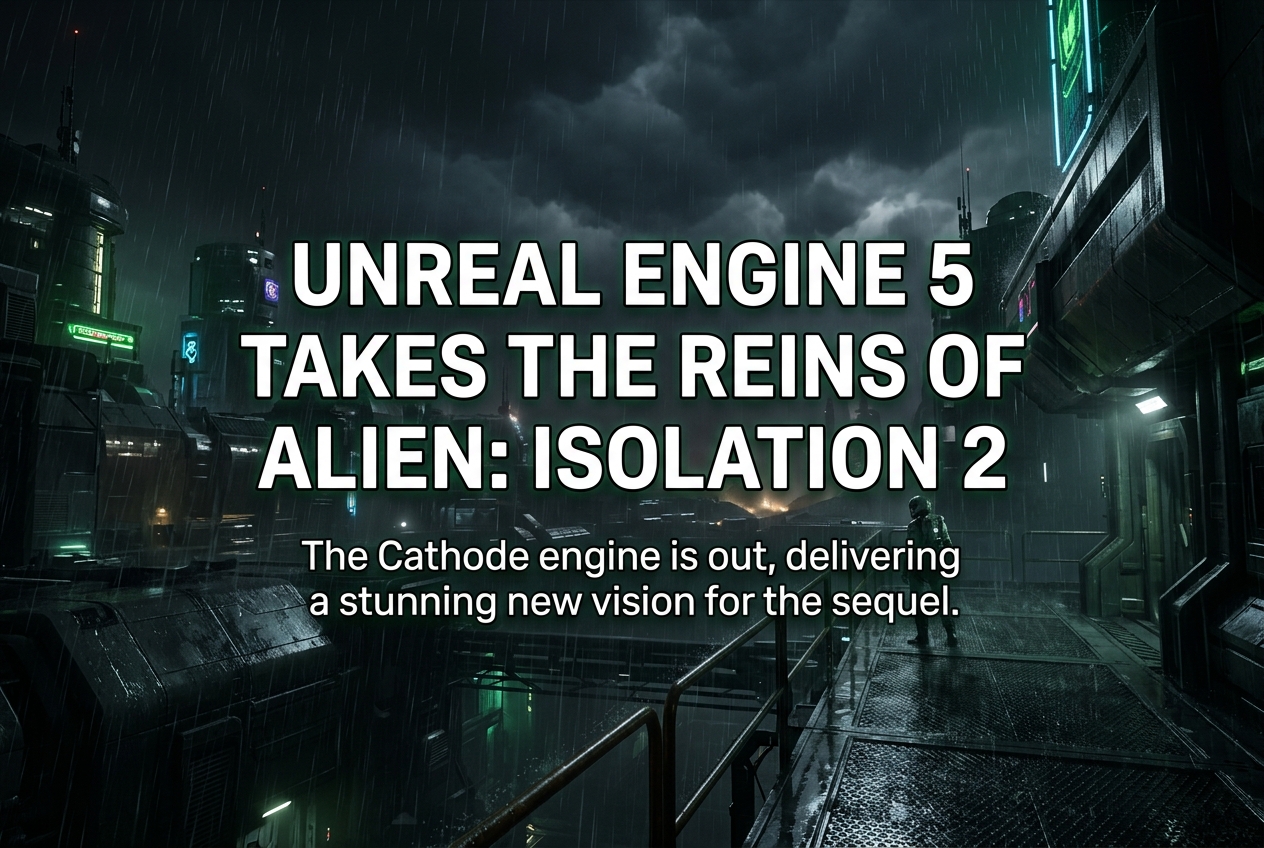
Creative Assembly has confirmed through job listings that Alien: Isolation 2 is built in Unreal Engine 5, abandoning the in-house Cathode engine. The Alien Day teaser hints at a rain-soaked colony setting far from Sevastopol’s corridors.
Alien: Isolation 2 is being built in Unreal Engine 5, not the Cathode engine that powered the 2014 original. Creative Assembly confirmed the technology choice through a job listing for a Senior Development Manager, which explicitly states: “This is an excellent opportunity for a talented Senior Development Manager to join the sequel to ALIEN: ISOLATION being built in Unreal Engine 5 (UE5).” The listing, first spotted by DSOGaming, marks the end of Cathode’s life as a game engine.
What Was the Cathode Engine?
Cathode was Creative Assembly’s proprietary engine, heavily modified from the tech behind 2005’s Spartan: Total Warrior and 2008’s Viking: Battle for Asgard. Trademarked by SEGA in 2013, it featured deferred rendering, real-time radiosity lighting, and a bespoke node-based scripting system called CAGE (Creative Assembly Game Editor). Its sophisticated AI architecture, including the famous director-driven “menace gauge” system that governed the Xenomorph’s behaviour, was a major reason Alien: Isolation felt so uniquely terrifying.
The engine shipped across PS3, PS4, Xbox 360, Xbox One, and PC, and was later ported to Nintendo Switch, macOS, Linux, iOS, and Android by Feral Interactive. Despite its technical achievements, Cathode was never licensed outside Creative Assembly. Its renderer was upgraded to DX12 and repurposed for Halo Wars 2, but the engine itself saw no further full-game deployment after Alien: Isolation.
Why Did Creative Assembly Abandon Cathode?
The short answer: Hyenas killed it. Creative Assembly’s cancelled multiplayer shooter initially started on Cathode before switching to Unreal Engine during development. After SEGA cancelled Hyenas in September 2023 due to “lower profitability of the European region,” the studio pivoted back to what it does best. By that point, Cathode had not been meaningfully updated in years, making it impractical for a modern AAA production.
UE5 offers Lumen global illumination, Nanite virtualised geometry, hardware-accelerated ray tracing, and mature asset-streaming pipelines that would take years to replicate in a proprietary engine. For a studio rebuilding after a cancelled project and significant layoffs, adopting the industry-standard engine was the pragmatic choice. SEGA’s own post-mortem acknowledged that Creative Assembly should focus on offline, single-player experiences rather than live-service experiments.
The “False Sense of Security” Teaser: A New Setting
On Alien Day (26 April 2026), Creative Assembly dropped a 25-second teaser titled “False Sense of Security” across SEGA’s and the official Alien: Isolation YouTube channels. The video description reads simply: “A feeling of being safer than one really is.”
The teaser shows an industrial door unlocking to reveal a rain-drenched exterior, followed by a brief shot of the series’ iconic emergency telephone save station. The outdoor, colony-like environment represents a stark departure from the original game’s claustrophobic Sevastopol station. Visible tree-like vegetation in the background rules out LV-426 (Hadley’s Hope from Aliens) and points toward an entirely new location in the Alien universe.
No characters, gameplay footage, platforms, or plot details were shown. The video carries an ESRB “Rating Pending” badge, confirming it represents an unreleased commercial product rather than a concept piece.
Will UE5 Deliver the Same Atmosphere?
Fan concern is understandable. The original Alien: Isolation holds a 92% positive rating across nearly 47,000 Steam reviews, and much of its atmosphere was credited to Cathode’s bespoke lighting and sound-propagation systems. The game’s “sound node network” let the Xenomorph realistically track player-generated noise through environments, while the six-channel ambient audio system dynamically mixed tension layers in real time.
UE5 brings different strengths. Lumen can simulate dynamic global illumination without pre-baked lightmaps, which could make the sequel’s environments even more responsive to player actions like turning on lights or setting fires. Nanite allows film-quality geometry without traditional LOD pop-in, potentially solving one of the original’s visual weaknesses on console.
The legitimate worry is performance. UE5 titles have earned a reputation for shader compilation stutter, traversal hitching, and heavy CPU overhead, especially in open environments. The teaser’s outdoor colony setting amplifies this concern. However, UE5 version 5.6 introduced significant improvements to hardware ray tracing efficiency and CPU-side bottlenecks for Lumen. Given that the game is years from release, Creative Assembly will likely be working with an even more mature iteration of the engine.
When Will Alien: Isolation 2 Release?
Not any time soon. Creative director Al Hope announced in October 2024 that the game was in “early development.” The current job listings, which include a Game Design Director tasked with “scoping an ambitious multi-year release plan,” confirm the project is still in its formation phase. Multiple outlets, including GagaДget, VGC, and DSOGaming, place the most realistic launch window around 2028.
No platforms have been announced. Given the timeline, PS5, Xbox Series X|S, and PC are near certainties, but a 2028 or later release could potentially coincide with next-generation hardware. The game’s official title has not been confirmed either; “Alien: Isolation 2” remains a working label used in job postings.
The Bigger Alien Gaming Landscape
Alien: Isolation 2 is not the only Alien game in the pipeline. At least two other projects are confirmed: Alien: Fireteam Elite 2, expected to lean into cooperative action, and an untitled first-person horror game from British studio Rebellion. This makes the current period one of the busiest in the franchise’s gaming history.
The original Alien: Isolation underperformed commercially at launch against SEGA’s expectations, which is precisely why a sequel took over a decade to greenlight. However, the game’s reputation grew enormously over time, becoming widely regarded as one of the best horror games ever made, earning a 93/100 from PC Gamer and being called “terrifying” by The Guardian with a perfect 5/5 score.
Questions Players Are Already Asking
Will Amanda Ripley return as the protagonist?
No character details have been revealed. The teaser showed no individuals, and Creative Assembly has not commented on whether Ellen Ripley’s daughter will return. The original game’s voice actress, Andrea Deck, has not been publicly attached to the sequel.
Is the game going open world?
The rain-soaked colony setting suggests at least some open or semi-open environments, a significant shift from Sevastopol’s linear corridors. Whether this translates to a full open-world design or simply larger, more varied level layouts remains unknown.
Could the Xenomorph AI match the original?
Cathode’s behaviour-tree system and director AI were bespoke creations for the first game. Recreating that quality in UE5 is an engineering challenge, not an engine limitation. Behaviour trees, director systems, and dynamic AI can absolutely be implemented in Unreal. The question is whether Creative Assembly’s team, which has undergone changes since 2014, can recapture the design philosophy that made the original’s Alien so convincing.
Should fans worry about the engine switch?
Engine changes are common in the industry and do not inherently signal a drop in quality. Studios like Crystal Dynamics (moved to UE5 for the next Tomb Raider), CD Projekt Red (shifted from REDengine to UE5 for The Witcher 4), and many others have made similar transitions. The risk is real, but so is the potential upside: UE5’s toolset could let Creative Assembly build richer, more detailed worlds than Cathode ever allowed.
The Bottom Line
Alien: Isolation 2 is a confirmed project with a confirmed engine and a confirmed creative lead, but almost nothing else. The Cathode-to-UE5 transition is a calculated bet: Creative Assembly is trading a dated but beloved proprietary engine for the industry’s most powerful and widely supported toolset. The “False Sense of Security” teaser, while brief, sets the right tone and hints at a bolder, more expansive setting. With a realistic launch window around 2028, patience is the only option. For fans who have waited over a decade, a couple more years to get it right should feel worth it.