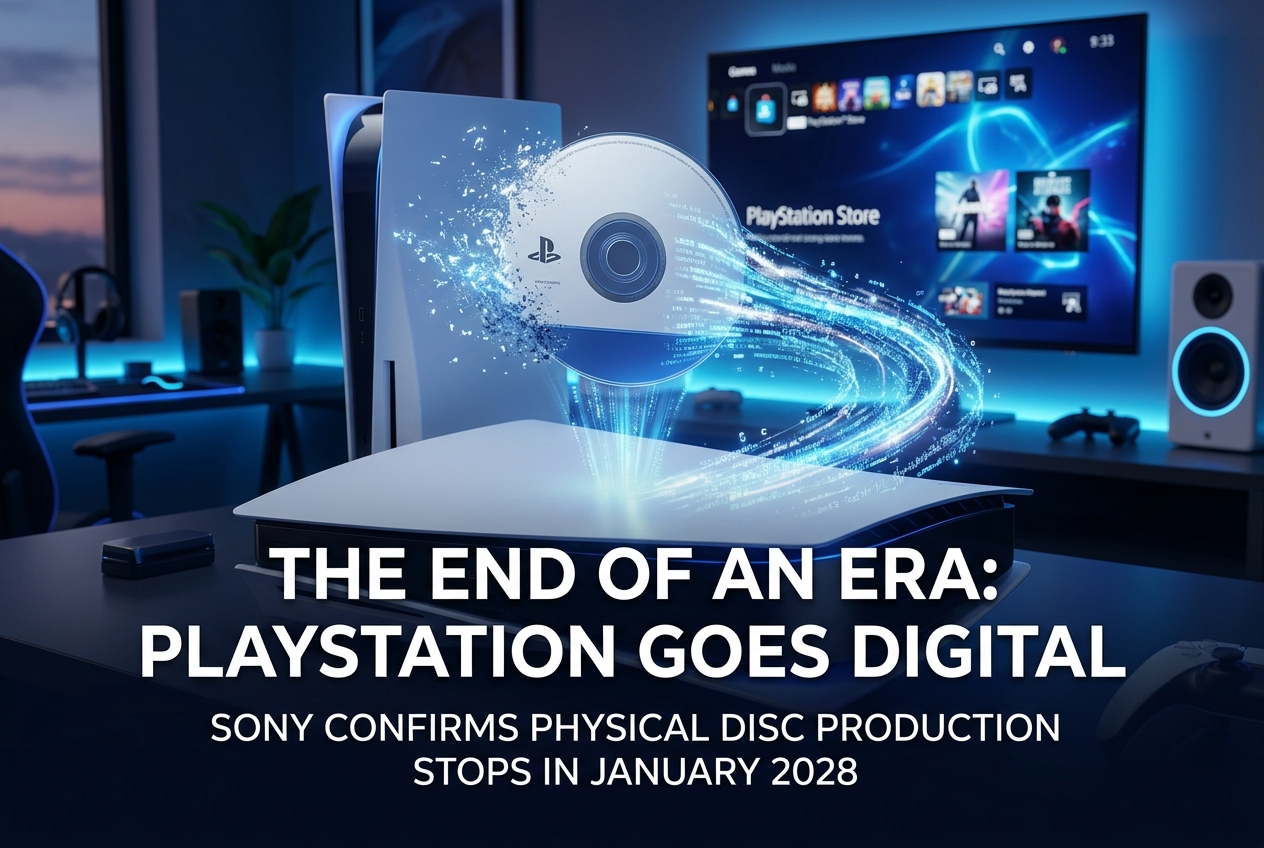
Sony Interactive Entertainment has officially confirmed that physical disc production for all new PlayStation games will end starting January 2028. Every new title, first-party and third-party alike, will be digital-only from that point forward.
Sony Interactive Entertainment announced on July 1, 2026 that physical disc production for all new games releasing on PlayStation consoles will be discontinued starting January 2028. After that date, every new title will be available exclusively through the PlayStation Store and at retailers in digital formats only. The announcement, published on the official PlayStation Blog, applies to both first-party Sony titles and all third-party games released on PlayStation hardware.
What Exactly Did Sony Announce?
In the PlayStation Blog post authored by Sid Shuman, Senior Director of SIE Content Communications, Sony described the transition as “a natural direction” to match how the majority of players already access and purchase games. The key details are clear:
- Starting January 2028, no new PlayStation game will be manufactured on disc.
- New releases will be sold digitally through the PlayStation Store or as download codes at physical retailers.
- Games already released or scheduled for disc release before January 2028 are unaffected.
- The decision covers every game on PlayStation consoles, not just Sony’s own studios.
Sony said it will “continue to prioritize resources to drive innovation in how players can access games” and maintain multiple purchasing channels for consumers.
The Numbers Behind the Decision
This move did not come out of nowhere. Sony’s financial results for the fiscal year ending March 2026 reveal that digital downloads accounted for 85% of all full-game software sales on PS4 and PS5 during Q4. That is the highest single-quarter digital ratio PlayStation has ever recorded, up from 80% in Q4 of the previous year. The full-year average reached 78% digital, compared to 76% in fiscal year 2024.
To put the trajectory in perspective, digital sales on PlayStation represented just 19% of software purchases in 2016. A decade later, that figure has more than quadrupled. Physical game revenue has shrunk to approximately 3% of Sony’s total PlayStation income, while digital software and add-on content now generates 49% of revenue. Despite the shrinking percentage, roughly 70 million physical games were still sold on PlayStation platforms last fiscal year, making the transition significant for a meaningful segment of buyers.
GTA 6 Set the Stage
Days before Sony’s announcement, Rockstar Games confirmed that GTA 6’s physical edition would ship without a disc, containing only a digital download code in the box. Priced at $79.99 for the standard edition and $100 for the ultimate edition in the US, the game launches on November 19, 2026 for PS5 and Xbox Series X/S. This was a landmark moment: the biggest game release in years choosing to go discless in its physical packaging sent a signal that the industry’s direction was locked in.
The BBC reported that fans expressed skepticism about paying full price for a physical box with just a code inside, especially after Take-Two CEO Strauss Zelnick had previously suggested a digital-only release was “not the plan.” The reality turned out to be a hybrid: a physical box exists, but the disc does not.
Does This Confirm a Discless PS6?
Sony has not officially announced the PlayStation 6, but this decision heavily implies it. Ampere Analysis analyst Piers Harding-Rolls stated that Sony’s January 2028 cutoff “pretty much guarantees” the PS6 will not launch before that date and raises serious questions about whether the next-generation console will include a disc drive at all.
The PS5 Pro already shipped without a built-in disc drive, offering it only as an optional external accessory. If Sony is ending all disc production for new games, including a disc drive in PS6 would serve only legacy backward compatibility purposes. Former PlayStation CEO Shawn Layden cautioned in early 2026 that a fully digital PS6 may be more complicated than it appears, given Sony’s global audience and market responsibilities. A hybrid approach remains possible, but the trajectory points increasingly toward an all-digital standard model.
What Happens to Existing Physical Games?
Sony explicitly stated that the transition has “no impact on games that already released, or will be releasing, prior to January 2028 in disc format.” Your current PS4 and PS5 disc library remains playable on consoles equipped with disc drives.
The critical caveat: if PS6 launches without a disc drive and no external drive option is offered, your existing disc collection will not transfer to the next generation. Backward compatibility through physical media would require keeping your PS5 operational. This represents a meaningful loss for players who have invested in large physical libraries over the years.
PS3 and PS Vita Stores Are Also Closing
On the same day, Sony announced the closure of the PlayStation Store on PS3 and PS Vita. The shutdown begins with PS3 in Mexico, Honduras, and Nicaragua in August 2026, extends to additional Latin American and Middle Eastern countries by late 2026, and completes globally for both PS3 and PS Vita in July 2027.
After closure, no new content purchases will be possible, though Sony stated that previously purchased games will remain downloadable “for the foreseeable future.” The Verge noted the irony: Sony is simultaneously ending physical disc production and shutting down legacy digital stores, raising pointed questions about long-term game preservation when both physical and digital access have finite lifespans.
What This Means for Game Ownership and Preservation
The shift to digital-only distribution intensifies the debate around game ownership. When you purchase a digital game, you acquire a license rather than a product. That license can be revoked, restricted, or rendered inaccessible if a platform shuts down. The closure of PS3 and PS Vita stores is a concrete example of this risk playing out in real time.
For collectors, the end of physical media removes the tangible element that has defined gaming culture since the 1980s. For budget-conscious gamers, the death of the second-hand game market eliminates a major avenue for affordable access. Digital games cannot be resold, lent to a friend, or traded in. While some view this as progress toward convenience, others see it as a consolidation of control by publishers at the expense of consumer rights.
Preservation advocates argue that without physical copies, games become entirely dependent on corporate infrastructure. If servers go offline or storefronts close, entire libraries could vanish. Platforms like GOG, which offer DRM-free digital purchases, remain the exception rather than the norm in the console space.
Physical Sales Still Matter in Some Markets
While global averages overwhelmingly favour digital, physical sales remain surprisingly strong in certain markets and for certain titles. Spanish AEVI data shows that first-week physical sales accounted for 90.1% of Metal Gear Solid Delta’s total, 82.1% of Silent Hill F’s, and 61.37% of Ghost of Yotei’s sales in Spain. These figures challenge the narrative that physical gaming is universally dead and suggest that the transition will hit different regions and demographics unevenly.
How the Broader Industry Is Moving
Sony is not acting in isolation. Microsoft’s Xbox Series S launched without a disc drive. Nintendo’s Switch 2 has reportedly adopted “code in box” for certain titles. Capcom’s latest financial data shows 93% of its game sales occurring through digital channels. In the United States, the International Trade Administration reported that 95% of video game sales were digital as far back as 2023.
The economic logic is straightforward: physical distribution involves manufacturing, packaging, shipping, retail markup, and shelf space costs. Digital distribution eliminates most of these, turning each sale into a significantly more profitable transaction for publishers. This financial reality makes the all-digital shift an inevitability that Sony has now formalized with a specific date.
Strengthening Your Digital Gaming Setup
As the industry moves fully digital, managing your digital purchases, in-game currencies, and digital codes efficiently becomes more important than ever. Whether it is topping up PlayStation Store wallet funds, buying e-pins for your favourite games, or securing digital gift cards, the infrastructure around digital gaming is expanding rapidly.
Questions Players Are Asking Right Now
Will my existing discs stop working?
No. All PS4 and PS5 discs will continue to work on consoles that have disc drives. Sony’s decision only affects new games released after January 2028.
Does this apply to third-party games too?
Yes. The announcement covers every new game releasing on PlayStation consoles after January 2028, regardless of publisher or developer.
Can I still buy physical boxes in stores?
You will be able to purchase games at retail, but the box will contain a digital download code rather than a disc. This is the model GTA 6 has already adopted for its November 2026 launch.
When will PS6 be released?
Sony has not announced an official release date. Industry analysts believe the January 2028 disc cutoff signals that PS6 will arrive no earlier than 2028, with some predictions pointing to 2029.
Will digital game prices drop without physical competition?
There is no confirmed pricing change. Some analysts expect that reduced production costs could theoretically lower prices, but the removal of physical retail competition could also reduce downward pressure on pricing. This remains one of the biggest open questions of the digital transition.
What about regions with limited internet access?
Sony has not addressed this directly. For players in areas with slow or unreliable internet, downloading large modern game files (often 50 to 100 GB or more) presents a genuine barrier that physical discs previously helped solve.
Sony’s January 2028 deadline closes a chapter that began in 1994 with the original PlayStation’s CD-based games. Over three decades, the format evolved from CD to DVD to Blu-ray, but the destination was always the same: a future where games live entirely in the cloud and on hard drives. That future now has an official start date.