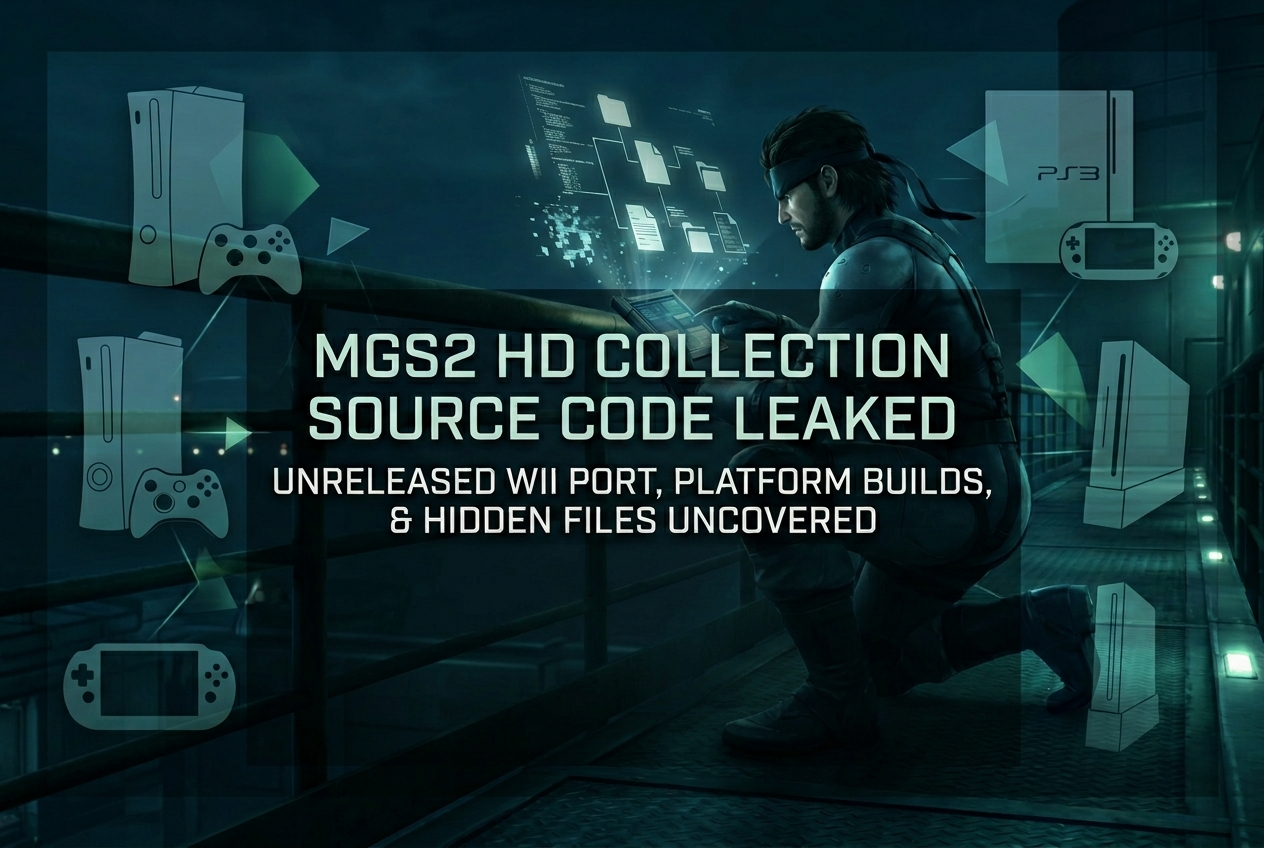
The full source code for Metal Gear Solid 2’s HD Collection remaster has surfaced online, containing code for Xbox 360, PS3, PS Vita builds and traces of an unreleased Wii port. Here’s everything we know about the leak.
The complete source code for Metal Gear Solid 2 HD, part of the 2011 Metal Gear Solid HD Collection, leaked onto the internet on May 1, 2026. Originally released in 2001 on PlayStation 2 and shipping over 7 million copies worldwide with a Metacritic score of 96, MGS2 is one of the most critically acclaimed games ever made. The leak, which appeared on 4chan’s /vr/ board, includes source code for multiple platform builds and approximately 28 GB of uncompressed game assets.
What Does the Leak Contain?
The leaked archive consists of two main components. The source code itself weighs in at roughly 155.8 MB and contains the codebase for several different platform builds of Metal Gear Solid 2 HD: Xbox 360, PlayStation 3, and PlayStation Vita. The file dates point to 2007, suggesting development work that predates the HD Collection’s November 2011 release by several years.
A separate set of uncompressed game assets totalling around 28 GB was also shared through a different link. Users who downloaded the asset pack reported finding over 15,000 textures in a single folder, along with audio files, codec dialogue, non-realtime cutscenes, and PSN trophy assets. These raw assets could prove valuable for the modding community working on the 2023 Master Collection PC version of the game.
An Unreleased Nintendo Wii Version?
One of the most surprising discoveries within the code is the presence of references to a Nintendo Wii build of Metal Gear Solid 2: Substance. The expanded Substance edition was previously released on Xbox, PlayStation 2, and PC, making the PC source code unsurprising. However, a Wii version was never announced or released by Konami. If these references are genuine, they suggest the publisher at least explored the possibility of a Wii port at some point during development.
Pre-9/11 Cut Content References Surface
Metal Gear Solid 2 infamously had content removed before its November 2001 launch due to the September 11 attacks. The original game featured a sequence in which Arsenal Gear crashes through Manhattan and displaces the Statue of Liberty, along with a post-credits news broadcast showing the statue’s new location on Ellis Island. These scenes were cut from the final game.
Users examining the leaked source code reported finding code references to the “Arsenal Gear to Manhattan crash” sequence from before the 9/11 censorship. However, the actual cut assets such as models and environmental data do not appear to be present. References to elements like the Federal Hall flags were also spotted in the source binaries, but the content packs themselves appear to contain only the material needed for the HD Collection ports rather than the original PS2 cut content.
Where Did the Leak Come From?
The prevailing theory points to Armature Studio, the developer responsible for the PlayStation Vita port of Metal Gear Solid HD Collection. Armature Studio was acquired by Meta in 2022 as part of the company’s push into VR gaming, having also worked on Resident Evil 4 VR for Meta Quest. In January 2026, Meta shut down Armature along with fellow studios Sanzaru Games and Twisted Pixel as part of a broader restructuring of its Reality Labs division.
Studio closures have historically led to source code leaks. When developers are laid off, hard drives and development equipment sometimes end up being taken home or sold at auction, and archived data can find its way online. As Kotaku noted, it would not be the first time that source code leaked following a studio shutdown. Konami has not issued any official statement regarding the leak.
What This Means for Modding and Preservation
For the game preservation and modding communities, this leak represents a significant milestone. Metal Gear Solid 2 already has an active modding scene on PC, particularly around the 2023 Master Collection Vol. 1 release. Community projects like MGSHDFix on GitHub address custom resolution support, and Nexus Mods hosts texture packs that restore visuals degraded during the Xbox-era porting process.
The leaked uncompressed assets could enable modders to create higher-quality texture packs for the Master Collection PC version. The HD Collection introduced some visual compromises compared to the original PS2 release, and these raw files bypass that compression. Additionally, the source code contains extensive references to 50/60Hz conversion functions (BP_IsPAL), which could enable more thorough frame rate modifications beyond what existing 120Hz mods achieve.
The presence of PS2-specific code behind ifdef compiler flags also opens the theoretical possibility of building a debug version of the original PS2 game, although doing so would require significant technical effort and access to legacy development tools like Visual Studio 2008 and platform-specific SDKs.
How Does This Relate to the Master Collection?
Konami released Metal Gear Solid: Master Collection Vol. 1 in October 2023, bringing MGS1, MGS2, and MGS3 to modern platforms including PC, PlayStation 5, Xbox Series X/S, and Nintendo Switch. The PC version of MGS2 within the Master Collection, while functional, launched with known issues including degraded audio encoding and texture quality that originated from the HD Collection era porting chain.
The leaked source code and assets offer potential fixes for some of these legacy issues. The raw audio and video files could be re-encoded properly for the PC version, addressing compression artifacts that have persisted across multiple re-releases. Konami has also announced Master Collection Vol. 2, which will include Metal Gear Solid 4: Guns of the Patriots and Peace Walker.
MGS2’s Enduring Legacy
Directed by Hideo Kojima, Metal Gear Solid 2: Sons of Liberty remains a landmark in game design. Its themes of information control, post-truth politics, social engineering, and artificial intelligence have only become more culturally relevant since the game’s 2001 release. The controversial decision to switch protagonists from Solid Snake to Raiden for the majority of the game was initially divisive, but is now widely regarded as a deliberate narrative choice that reinforced the game’s central themes about identity and information manipulation.
The fact that its source code is generating this level of community interest nearly 25 years after its original release speaks to the enduring impact of Metal Gear Solid 2 on gaming culture and the ongoing importance of game preservation.
Key Questions About the Leak
Is the leaked source code confirmed real?
While no official confirmation exists from Konami, multiple users who examined the files have found legitimate Bluepoint Games render code, build scripts, and platform-specific compiler configurations consistent with professional game development. Major outlets including Kotaku have reported the leak as credible based on available evidence.
Does the leak include the original PS2 source code?
The primary codebase is for the HD Collection remaster. However, PS2-specific code sections remain in the files behind ifdef compiler directives, indicating that the HD Collection build evolved directly from the original PS2 codebase through successive platform ports.
Can someone build and run the game from this code?
Compiling the source code requires legacy development tools, specifically Visual Studio 2008 and Xbox 360 SDK libraries. The build scripts reference these older environments, and getting the code to compile on modern toolchains would require significant adaptation. The source code alone, without the separately leaked assets, is not sufficient to produce a runnable game.
Will this lead to new mods for the Master Collection version?
Potentially, yes. The uncompressed textures and audio could be used to create improved asset packs. The source code itself provides deeper insight into the game’s engine architecture, which could benefit ongoing modding projects like frame rate fixes and camera modifications that the community has already been developing.