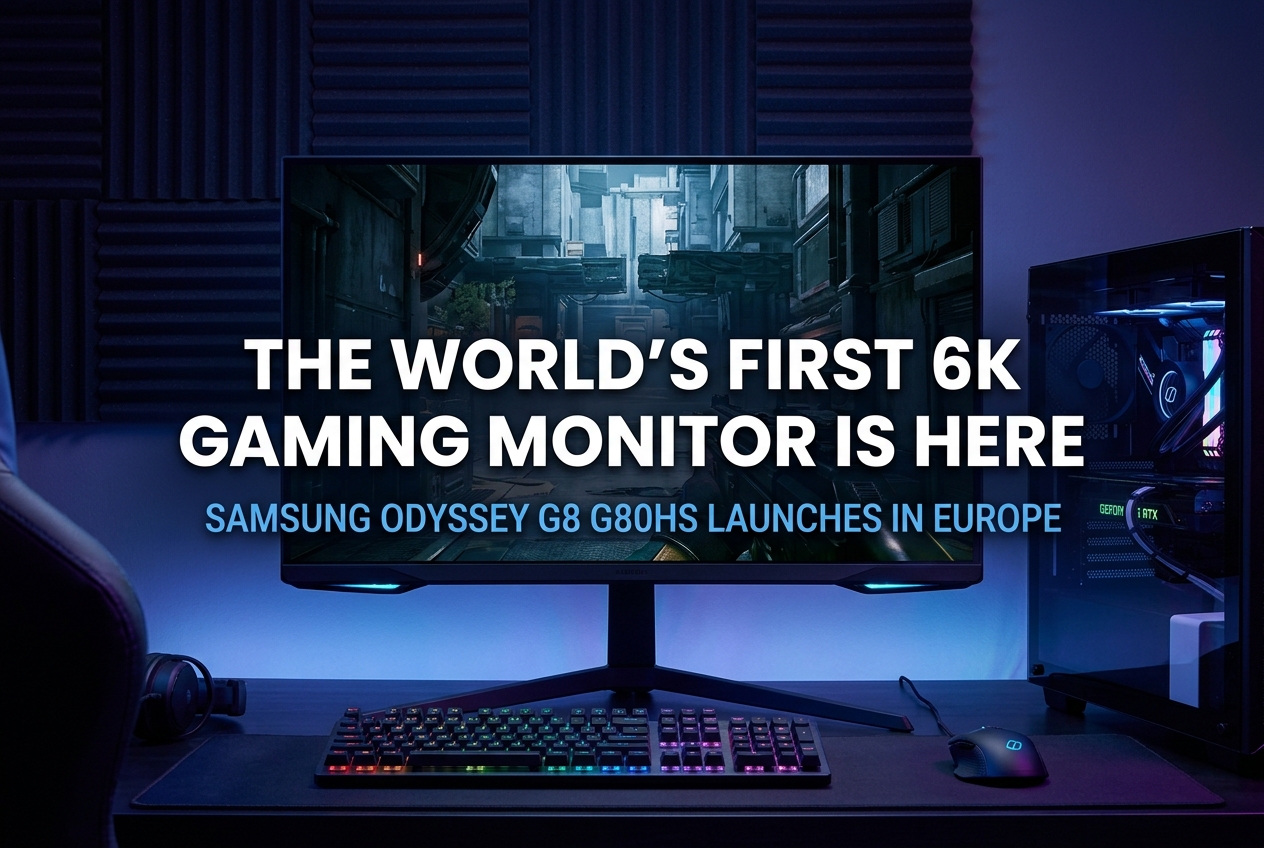
Samsung’s Odyssey G8 G80HS is now available for pre-order in Europe at €1,499 as the world’s first 6K gaming monitor. Featuring a 32-inch Fast IPS panel at 6144×3456, Dual Mode switching to 3K at 330Hz, and DisplayPort 2.1 UHBR20, it targets high-end gamers and creators alike.
Samsung’s Odyssey G8 (G80HS) has gone on sale in Europe as the industry’s first 6K gaming monitor, packing 21.2 million pixels into a 32-inch Fast IPS panel at a native resolution of 6144 x 3456. Priced at €1,499 (~$1,751) and initially available through Samsung’s German online store, the monitor is scheduled to begin shipping on June 19, 2026, with broader European availability expected shortly after.
What Does 6K Resolution Actually Mean for Gaming?
The G80HS delivers a pixel density of 224 pixels per inch, roughly 2.5 times the total pixel count of standard 4K (3840 x 2160) displays. To put that in perspective, a typical 4K monitor contains around 8.3 million pixels, while this 6K panel pushes 21.2 million. That 224 PPI figure rivals Apple’s “Retina” displays, making it one of the highest pixel density LCDs ever released for gaming.
In practice, this level of detail sharpens distant textures, environmental objects, and fine UI elements that remain blurred or aliased on lower-resolution screens. Open-world titles and graphically demanding AAA games benefit the most, with surface detail and draw distance seeing meaningful visual improvements.
Dual Mode: 165Hz for Immersion, 330Hz for Competition
The standout feature of the G80HS is Samsung’s Dual Mode technology, which lets the monitor switch between two distinct operating profiles:
- 6K Mode (6144 x 3456 at 165Hz): Maximum detail for story-driven games, creative work, and general desktop use.
- 3K Mode (3072 x 1728 at 330Hz): Halved resolution with doubled refresh rate, targeting competitive shooters like Valorant, CS2, and Apex Legends.
Samsung achieves this using a 2×2 pixel mapping technique that maintains image clarity even at the lower resolution tier. This dual-purpose approach effectively replaces the need for two separate monitors: one for productivity and visual fidelity, another for esports-grade speed.
Full Technical Specifications
| Specification | Detail |
|---|---|
| Screen Size | 32 inches (flat) |
| Panel Type | Fast IPS |
| Native Resolution | 6144 x 3456 (6K) |
| Dual Mode Resolution | 3072 x 1728 (3K) |
| Refresh Rate | 165Hz (6K) / 330Hz (3K) |
| Response Time | 1ms GtG |
| Brightness | 350 cd/m² (typical) |
| Contrast Ratio | 1000:1 |
| Colour Depth | 10-bit, 1 billion colours |
| HDR | HDR10, HDR10+ Gaming |
| Adaptive Sync | AMD FreeSync Premium Pro, NVIDIA G-Sync Compatible |
| Ports | 2x HDMI 2.1, 1x DisplayPort 2.1 (UHBR20), USB 3.2 hub (USB-B upstream, 2x USB-A downstream), headphone jack |
The inclusion of DisplayPort 2.1 with UHBR20 is critical. This connection delivers 80 Gbps of bandwidth, enough to drive 6K at 165Hz without relying on Display Stream Compression (DSC). HDMI 2.1 is also present but limited to 48 Gbps, which will restrict full-resolution, high-refresh performance.
What GPU Do You Actually Need to Run 6K?
Driving 21.2 million pixels at high frame rates is an enormous ask. During CES 2026, Samsung demonstrated the G80HS running Cyberpunk 2077 on an NVIDIA RTX 5080 system, and hands-on reports described performance as “decent” at 6K, though far from locked at 165 FPS in demanding titles.
Here is a realistic breakdown of what hardware you need:
- Minimum for 6K gaming: NVIDIA GeForce RTX 5080 ($999 MSRP) or RTX 5090 ($1,999 MSRP). Both support DisplayPort 2.1 UHBR20. The RTX 5090 leads the 5080 by 30% to nearly 70% at 4K, and that gap grows wider at 6K.
- DLSS 4 and Frame Generation: NVIDIA’s AI upscaling and multi-frame generation technology is practically essential for reaching playable frame rates at 6K. Without it, even the RTX 5090 will struggle in modern ray-traced titles.
- For 3K 330Hz mode: The GPU requirements drop significantly. An RTX 5070 Ti or equivalent should handle competitive titles comfortably at 3K.
- Cable: A certified DP80 DisplayPort cable is required for the full 80 Gbps connection.
Previous-generation NVIDIA RTX 40 series cards lack DisplayPort 2.1, meaning they would need DSC and would be bandwidth-limited at 6K. AMD’s RX 7000 series supports DP 2.1 at UHBR13.5 (54 Gbps), which may not be sufficient for uncompressed 6K 165Hz either. For those interested in the broader implications of next-gen GPU technology, GamerMarkt has a detailed breakdown of DLSS 4.5 and its performance impact.
How Does the G80HS Compare to Other 2026 Odyssey Models?
Samsung’s 2026 Odyssey lineup spans five models, each targeting a different use case:
| Model | Size | Resolution | Panel | Refresh Rate | Dual Mode |
|---|---|---|---|---|---|
| Odyssey 3D (G90XH) | 32″ | 6K | IPS | 165Hz | 330Hz (3K) + Glasses-Free 3D |
| Odyssey G6 (G60H) | 27″ | QHD | IPS | 600Hz | 1,040Hz (HD) |
| Odyssey G8 (G80HS) | 32″ | 6K | IPS | 165Hz | 330Hz (3K) |
| Odyssey G8 (G80HF) | 27″ | 5K | IPS | 180Hz | 360Hz (QHD) |
| Odyssey OLED G8 (G80SH) | 32″ | 4K | QD-OLED | 240Hz | N/A |
The G80HS sits between the premium 3D-capable G90XH and the more accessible 5K G80HF. If you want OLED contrast and deeper blacks but are willing to accept 4K instead of 6K, the G80SH with its QD-OLED panel and USB-C 98W power delivery is worth considering.
Who Is the 6K Monitor Really For?
The G80HS is not a pure gaming monitor. It is a dual-purpose display targeting users who split their time between creative work and gaming. The 6K resolution makes it a genuine productivity tool: software developers get dense code views, video editors work with native footage detail, and designers see their output without scaling compromises.
Then at night, switch to 3K 330Hz and you have an esports-ready panel that rivals dedicated high-refresh monitors. Samsung’s pitch is that you no longer need two monitors. Whether the €1,499 price justifies replacing two separate displays depends on your workflow and gaming habits.
Things Worth Knowing Before You Buy
Can I use this monitor with a PlayStation 5 or Xbox Series X?
No current console supports 6K output. The PS5 and Xbox Series X max out at 4K 120Hz via HDMI 2.1. The G80HS will accept that signal, but you will not benefit from the native 6K resolution or 3K 330Hz mode without a capable PC.
Is 350 nits bright enough?
For a Fast IPS gaming panel, 350 nits is a standard figure. It handles well-lit rooms adequately but falls short of the 1,000+ nit peaks that Mini LED and high-end OLED monitors achieve. HDR10+ Gaming certification is present, but peak brightness is not this monitor’s strongest suit. If HDR performance is your priority, the OLED G80SH model may be a better fit.
Why Fast IPS instead of OLED?
Manufacturing a 6K OLED panel at this size is not commercially viable yet. Fast IPS allows Samsung to hit the 6K resolution target with 1ms response time, 178-degree viewing angles, and 10-bit colour at a price that, while high, remains within reach. Samsung reserves its QD-OLED technology for the 4K G80SH model in this lineup, which offers superior contrast and deeper blacks but at a lower resolution.
Do I need a new cable?
Yes. To unlock the full 80 Gbps bandwidth of DisplayPort 2.1 UHBR20, you need a DP80-certified cable. Standard DP 1.4 cables will physically connect but will bottleneck performance. Samsung does not include USB-C connectivity on this model, so DP 2.1 is the primary high-bandwidth pathway.
Is the monitor available outside Germany?
As of early May 2026, the G80HS is available for pre-order through Samsung’s German store at €1,499 with shipping starting June 19. Samsung has indicated broader European availability will follow, though specific dates for the UK, France, and other markets have not been confirmed. US pricing and availability are yet to be announced.