62% of Gen Z refuse to pay full price for video games, and 59% subscribe to platforms only to cancel after finishing one title. Platform loyalty is dead. Here’s what the access-first era means for gaming.
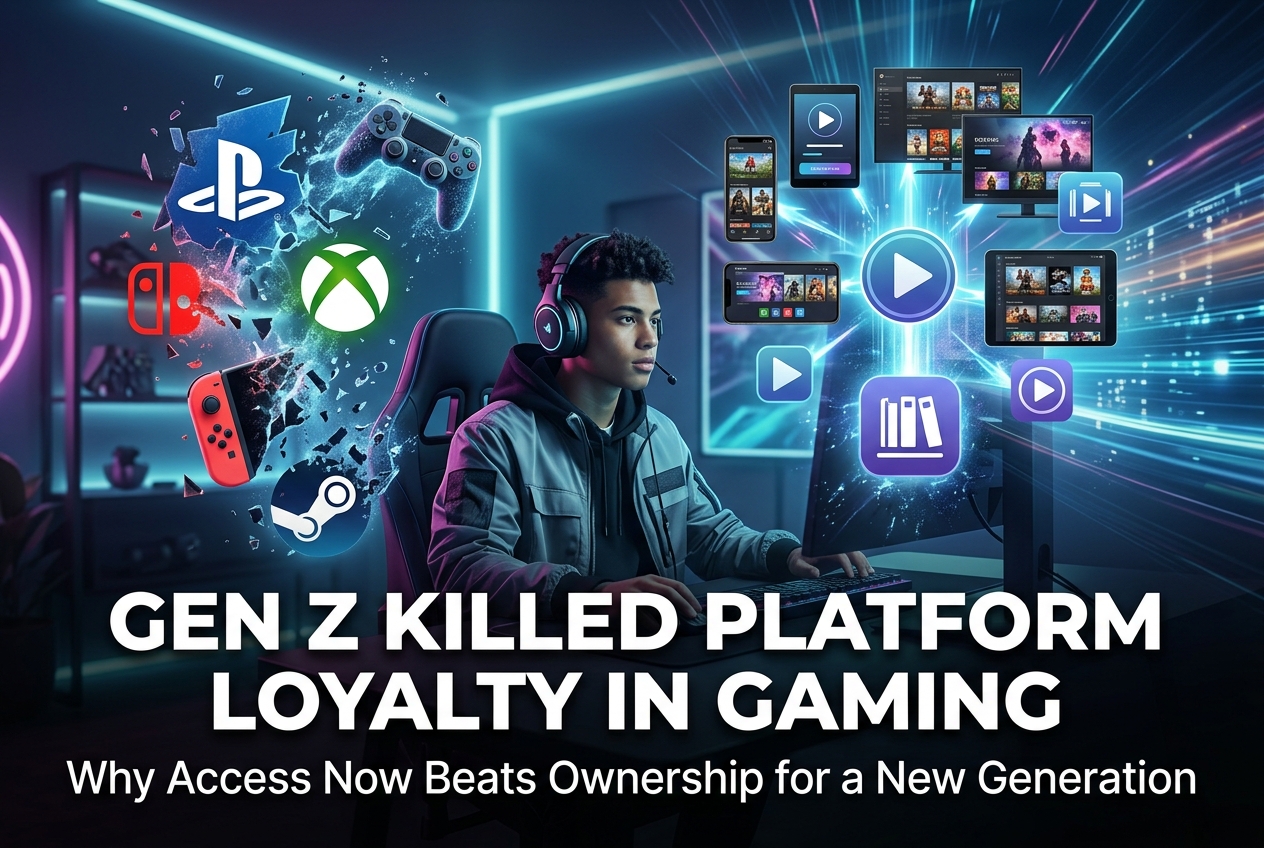
62% of Gen Z consumers now refuse to pay full price for video games. According to IGN’s 2026 Entertainment Engagement Report, surveying 6,250 people across the US, UK, and Australia, younger audiences have fundamentally rejected the ownership model that defined gaming for decades. Platform loyalty is being replaced by subscription hopping, cross-device fluidity, and a pragmatic approach where access always wins over possession.
The Subscription Hop: Subscribe, Play, Cancel, Repeat
The most striking finding from IGN’s report is that 59% of Gen Z actively subscribe to a streaming or gaming service just to access a single title, then cancel immediately afterward. This “subscribe, binge, cancel” loop has become the default consumption model for younger audiences. Fortune’s coverage of the report notes that while Gen Z and millennials still maintain the most active subscriptions (averaging over three services each), they treat these as temporary access passes, not long-term commitments.
The pattern extends directly into gaming. According to Gitnux’s 2026 Gen Z Gaming Statistics report, 42% of Gen Z gamers subscribe to services like Xbox Game Pass. But Mordor Intelligence data shows 73% of Gen Z gamers prefer subscriptions over individual game purchases. The critical nuance: these subscriptions are not permanent. Between January and March 2026, 37% of Gen Z subscribers cancelled at least one service, with another 29% planning to do the same soon.
Why Ownership Lost Its Appeal
The shift from ownership to access is driven by multiple converging forces. When you “buy” a digital game, you don’t truly own it. Platforms can revoke access, remove titles from libraries, or shut down servers entirely. California’s AB 2426 legislation is now attempting to clarify the legal difference between licensing and ownership, acknowledging that consumers have been misled about what digital purchases actually mean.
Economics accelerate the trend. The BuffHub 2026 Mobile Gaming Report found that gamers aged 18 to 24 have cut their weekly video game budgets by approximately 25% compared to the previous year, yet they maintain the same playtime. The global games market reached roughly $197 billion in 2025, with mobile gaming contributing $108 billion, but Gen Z is finding ways to stay engaged without spending more. Free-to-play models now generate $92 billion annually, representing over 40% of total online gaming revenue.
Meanwhile, subscription fatigue is real: 87% of Gen Z report experiencing it. US consumers spend approximately $69 monthly on subscriptions ($828 annually), according to Deloitte. Subscription growth itself dipped to 7% in 2025, down from 12% in 2024. Younger consumers are the primary force behind this slowdown.
The Game-First, Device-Second Generation
Gen Z doesn’t pick a platform and then find games to play on it. They pick a game and expect it to work everywhere. This represents a fundamental reversal from how older generations approached gaming. According to Deconstructor of Fun’s analysis with Google Gaming EMEA Head Tobias Knoke, 69% of Gen Z game on mobile, 42% on PC, and 38% on console, often switching between all three depending on context.
Cross-platform functionality is now a baseline expectation. Players who use multiple platforms return 31% more often than single-platform users. Tablet gaming usage among Gen Z jumped from 17% in 2020 to 22% by Q2 2024. Cloud gaming services like Xbox Cloud Gaming and NVIDIA GeForce NOW represent the final abstraction: completely separating play from dedicated hardware.
This fluidity kills traditional platform loyalty by design. When a game runs identically on your phone, laptop, and console, the hardware brand becomes irrelevant. The game is the relationship, not the device.
The Social Circle Effect on Platform Choices
Social connection ranks among the top three reasons Gen Z plays games. According to the Deconstructor of Fun analysis, 34% of Gen Z plays primarily to socialise, compared to 26% of other generations. More critically, Gen Z gamers are more likely than any other cohort to quit or return to a game because of their friends.
Tobias Knoke articulated it sharply: “You need to think about them not as individuals but as circles of friends. If you lose one player, you might be losing three, and vice versa if you manage to re-engage all of them.” This social-circle dynamic means that when a friend group collectively moves to a new game, individual platform preferences dissolve instantly. The group goes where the fun goes.
This interconnectedness directly undermines single-platform retention strategies. Friend suggestions, competitive challenges, social leaderboards, and co-op experiences now matter more than hardware ecosystems. Roblox hit 85.3 million daily active users by the end of 2024, with teen usage rising from 34% to 46% over that year, largely because it functions as a social platform first and a game platform second.
Spending Less, Playing More: The Value Paradox
Gen Z’s relationship with money in gaming is paradoxical. They spend less overall but remain deeply engaged. The BuffHub 2026 report confirmed that despite a 25% budget cut, playtime stayed constant. Between January and April 2025, both online and retail game purchases fell 13% year-over-year among young Americans, according to Circana data.
Yet in-game purchases still drive 76% of online gaming revenue globally in 2025. The average gamer spends $147 annually on microtransactions, up from $132 the previous year. Cosmetics alone account for 41% of microtransaction revenue. Gen Z’s spending pattern is selective rather than absent: 52% of Gen Z gamers make in-game purchases, and mobile gamers contribute 57% of all microtransaction revenue.
The shift is toward what industry analysts call “friendslop” titles: free or sub-$10 social games that maintain engagement without requiring significant investment. Gen Z is willing to spend, but only when the value exchange feels fair. A notable 36% quit games specifically because of intrusive ads, while rewarded ads and premium cosmetics remain acceptable.
What This Means for Game Accounts and Digital Assets
As ownership shifts to access, the value locked inside game accounts becomes more significant. Rare skins, high competitive ranks, champion collections, and progression milestones represent real economic value that persists even as players hop between subscription services. Gen Z’s annual battle pass spending averages $120 per gamer, and these accumulated digital assets don’t disappear when a subscription lapses.
This creates a natural secondary market for game accounts. When a player moves on from a title, the hundreds of hours and dollars invested in that account still hold value for someone else.
The Subscription Landscape Is Adapting
Microsoft’s response to these trends has been aggressive. Xbox Game Pass Ultimate dropped from $29.99 to $22.99 per month in April 2026, while PC Game Pass fell to $13.99. New Xbox CEO Asha Sharma publicly acknowledged that “Game Pass is too expensive” and signalled plans for cheaper tiers, ad-supported options, and potential bundling deals. A leaked “Starter Edition” tier would offer 50+ games and 10 hours of monthly cloud gaming at a price below the current Essential tier.
These moves reflect an industry-wide recognition that Gen Z treats subscriptions as utilities, not commitments. InsightTrendsWorld’s 2026 analysis describes this as “access-first entertainment” where consumers use streaming and gaming platforms as “temporary cultural access points” driven by hype cycles, social urgency, and economic pragmatism rather than brand allegiance.
Savanta research confirms the structural scale: 70% of consumers aged 18-44 use subscription services, averaging 8.4 subscriptions. But 46% of 18-24-year-olds share subscription costs with family or friends rather than paying fully themselves. Only 46% of this cohort fully fund their own subscriptions, compared to 80% of consumers aged 35 and above.
Monetisation That Works (and What Doesn’t)
Gen Z has strong, data-backed opinions about how games should make money. Disruptive ads are a dealbreaker for 36% of the audience. Rewarded ads work if the value exchange feels fair. Premium cosmetics and personalisation options remain the strongest revenue driver: unique skins, status items, and avatar customisation create the emotional investment that subscriptions alone cannot.
Battle pass systems have become the dominant monetisation framework. An estimated 60-65% of players in leading titles like Fortnite and Call of Duty regularly engage with battle passes. StreamsCharts’ 2026 generational analysis notes that Gen Z grew up surrounded by battle passes, seasonal drops, and premium skins, normalising these as standard parts of gaming culture rather than optional extras.
The key principle: monetisation must feel rewarding, not extractive. If it feels like a cash grab, Gen Z leaves. The most successful models frame spending as self-expression and social participation rather than pay-to-win mechanics.
Things Worth Knowing Before Diving Deeper
Is platform loyalty truly dead, or just evolving?
It’s evolving rather than vanishing entirely. Future Platforms research found that 18-24-year-olds are the least likely to join loyalty programmes but become the most engaged and loyal members once they do. Gen Z doesn’t reject loyalty; they reject loyalty that offers poor value. Brands that provide genuine personalisation, community belonging, and transparent value can still earn lasting engagement. The bar is simply higher.
Will subscriptions fully replace game purchases?
Not completely, but the balance is shifting fast. In the US, 52% of gamers already subscribe to at least one gaming service. Among console gamers specifically, that figure reaches 74%. The access model works especially well for casual and mid-core players who want variety without upfront costs. However, dedicated fans of specific franchises still buy premium titles at launch, particularly when day-one Game Pass inclusion isn’t guaranteed.
How does this affect the value of existing game accounts?
Paradoxically, access-first gaming increases account value. When new players can try any game through a subscription but want to skip the grind, pre-built accounts with rare items and high ranks become more desirable. The same logic applies when players leave a game: instead of abandoning digital assets, they can recover value through trusted marketplaces. This secondary economy grows alongside the subscription model rather than competing with it.
What about Gen Z’s spending on gaming overall?
Gen Z spends approximately $500 annually on gaming on average, with a monthly average of around $45 according to Gitnux. While the total budget dropped 25% year-over-year, the allocation shifted toward subscriptions, battle passes, and selective in-game purchases rather than full-price game ownership. Spending is becoming more strategic, not disappearing.
The Bigger Picture: Access as a Lifestyle
Gaming is just one front in a broader generational shift. InsightTrendsWorld’s cross-industry analysis notes that access-first behaviour now spans fashion rental platforms, subscription beauty services, co-working spaces, mobility subscriptions, and digital memberships. Gen Z increasingly rejects permanent ownership and long-term commitments across every category, preferring flexibility, low friction, and the ability to switch at will.
In gaming specifically, this means the industry’s future depends on designing around engagement loops rather than ownership transactions. The global gaming population is projected to hit 3.5 billion by the end of 2025. eMarketer expects 75% of Gen Z to engage in digital gaming by 2027. The audience is massive, growing, and fundamentally allergic to being locked in. Studios, platforms, and marketplaces that understand this will thrive. Those still building around permanent ownership risk losing the largest gaming generation in history.