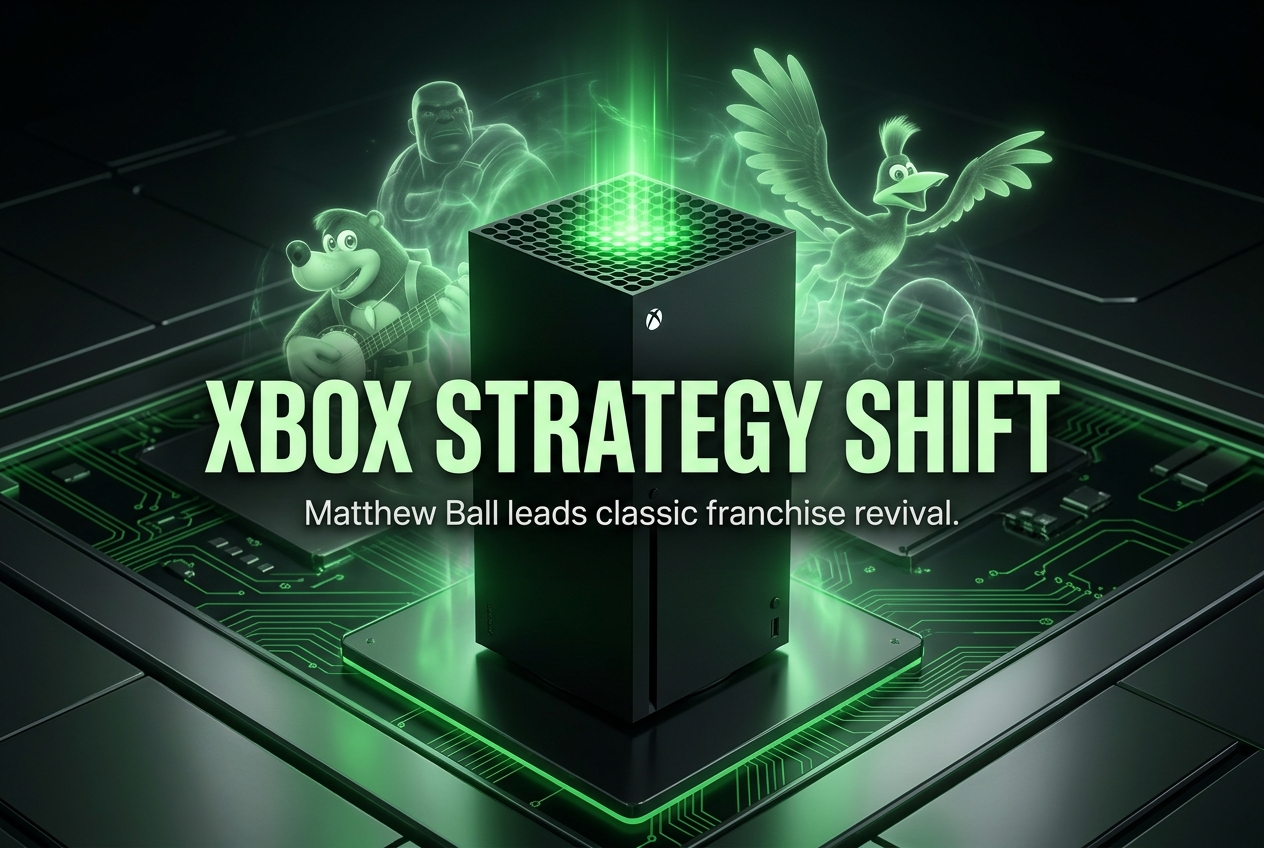
Xbox CEO Asha Sharma has brought in renowned industry analyst Matthew Ball as Chief Strategy Officer, with a stated mission to revive dormant franchises and turn around the console business ahead of Project Helix’s launch.
Xbox appointed renowned gaming industry analyst Matthew Ball as its new Chief Strategy Officer on 20 May 2026, marking one of the most significant leadership moves under CEO Asha Sharma’s tenure. In his first on-the-record comments to Bloomberg, Ball stated his focus is on “reviving storied franchises and strengthening Xbox’s console business.” The hire arrives alongside former Azure OpenAI infrastructure lead Scott Van Vliet as CTO and longtime Activision veteran Chris Schnakenberg as corporate VP of partnerships and business development.
Who Is Matthew Ball and Why Does This Matter?
Ball is best known for his annual “The State of Video Gaming” reports, widely considered essential reading across the industry. He previously held strategy roles at Amazon Studios, Otter Media, McKinsey, and Accenture, and authored the 2022 international bestseller “The Metaverse.” His connection to Xbox runs deeper than most realize: he advised Microsoft on Game Pass subscription strategy as early as 2020.
Speaking to Bloomberg, Ball called the opportunity “irresistible,” describing himself as a passionate Xbox fan with “thousands of memories in specific basements playing Halo, playing Gears of War.” Sharma revealed Ball had already been advising her since day 10 of her three-month tenure before being officially brought on staff. His appointment signals that Xbox views its strategic direction, not just its game pipeline, as the core problem to solve.
What Is Wrong with Xbox’s Console Business?
Ball’s February 2026 industry report painted a sobering picture: console gaming has been “losing the attention war for a half decade” against short-form video, mobile platforms, and social gaming spaces like Roblox. Xbox hardware has faced steep year-over-year declines, and Game Pass growth appears to have plateaued. The last publicly confirmed subscriber count was 34 million in early 2024, with third-party estimates suggesting a range of 35 to 37 million by Q1 2025. In October 2025, Microsoft raised Game Pass Ultimate pricing by 50% (from $19.99 to $29.99/month in the US), a move that signalled margin optimization rather than aggressive growth.
Ball acknowledged that “the last few years have had a lot of different and largely disappointing quarters” for Xbox. His mandate is blunt: “Our job is to turn around the business, to grow its reach in players and player hours.” He still believes console gaming is “important, durable and still growing,” but Xbox needs to give players stronger reasons to choose its ecosystem over PlayStation and Nintendo Switch 2.
Which Classic Franchises Could Return?
Microsoft owns one of the largest IP portfolios in gaming, massively expanded by the $69 billion Activision Blizzard acquisition in 2023 and the earlier ZeniMax Media deal. Dozens of beloved franchises have been dormant for years or even decades. The names generating the most community excitement include:
- Banjo-Kazooie: Rare’s iconic platformer last received a mainline entry in 2008 with Nuts & Bolts. As of June 2024, journalist Jez Corden confirmed no new Banjo game was in active development, but Ball’s arrival could change the calculus.
- MechAssault: The beloved mech-action series has been absent since 2004. Former Xbox boss Phil Spencer previously expressed personal interest in reviving the franchise.
- Crimson Skies: This alternate-history aerial combat game last appeared in 2003 and has remained a fan favourite request ever since.
- Viva Piñata: Another dormant Rare property, last active in 2008, with a devoted cult following.
- Blue Dragon and Lost Odyssey: Mistwalker’s Xbox 360 JRPGs, each limited to a single entry, remain cult classics among RPG fans.
- Shadowrun, Kameo, and Hexen: Niche but passionately requested franchises sitting in Microsoft’s vault.
The Activision Blizzard deal added further dormant series like Crash Bandicoot, Spyro, StarCraft, and Prototype. Which of these will be prioritized under Ball’s strategy remains to be seen, but the sheer volume of untapped IP gives Xbox enormous creative runway.
Beyond Exclusivity: Ball’s Vision for Social Gaming
Many fans want Xbox to reclaim its identity through exclusive titles. Sharma is actively evaluating that approach. Ball, however, suggested that the “binary of exclusivity” is not the only path forward. Instead, he emphasized games that “find better and bigger ways to explore, create, co-create and build together.”
Sharma’s stated priority is to “elevate creator-centric platforms like Minecraft, The Elder Scrolls, and Sea of Thieves.” This aligns directly with Ball’s research, which identifies social elements, multiplayer ecosystems, modding communities, and user-generated content as the strongest counters to platforms like Roblox and TikTok. The strategy appears to be about building deep engagement ecosystems, not just shipping single-player sequels.
This does not mean exclusives are off the table. Sharma is still reviewing that question, and Ball notably did not rule it out. But the emphasis suggests Xbox’s revival strategy will be broader than simply locking games to one console.
Project Helix: The Hardware Foundation
Classic franchise revivals need compelling hardware to land on, and Xbox is building exactly that. Project Helix, announced in March 2026, is a hybrid console-PC device designed to run both Xbox and PC games natively. It will feature AMD’s next-generation “Magnus” architecture, promising six times the performance and twenty times the ray-tracing capability of Xbox Series X.
Key details shared at GDC 2026 include a unified development environment (one build for both Windows and Xbox), AI-powered neural rendering that could make backward-compatible games look closer to remakes than remasters, and potential access to PC storefronts like Steam and Epic Games Store. Developer kits are expected to ship in 2027, with a consumer launch targeted for the same year.
For classic franchise revivals, Helix’s backward compatibility and AI upscaling features are particularly relevant. Older titles from the original Xbox and Xbox 360 libraries could benefit dramatically from the neural rendering pipeline, giving Microsoft a way to re-present classic games in a modern light even before full remakes or sequels are developed.
The Leadership Overhaul Under Asha Sharma
Ball’s appointment is part of a sweeping leadership restructure. Phil Spencer retired in February 2026 after 38 years at Microsoft. Xbox President Sarah Bond also departed, and Matt Booty was promoted to Executive VP and Chief Content Officer, overseeing the company’s nearly 40 game studios. Sharma, who previously led Microsoft’s CoreAI division, has no prior gaming industry background, which makes the recruitment of deep-domain experts like Ball and Booty essential.
Epic Games CEO Tim Sweeney praised the new executive team on X, calling it “quite a world class team being assembled” that “foreshadows serious dedication to the future of gaming for Windows, Xbox, Minecraft, Call of Duty, and the many world class studios in the Microsoft family.” The combination of Sharma’s operational expertise, Ball’s strategic analytical depth, and Booty’s content leadership represents a fundamentally different Xbox leadership model compared to the Spencer era.
How Game Pass Fits Into the Revival Strategy
Game Pass remains central to how Xbox monetizes its content library. The current US pricing structure includes Ultimate at $29.99/month (500+ games, day-one access, EA Play, cloud gaming), Premium at an intermediate tier with 200+ games and first-party titles added within 12 months, and Essential as the entry-level option with 50+ games and online multiplayer. Despite the October 2025 price increases, the service’s value proposition could be significantly boosted by classic franchise revivals.
New entries in dormant series launching day one on Game Pass would serve dual purposes: attracting new subscribers and giving existing members a stronger reason to stay. Ball’s prior advisory work on Game Pass economics suggests he understands this lever well. The question is whether revival titles will be positioned as subscription anchors or also sold as premium standalone releases.
What Should Players Expect Next?
Ball’s hiring is a strategic signal, not a game announcement. No specific titles, studios, or timelines have been confirmed for franchise revivals. However, several factors point toward meaningful action rather than empty corporate positioning:
- Ball explicitly named franchise revival as his core mission in a Bloomberg interview, creating a public accountability marker.
- Sharma’s team is actively evaluating exclusivity strategy, which could determine whether revivals stay Xbox-first or go multiplatform.
- Project Helix’s AI-driven backward compatibility could serve as a bridge, bringing classic games to modern hardware with significant visual upgrades ahead of full new entries.
- Microsoft’s massive IP portfolio, now including Activision Blizzard and ZeniMax properties, provides dozens of viable candidates without needing to acquire new studios.
- Ball’s data-driven approach, built on years of industry analysis, suggests decisions will be informed by market opportunity rather than pure nostalgia.
Xbox sits on one of the richest collections of dormant gaming IP in the industry. From Banjo-Kazooie to Crimson Skies, MechAssault to Viva Piñata, the raw material for a meaningful revival strategy exists. Matthew Ball’s job is to turn that potential into a coherent plan that strengthens Xbox’s console identity, fuels Game Pass growth, and gives players reasons to invest in the platform ahead of Project Helix. The pieces are in place; what matters now is execution.