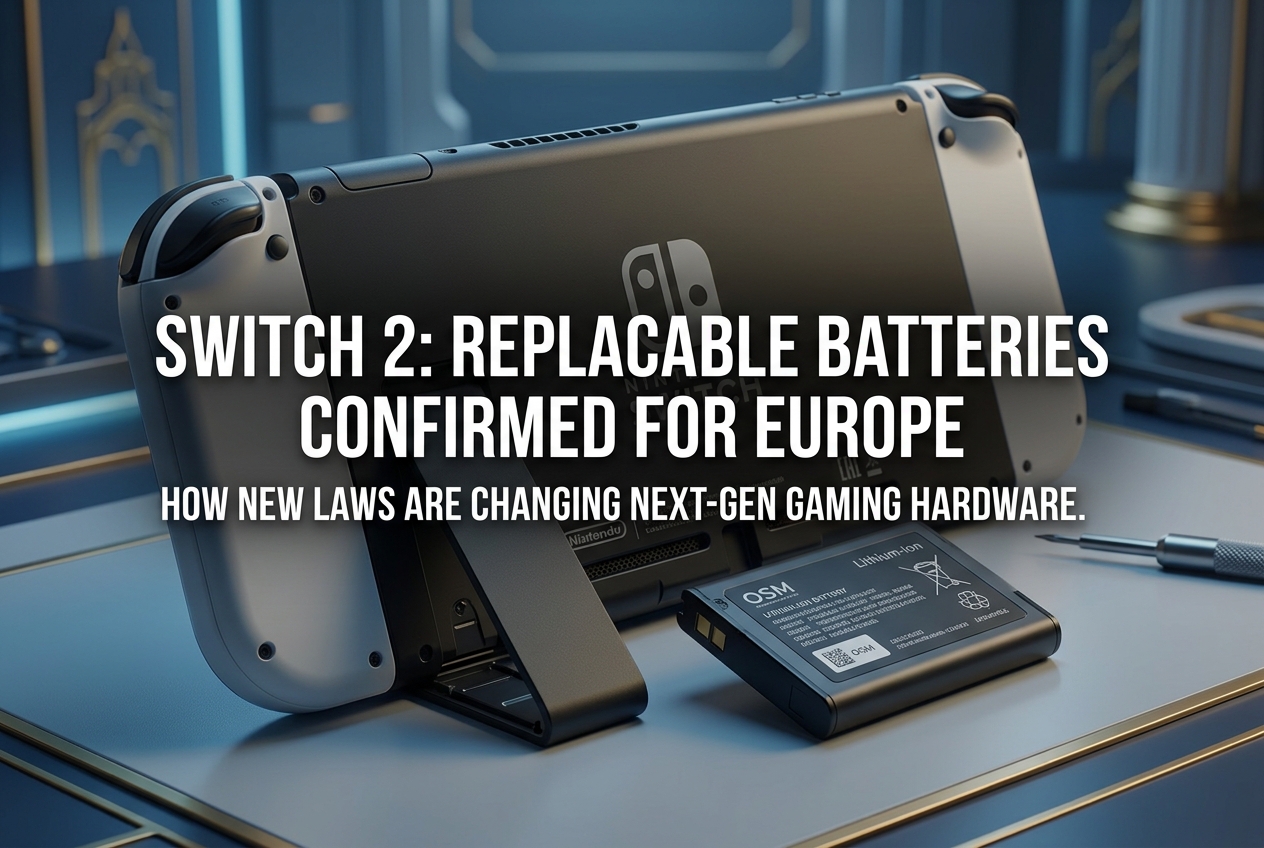
Nintendo has officially confirmed a hardware revision of the Switch 2 with user-replaceable batteries for the European Union. Marked with an OSM product code, the new model will comply with EU Battery Regulation 2023/1542 before its February 2027 deadline.
Nintendo has officially confirmed it will release a revised Switch 2 model in the European Union featuring a user-replaceable battery. With 19.86 million units shipped worldwide as of March 2026, the Switch 2 is now facing its biggest hardware redesign since launch, driven by EU Battery Regulation 2023/1542. The updated consoles will carry a new “OSM” product code on packaging, distinguishing them from the current “BEE” models that use glued-in batteries.
Why Is Nintendo Redesigning the Switch 2?
The EU Battery Regulation, adopted in July 2023, requires that portable batteries in consumer electronics be “readily removable and replaceable by the end-user at any time during the lifetime of the product.” This mandate takes effect on 18 February 2027 and applies to all new portable devices placed on the EU market after that date. The regulation is part of the EU’s broader right-to-repair push, aiming to reduce e-waste and extend product lifespans.
The current Switch 2 falls far short of these requirements. According to iFixit’s teardown, the battery is firmly glued inside the housing and requires 32 steps, specialised JIS screwdrivers, adhesive remover, and thermal putty to replace. iFixit gave the console a repairability score of just 3 out of 10. The EU regulation specifically states that removal must not require specialised tools, heat, or solvents, making the current design non-compliant.
What We Know About the EU Model
Nintendo’s announcement in early June 2026 revealed several key details. The compliant consoles will have unique model numbers and carry an “OSM” code on retail packaging. Current Switch 2 hardware uses the “BEE” model prefix. These EU-specific units will be treated as separate products for regulatory purposes.
The redesign extends beyond the main console. Both Joy-Con 2 controllers, which currently house 500 mAh lithium-ion batteries, will also be modified for easy user replacement. The standard Switch 2 packs a 5,220 mAh battery rated for approximately 2 to 6.5 hours of gameplay, with a full charge taking around 3 hours in sleep mode. Whether the EU revision will alter battery capacity or overall dimensions remains unknown.
How Does This Affect Hardware Design?
Making a battery user-replaceable in a compact handheld console requires a fundamental rethink of internal architecture. Nintendo must revise the internal component layout, housing design, and assembly process. The company could not account for the regulation’s specific technical requirements during the Switch 2’s original development cycle, which typically spans two to four years. The detailed specifications were finalised after hardware development was already well underway.
Running two parallel manufacturing lines, one for the EU and one for the rest of the world, adds significant production costs. Reports from Nikkei suggest Nintendo is already experiencing reduced profit margins on region-specific Switch 2 hardware in Japan. A similar cost impact is expected for the European variant, potentially affecting the console’s retail price in the region.
Will Other Regions Get the Replaceable Battery?
For now, the user-replaceable battery model is an EU exclusive. Gamers in the United States, Japan, and other markets will continue receiving consoles with permanently glued-in batteries. However, Nikkei reported that Nintendo indicated it “may take similar measures” in the US and Japan “should consumer awareness of the right to repair increase” in those regions.
The situation draws parallels to Apple’s switch from Lightning to USB-C. After the EU mandated USB-C for smartphones, Apple initially planned a Europe-only change before rolling it out globally. Industry analysts suggest Nintendo could follow a similar path, particularly if maintaining two separate production lines proves more expensive than adopting a single global design.
What About the Original Switch?
The original Nintendo Switch, which has shipped 155.92 million units lifetime, faces a less certain future in the EU. Since the regulation targets new products placed on the market after February 2027, existing dealer stock can still be sold. However, any new shipments would need to comply, making discontinuation of the original Switch in Europe before the deadline a likely outcome. Nintendo has not officially confirmed this, but analysts consider it the most logical scenario.
The Bigger Picture: Right to Repair Across Gaming
Nintendo is not the only company affected. The EU Battery Regulation covers all portable battery-powered devices, including smartphones, laptops, wireless headphones, and gaming peripherals. Sony has already begun making battery replacement easier in its DualSense controllers, and Apple has adjusted newer iPhone designs for improved repairability. The regulation sets recycling targets too: 50% lithium recovery by 2027, rising to 80% by 2031.
For the gaming industry specifically, this marks a significant shift. Handheld consoles, controllers, and portable accessories have long relied on sealed battery designs for slim form factors and water resistance. The EU regulation includes a narrow exemption for devices regularly exposed to water, but standard gaming handhelds do not qualify.
Switch 2 Sales Context and Pricing
The Switch 2 launched in June 2025 at $449.99 in the US and €469.99 in Europe. In May 2026, Nintendo announced a global price increase effective 1 September 2026, raising the US price to $499.99 and the European price to €499.99. Whether the EU-exclusive replaceable battery model will carry an additional premium on top of this increase is not yet known.
Despite the price hikes, the Switch 2’s sales trajectory remains strong. The console shipped 19.86 million units in its first fiscal year, with 4.40 million of those going to Europe. Nintendo forecasts 16.5 million additional units for the fiscal year ending March 2027, though the company acknowledges the price increase may temper demand.
Questions Gamers Are Asking
When will the EU model be available?
Nintendo has not provided an exact launch date. Since the regulation takes effect on 18 February 2027, the revised model needs to be available before that deadline. A late 2026 or early 2027 release window is the most widely expected timeframe.
Will the current Switch 2 stop being sold in Europe?
The regulation applies to new products placed on the market after February 2027. Existing stock at retailers can still be sold, but new shipments of non-compliant hardware would not be permitted after the deadline.
Can I swap batteries on the go for longer play sessions?
In theory, yes. A user-replaceable battery design means you could carry a charged spare and swap it in without tools. This would effectively eliminate downtime during long trips or gaming sessions, though Nintendo has not yet confirmed whether spare batteries will be sold separately.
Will the design be thicker or heavier?
Hardware redesigns for removable batteries typically require some changes to chassis thickness or weight distribution. Nintendo has not shared any specifications yet, so the physical impact on the console’s form factor remains unknown.
Does this affect game compatibility?
No. The OSM model is a hardware revision focused on battery accessibility. Game compatibility, performance, and software features are expected to remain identical to the standard BEE model.
Nintendo’s confirmation of a replaceable-battery Switch 2 for Europe signals a turning point for portable gaming hardware. While the change is regulation-driven rather than voluntary, it delivers a genuine benefit to players: longer console lifespans, lower long-term costs, and reduced e-waste. Whether this EU-only revision eventually becomes the global standard depends on how quickly right-to-repair legislation spreads beyond Europe, but the precedent is now set.