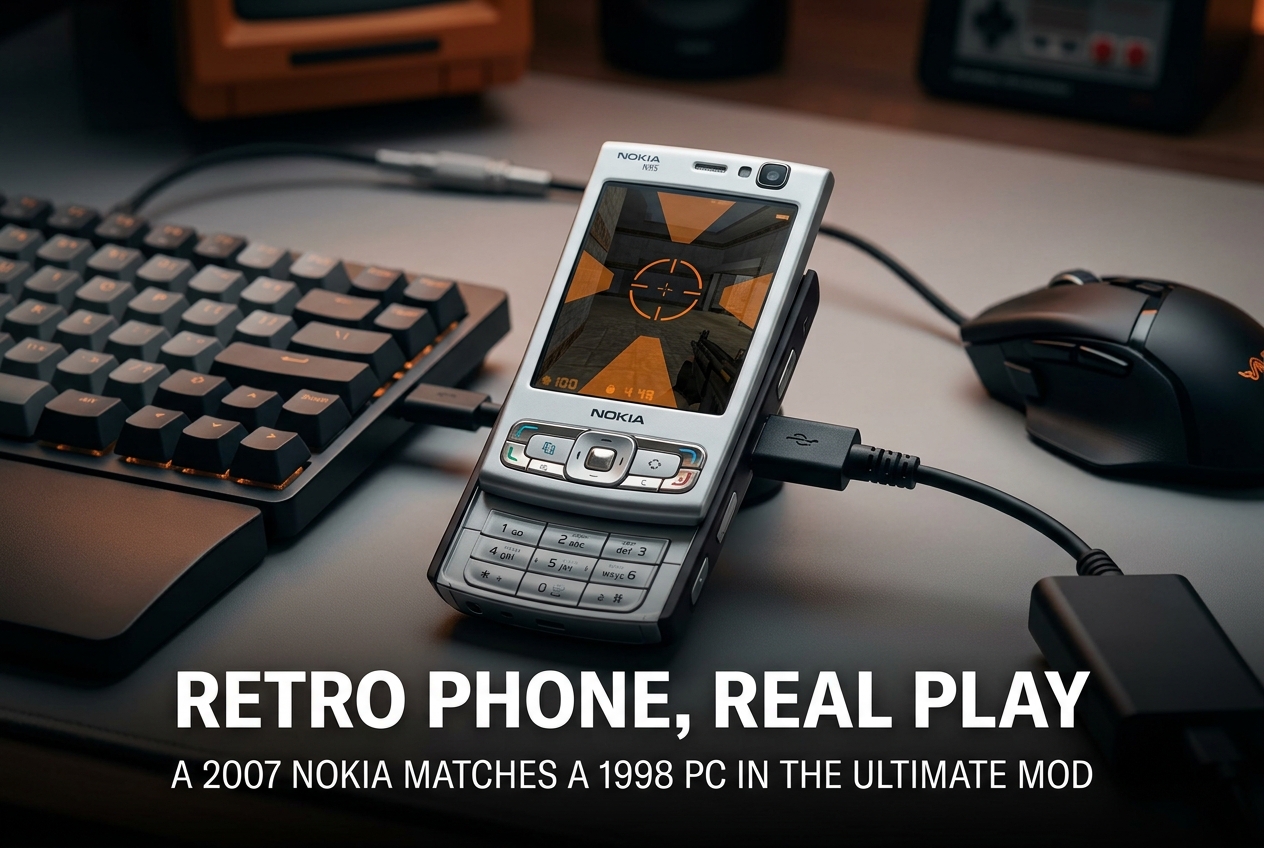
Argentine developer Dante Leoncini achieved 30 FPS running original Half-Life on a 332 MHz Nokia N95 from 2007, complete with mouse and keyboard support.
Argentine developer Dante Leoncini has gotten the original Half-Life running at 30 FPS on a Nokia N95, the iconic Symbian slider phone that launched in 2007. Leoncini shared the achievement on X on June 5, 2026, noting that mouse and keyboard support has also been added. Half-Life shipped in 1998 with minimum requirements of a 133 MHz Pentium and 24 MB of RAM, specs the N95 surpasses on paper with its 332 MHz dual-core processor and 64 MB of memory.
What Hardware Does the Nokia N95 Pack?
The Nokia N95 was a flagship multimedia phone for its era. Under the hood, it runs a Texas Instruments OMAP 2420 dual-core processor based on the ARM11 architecture, clocked at 332 MHz. Graphics are handled by a PowerVR MBX 3D accelerator, and the original model ships with 64 MB of RAM. The display measures 2.6 inches at 240×320 pixels, all running Symbian OS 9.2 with S60 3rd Edition.
An 8 GB storage variant released later in 2007 doubled the RAM to 128 MB and featured a slightly larger 2.8-inch screen. The phone also included a 5-megapixel camera with Carl Zeiss optics, built-in GPS, Wi-Fi, Bluetooth, HSDPA support, and FM radio. Nokia marketed it as a “multimedia computer,” a label that now seems surprisingly justified given what developers are managing to run on it nearly two decades later.
How Does Half-Life Run on a Symbian Phone?
Because the Nokia N95 uses an ARM processor and a non-Windows operating system, simply emulating the PC version of Half-Life is not feasible. Instead, the game requires a native Symbian build. Whether Leoncini used Xash3D, the popular open-source engine compatible with Valve’s GoldSrc, has not been officially confirmed. However, Xash3D is the standard tool behind most Half-Life ports to unconventional platforms, having been successfully deployed on Android, the Raspberry Pi, and Meta Quest headsets.
GoldSrc itself is Valve’s heavily modified version of id Software’s original Quake engine, powering Half-Life, Counter-Strike, Team Fortress Classic, and several other landmark titles from the late 1990s and early 2000s. The engine’s relatively modest demands are precisely what makes ports like this theoretically possible, even on hardware as limited as a 2007 mobile phone.
Are There Still Performance Issues?
Leoncini acknowledged that some slowdowns remain but confirmed he has already identified the cause and is working on a fix. In his earlier Quake 3 work on the same device, the CPU proved to be the primary bottleneck, and the current performance dips are believed to stem from the same limitation. A few additional bugs still need to be resolved, but the project is clearly in an advanced and playable state.
Leoncini’s Other Nokia N95 Projects
Half-Life is far from Leoncini’s only project for the Nokia N95. The developer has also built Whisk3D (formerly Blendersito), a Blender clone written from scratch for Symbian OS. The name was changed to avoid trademark issues with the Blender Foundation. Whisk3D allows basic 3D modelling on the N95, including vertex extrusion, plane creation, and rendering via a connected monitor and keyboard over TV-out.
Leoncini has also developed his own game engine for the platform, and all of these projects are shared as open source on his GitHub. Before Half-Life, he had already ported Quake 3 and Crash Bandicoot to the handset, and also set up emulation for Sega, ScummVM, and NES systems. The developer’s broader mission is to raise awareness about software-driven planned obsolescence, demonstrating that old phones remain far more capable than most people assume.
The 2008 Quake 3 Port That Paved the Way
Leoncini is not the first to push the OMAP 2420 chipset to its gaming limits. Back in 2008, developer Olli Hinkka ported Quake III Arena to S60 3rd Edition phones using the same processor, complete with Bluetooth keyboard and mouse support and even the ability to host a multiplayer server directly on the phone. That port, however, required the N95 8GB model or similarly higher-RAM devices like the N82 and E90. The original N95 with its 64 MB of RAM could not handle it.
Whether Leoncini is using the standard 64 MB model or the 8 GB variant remains unconfirmed, though visual evidence from his posts suggests the original white-cased version. If that is the case, running Half-Life at 30 FPS on half the RAM that Quake 3 needed would be a significant achievement in its own right.
Why Running Games on Old Hardware Matters
The hobby of running games on unconventional or vintage devices has grown into a thriving niche within the tech community. From getting Doom to boot on a 40-year-old printer controller to experimenting with retro consoles through decompilation and recompilation projects, developers continue to find creative ways to push the boundaries of old hardware. The Nokia N95 running Half-Life fits neatly into this tradition.
These projects serve multiple purposes. They prove that software optimisation can extract remarkable performance from limited hardware. They highlight the throwaway culture surrounding older devices that still have meaningful computing capability. And for a generation of gamers who grew up with these phones, they provide a nostalgic bridge between two eras of technology.
Half-Life’s Enduring Legacy
Released by Valve in 1998, Half-Life redefined the first-person shooter genre with its seamless narrative, scripted events, and immersive world-building. The game spawned some of the most influential mods in PC gaming history, including Counter-Strike, Day of Defeat, and Team Fortress Classic. Its minimum system requirements of a 133 MHz Pentium, 24 MB of RAM, and an SVGA graphics card reflected the mainstream hardware of the late 1990s.
The fact that a 2007 mobile phone can now deliver a playable experience at 30 FPS demonstrates both how modest those original requirements were and how much raw capability was packed into flagship phones of that era. It is a fitting tribute to a game that continues to inspire developers and communities nearly three decades after its release.
Common Questions About This Project
Is Half-Life actually playable on the Nokia N95?
Yes. The game reaches 30 FPS with mouse and keyboard support. Some slowdowns remain, but Leoncini has identified the cause and is actively working on fixes.
Is this emulation or a native port?
It is a native build, not emulation. The ARM processor and Symbian OS make PC emulation impractical, so the game had to be compiled specifically for the platform.
Does it use the Xash3D engine?
This has not been officially confirmed by Leoncini. However, Xash3D is the most commonly used open-source engine for porting Half-Life to non-PC platforms, supporting Android, Raspberry Pi, Meta Quest, and more.
What other games run on the Nokia N95?
Leoncini has previously run Quake 3 and Crash Bandicoot on the device, alongside Sega, ScummVM, and NES emulation. He has also built a full Blender clone called Whisk3D for Symbian.
Which Nokia N95 model is being used?
The exact model has not been confirmed. Visual evidence suggests the original 64 MB RAM version, though the 8 GB variant with 128 MB RAM also exists. If it is the standard model, the achievement is even more impressive given the tighter memory constraints.