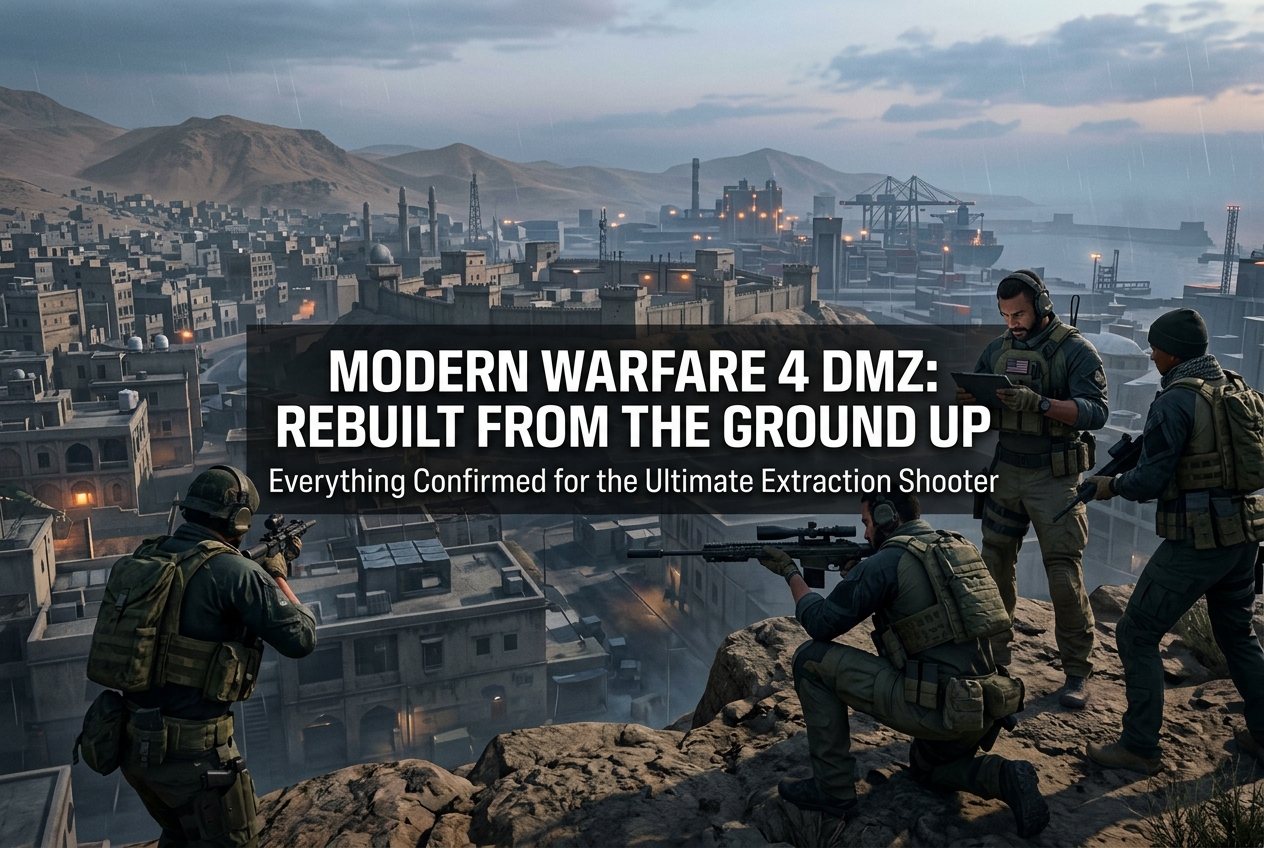
Call of Duty: Modern Warfare 4 rebuilds DMZ from the ground up with the massive Hajin map, a Forward Operating Base progression hub, operator trait trees, a PvP bounty ecosystem, and dynamic weather. Here is everything confirmed so far about the extraction shooter mode launching October 23, 2026.
Call of Duty: Modern Warfare 4 launches on October 23, 2026, across PlayStation 5, Xbox Series X|S, PC and Nintendo Switch 2, and it brings the most ambitious extraction shooter the franchise has ever attempted. DMZ is no longer a free-to-play beta experiment. It sits alongside Campaign and Multiplayer as a fully featured third pillar, complete with its own progression system, narrative, and economy. Up to 20 squads of three (approximately 60 players) deploy into the same massive map in each match.
What Is DMZ and How Has It Changed Since 2022?
DMZ first appeared in 2022 as a free beta bundled with Modern Warfare II and Warzone 2.0. Infinity Ward’s Multiplayer Creative Director Geoff Smith described the original as “a crazy experiment” and “a proving ground” that helped the studio learn what resonated with players. The Modern Warfare 4 version is built on that foundation but reconstructed from the ground up into a far deeper extraction experience.
The biggest shift is persistence. Players now build out a Forward Operating Base (FOB), maintain a persistent inventory across deployments, and develop separate Active Duty operators, each with their own loadout, backpack and trait tree. Unlike the 2022 beta, where extracted valuables were mostly converted into XP, MW4 DMZ features a proper stash, vendors, crafting, and a cash-driven gunsmith economy. The mode is no longer free: it ships as part of the paid Modern Warfare 4 package, and it will not appear on Xbox Game Pass until at least a year after launch.
The Hajin Exclusion Zone: A Map Bigger Than Al Mazrah
DMZ takes place in Hajin, a South Korean exclusion zone created after a nuclear reactor meltdown during the events of the Modern Warfare 4 campaign. The map sits at a tripoint where South Korea, North Korea and Russia converge, and developers confirmed it is larger than Al Mazrah from the original DMZ. Infinity Ward frames Hajin as a “living world” shaped by environmental storytelling and exploration.
Nine distinct points of interest have been confirmed for launch:
- Hajin City: Dense urban area with vertical gameplay opportunities
- Casino: A key story mission location
- Fallout: A heavily irradiated zone requiring a gas mask or hazmat suit to enter
- Hospital: Abandoned medical facility
- Military Base: Described as the hardest POI in the game
- Farmlands: Open rural terrain for long-range engagements
- Prison: Heavily fortified complex
- Broadcast: A broadcasting station
- Dead Town: A deserted settlement
Urban zones offer vertical combat, while rural areas deliver open sightlines. Air carriers move cargo overhead, convoys patrol roads, and hostile factions fight for control of strategic positions. The world is constantly in motion even without player intervention.
How Does Dynamic Weather Work?
One of the most significant additions to DMZ is a dynamic weather system. Confirmed weather states include default, fog, rain, heavy rain, snow, heavy snow and wind. Weather is localised rather than map-wide: one area may be foggy while another is clear, creating pockets of reduced visibility that affect tactical decisions.
The system also intensifies over time. As a match progresses and radiation spreads, weather conditions worsen, reinforcing the extraction pressure. Staying deployed longer means dealing with harsher environments on top of escalating AI threats.
Three Ways to Play: Story Missions, Dynamic Ops and Free Roam
Before infiltrating Hajin, players select one of three activity types. All three coexist simultaneously in the same world, meaning you might run into squads pursuing entirely different objectives.
Story Missions: Narrative-driven objectives written by the Modern Warfare 4 single-player team. These take place in specific POIs and tie directly into the campaign lore. Matchmaking groups players searching for the same story mission, reducing the risk of mismatched objectives in random squads.
Dynamic Operations: Multi-step, randomly generated missions that change every match. Tasks range from neutralising abandoned weapons programmes to high-risk rescue operations. The steps leading to the main objective are randomised each time, keeping each deployment fresh.
Free Roam: Open-ended exploration and player-driven encounters. Free Roam preserves the sandbox freedom that defined the original DMZ and is likely to attract the most PvP-focused players.
Forward Operating Base: Your Persistent Hub
The FOB is the centrepiece of the DMZ loop. Before and after every deployment, players return here to prepare gear, manage inventory and progress their account. The FOB is presented in third person so squad members can see each other and newer players can learn its systems more intuitively.
As your DMZ rank increases, new stations come online and existing ones upgrade:
- 3D Printer: Crafts equipment such as plate carriers and killstreaks from ingredients and recipes found in Hajin. Rarer recipes unlock printer upgrades.
- Gunsmith: Operates on a cash economy rather than cooldowns. In-game money earned during deployments is spent to build weapons and add attachments. Each attachment raises the cost of the next; high-value parts like suppressors and thermal optics are more expensive, making looting enemy players’ weapons a genuinely valuable strategy.
- The Stash: A persistent inventory where extracted items are stored between deployments.
- Vendor: Sell and buy items using in-game cash.
- Bounty Board: The central hub for PvP-focused risk-versus-reward decisions.
The FOB also visually evolves as players progress. New stations appear, the environment changes, and the base grows to reflect the player’s investment in the mode.
Operator Progression and the Trait Tree
DMZ features its own dedicated progression system, entirely separate from Multiplayer. All XP earned in DMZ (whether you extract or die) goes towards your DMZ rank, which unlocks and upgrades FOB stations and content. There are no XP penalties for dying during a match.
Each operator has an individual trait tree. As operators level up, players earn trait points that can be invested in different abilities, enabling specialised builds: a stealth-focused loot runner, an aggressive PvP hunter, or a balanced all-rounder. Each operator also carries their own distinct loadout and backpack rather than sharing equipment across the roster.
Players can maintain multiple Active Duty operators, each progressing independently. This creates meaningful decisions about which operator to risk on a given deployment.
The MIA System: Death Is Costly, Not Final
In most extraction shooters, death means a clean reset. MW4 DMZ introduces the MIA system to soften the blow while preserving meaningful stakes. When an operator dies, all carried loot is lost, but the operator itself enters MIA status rather than being permanently gone.
Players can spend in-game cash to rescue the MIA operator, reinstating their level, purchased traits, unspent trait points and dog tag. However, the cost of recovery scales with the operator’s progression: a level 2 operator is cheap to bring back, while a fully levelled operator demands a significant cash investment. This creates a compelling risk loop. Over-investing in a single high-level operator means a costly rescue or temporarily switching to a less developed backup.
The Bounty System and PvP Ecosystem
For players who thrive on player-versus-player combat, MW4 DMZ introduces a layered bounty ecosystem that rewards aggression while creating natural consequences:
- Killing other players increases your notoriety level, which marks your presence on the map for nearby squads.
- Once notoriety crosses a threshold, a bounty is automatically placed on your head.
- Any player who kills you and exfils with your dog tag collects the bounty reward.
- Continue killing and you reach “Wanted” status.
- When Wanted, other players can spend in-game cash to purchase intel on your location, effectively becoming bounty hunters tracking you across Hajin.
Weekly global leaderboards track the top 50 bounty hunters and top 50 killers. A separate friends leaderboard lets squads compete among themselves. Infinity Ward emphasised that the system does not punish PvP, but ensures that a reputation for killing eventually catches up with you.
Stealth System and AI Threat Tiers
MW4 DMZ features four tiers of AI enemies: standard soldiers, hostile elites, dangerous lieutenants and roaming commanders. Commander-level threats include juggernauts, tanks, drone swarms and attack helicopters with mounted gunners. The lieutenant bosses drop dog tag cases when killed, which populate the Boss Board and create high-value extraction targets visible to all players in the match.
A new stealth system brings single-player-style detection mechanics into the extraction mode. An on-screen meter and audio cue alert players when they are about to be spotted by AI. Breaking line of sight and ducking into cover freezes the detection, allowing a silent approach. Taking out enemies undetected prevents reinforcements from being called.
Going loud triggers a wanted-rating escalation system reminiscent of Grand Theft Auto. The more noise you make, the tougher the AI reinforcements: ground vehicles chase you down roads, helicopters fire RPGs from above, and elite squads close on your position. This “you push, the world pushes back” philosophy gives players genuine control over the pace of each deployment.
Looting, Crafting and the Weapon Economy
The loot loop revolves around two core systems. The 3D Printer at the FOB converts raw materials and discovered recipes into usable gear. Killstreaks, plate carriers and equipment are all crafted here. Rare recipes found during deployments unlock higher-tier printing options.
The Gunsmith operates on an in-game cash economy. Money earned during runs flows back to the FOB and is spent on building weapons and attaching modifications. Each attachment increases the cost of the next one, creating a genuine economy around weapon customisation. Ultra-rarity weapons that break standard Gunsmith rules (reportedly carrying up to eight attachments) have also been confirmed as findable loot within Hajin.
The persistent stash lets players store extracted items between deployments, making successful extractions genuinely rewarding in the long term. The old system of converting extracted items into XP has been replaced by real inventory management.
Solo Player Features
Infinity Ward built several systems specifically for solo operators. The tourniquet grants one automatic self-revive per deployment when downed, bringing the player back in a wounded state until they find a med kit or bandage. This is particularly effective against AI encounters.
Proximity chat has been rebuilt with distance falloff, directionality and interior reverb, adding a layer of tactical awareness to encounters with other players. A drag-revive system lets players pull downed enemies, and melee attacks can interrupt an opponent’s self-revive attempt.
Infiltration Options and Matchmaking
The original DMZ dropped players straight into the map with a fixed spawn. MW4 DMZ offers multiple infiltration methods: ground vehicle, helicopter, AC-130, and a standard infil. Higher-rank players unlock more dramatic entry options.
Matchmaking has been reworked. When squad fill is enabled, the system matches players based on their selected activity type. If your squad is queuing for a Story Mission, the random fourth member will also be someone who selected that same mission, reducing the frustration of mismatched goals.
Key Questions Players Are Asking
Is DMZ free to play?
No. Unlike the 2022 beta, which was free as part of Warzone 2.0, MW4 DMZ requires purchasing Modern Warfare 4. The game is not included in Xbox Game Pass at launch and will not be available on the service until at least one year post-release.
Will there be forced inventory wipes?
Infinity Ward has stated clearly that DMZ is an extraction shooter and they are not planning any forced resets.
Is there a PvE-only mode?
No. DMZ is confirmed as PvPvE only. Every deployment includes both AI enemies and real players. There is no pure PvE playlist.
Does DMZ XP carry over to Multiplayer?
DMZ has its own dedicated progression. DMZ XP upgrades your DMZ rank and FOB. Infinity Ward is considering allowing XP to flow from DMZ back into Multiplayer prestige progression, but XP does not flow from Multiplayer into DMZ.
Which platforms is DMZ available on?
Modern Warfare 4 and DMZ launch on October 23, 2026, on PS5, Xbox Series X|S, PC (Steam, Battle.net, Xbox on PC) and Nintendo Switch 2 with full cross-play support. There is no PS4 or Xbox One version. The game requires a continuous internet connection for all modes including DMZ.
What editions include DMZ?
Both the Standard Edition and the Vault Edition include Campaign, Multiplayer and DMZ. The Vault Edition adds a DMZ Deployment Bonus alongside the Hostile Alliance Operator Pack, Special Forces Operator Pack, Signature Weapon Collection and one season of BlackCell. Preordering any digital edition grants Open Beta Early Access and the Hunter Killer Operator Skin. A 10% loyalty discount on the Vault Edition is available to previous Call of Duty owners.
Modern Warfare 4’s DMZ represents the most serious investment Call of Duty has ever made in the extraction shooter genre. The combination of the Hajin map’s scale, the FOB progression hub, operator trait trees, the bounty ecosystem, crafting economy and dynamic weather creates a mode that directly competes with dedicated extraction titles. Whether you approach it as a stealth operative, a PvP bounty hunter or a loot-focused survivor, DMZ on October 23 is shaping up to be one of the biggest additions to the franchise in years.