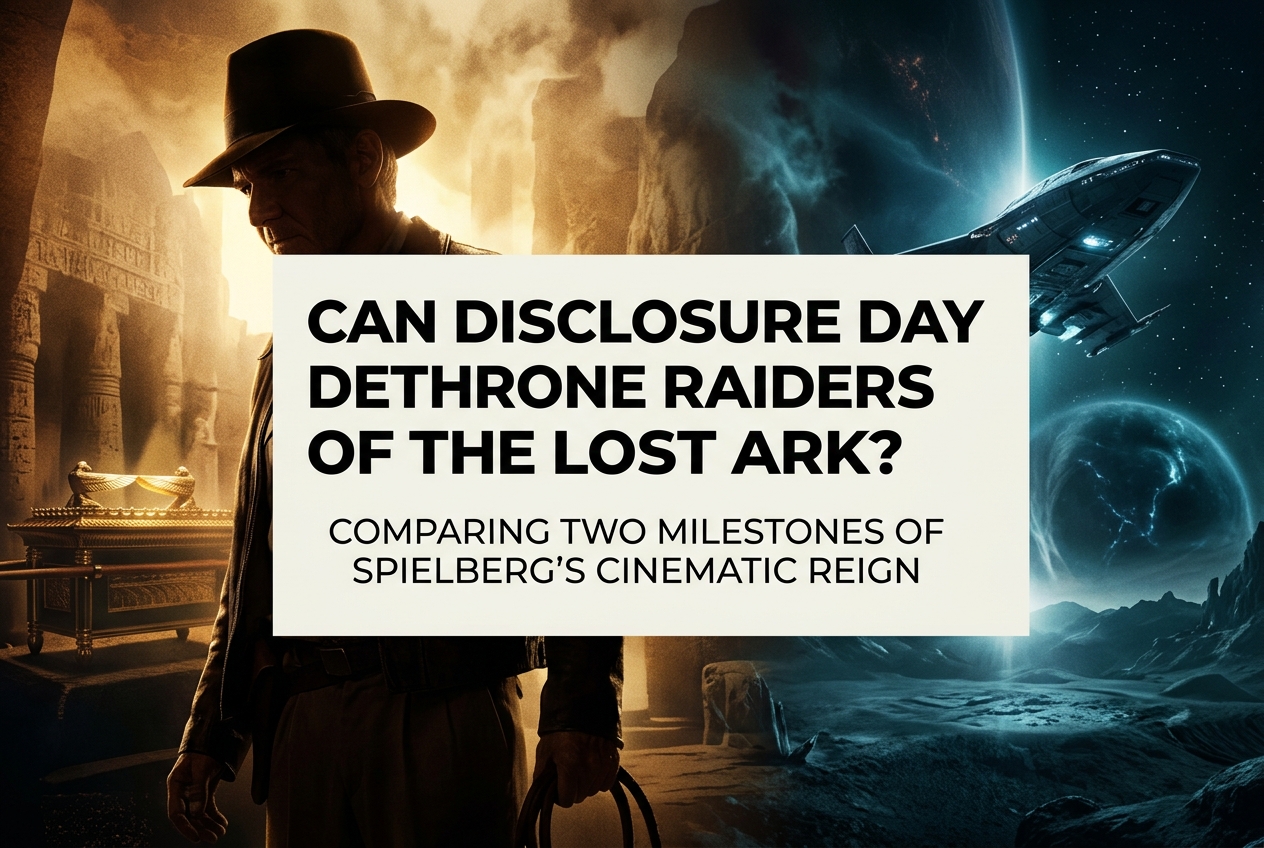
Steven Spielberg’s Disclosure Day opened to $44 million domestically and $93 million worldwide, earning his best original-film debut ever. Critics call it his best in 20 years, but the consensus is clear: Raiders of the Lost Ark remains untouchable.
Steven Spielberg’s Disclosure Day opened at number one with $44 million domestically and approximately $93 million worldwide over its June 12-14, 2026 debut weekend, marking the 79-year-old director’s best opening weekend for an original film in his entire career. The UFO thriller starring Emily Blunt has drawn widespread critical praise, with Rotten Tomatoes showing an 81% critics score and 75% audience rating. Yet almost every positive review circles back to the same benchmark: 1981’s Raiders of the Lost Ark. And almost every comparison ends with the same conclusion: the throne still belongs to Indiana Jones.
What Is Disclosure Day About?
Disclosure Day follows a Kansas City meteorologist named Margaret (Emily Blunt) who gets pulled into a massive government conspiracy to suppress 78 years of evidence proving extraterrestrial contact with Earth. The script, written by longtime Spielberg collaborator David Koepp (Jurassic Park, War of the Worlds), imagines that aliens never left after the events of Spielberg’s 1977 classic Close Encounters of the Third Kind. Spielberg himself has described the new film as a “bookend” to that earlier work.
The cast also features Josh O’Connor as a truth-seeking tech expert, Colin Firth as a sinister government enforcer, Eve Hewson, and Colman Domingo. Running at 2 hours and 25 minutes, the film had its world premiere on June 2 at Le Grand Rex in Paris before rolling out across theatres worldwide. Spielberg, who conceived the original story, told reporters at SXSW that he has “very strong suspicions that we are not alone on Earth right now” and made the film with that conviction in mind.
How Are Critics Responding?
The critical response has been largely enthusiastic but not unanimous. Rotten Tomatoes currently shows an 81% critics score from over 150 reviews. The Hollywood Reporter’s David Rooney praised the film’s “breathless action sequences” and called Emily Blunt “simply breathtaking and never more magnetic.” Inverse’s Hoai-Tran Bui described it as “the most energized filmmaking Spielberg has done in decades.” Multiple critics, including Gizmodo’s Germain Lussier, called it Spielberg’s best film in 20 years.
Not everyone agreed. Variety’s Owen Gleiberman wrote that “Disclosure Day never gives you the contact high of awe that Close Encounters did,” calling it “too cut-and-dried about what it believes.” Slant Magazine’s Eli Friedberg found the drama “convoluted and schematic,” while NPR’s review noted that “sentimentality does ultimately overshadow Disclosure Day, particularly in the climactic finale.” The consensus from RogerEbert.com’s Brian Tallerico lands in the middle: the final scenes are “among the most emotionally riveting of Spielberg’s career,” but the script “sometimes trips over itself trying to explain it all.”
Emily Blunt Delivers a Career-Defining Performance
If there is one point of near-universal agreement, it is Emily Blunt’s performance. Rotten Tomatoes’ review roundup calls it potentially “the best performance of her career.” Next Best Picture’s Matt Neglia wrote that “Disclosure Day belongs entirely to Emily Blunt.” Consequence’s Liz Shannon Miller noted she is “the movie’s MVP, navigating the hairpin turns required of her character’s journey with an ease that could be overlooked.” Even more tempered reviews, such as Polygon’s Jacob Kleinman, co-signed the “rapturous Emily Blunt praise.”
Josh O’Connor and Colin Firth also drew strong notices, with Deadline’s Pete Hammond saying O’Connor “matches Blunt beat for beat” and Inverse’s Bui calling Firth “the real standout as the deliciously sinister embodiment of shadowy federal authority.”
John Williams at 94: A Landmark 30th Spielberg Score
One of the most remarkable stories behind Disclosure Day is its score. John Williams, now 94 years old and seen publicly only in a wheelchair, composed, orchestrated, and largely conducted the film’s music across seven recording sessions spanning six months. An orchestra of 96 players was assembled at Sony Pictures Studios, with the final session taking place on February 20, 2026. Williams recorded over two hours and 20 minutes of music; the final film contains 82 minutes of score.
This marks Williams’ 30th collaboration with Spielberg, a partnership stretching back to The Sugarland Express in 1974. What makes this score unusual is its restraint. Rather than sweeping, theme-first orchestration, Williams opted for atmospheric tension, sparse arrangements, and slow-building suspense. The track titles reflect this: lowercase, ellipsis-punctuated fragments like “listen…”, “memory…”, and “empathy…” Spielberg has already spoken to Williams about a 31st film together.
Why Raiders of the Lost Ark Still Sits on Top
Raiders of the Lost Ark was released in 1981 on a $22 million budget and earned over $200 million at the box office in its initial run. It holds a 93-94% critics score and a 96% audience score on Rotten Tomatoes, along with an 8.4/10 on IMDb from over 1.1 million votes. Rotten Tomatoes’ critical consensus describes it as “one of the most consummately entertaining adventure pictures of all time.”
In June 2026, the Boston Globe published a comprehensive ranking of all Spielberg films and placed Raiders at number one. The critic wrote: “When I interviewed Karen Allen, I told her that Raiders was the best time I have ever had in a movie theater. Forty-five years later, my opinion hasn’t changed.” Forbes has called it a film that “set a new benchmark for the action-adventure genre,” while its influence on everything from the Marvel Cinematic Universe to modern blockbuster pacing has been widely documented.
Disclosure Day vs. Raiders: The Numbers Tell the Story
| Category | Raiders of the Lost Ark (1981) | Disclosure Day (2026) |
|---|---|---|
| Rotten Tomatoes (Critics) | 93-94% | 81% |
| Rotten Tomatoes (Audience) | 96% | 75% |
| IMDb | 8.4/10 | TBD (new release) |
| Budget | $22 million | $115 million |
| Opening Weekend (Domestic) | N/A (different era) | $44 million |
| Worldwide Opening | N/A | ~$93 million |
| John Williams Score | Iconic, theme-driven | Restrained, atmospheric |
The comparison underscores the gap. Even reviewers who championed Disclosure Day framed their praise in Raiders’ shadow. IndieWire’s Jim Hemphill called Disclosure Day “as exhilarating as Raiders but with the emotional texture of his post-9/11 work.” That framing is telling: Raiders remains the yardstick against which Spielberg measures himself, and against which the world measures Spielberg.
What Makes Raiders Untouchable After 45 Years?
Part of the answer lies in what Raiders created rather than what it is. Before Indiana Jones, the idea of a globe-trotting archaeologist-action-hero did not exist as a genre template. Spielberg and George Lucas built the blueprint for modern blockbuster adventure, combining practical stunts, John Williams’ triumphant brass themes, Harrison Ford’s effortless charisma, and a pace that never relented across 115 minutes. The film earned six Academy Award nominations and won four technical Oscars.
Raiders also benefits from a cultural permanence that newer films struggle to replicate. Its iconic sequences (the boulder chase, the Cairo swordfight, the Ark opening) have been referenced, parodied, and studied for over four decades. As Far Out Magazine wrote, it “packs the exact same punch whether it’s being watched for the first, fifth, tenth, or fiftieth time.” That kind of rewatchability is almost impossible to manufacture in an era of streaming saturation and shorter attention spans.
Box Office Context: Spielberg’s Best Original Opening Ever
Disclosure Day’s $44 million domestic opening surpassed Ready Player One’s $41.8 million debut in 2018, making it Spielberg’s strongest opening for an original (non-franchise) film. His overall best opening weekend remains Indiana Jones and the Kingdom of the Crystal Skull, which cleared $100 million over Memorial Day weekend in 2008. Internationally, the UK ($7.8 million), Mexico ($5.4 million), France ($4.9 million), and Germany ($4.1 million) were the top-performing markets, with China still pending a June 27 release.
Box Office Watch projects a domestic total between $115 million and $125 million for Disclosure Day, with a wider range of $91-149 million depending on legs. For context, Spielberg’s recent films have varied widely: The Fabelmans (2022) earned $45 million worldwide total, while West Side Story (2021) managed $76 million globally. A final tally north of $200 million worldwide would mark a significant commercial rebound for the director.
What Does Disclosure Day Mean for Spielberg’s Legacy?
At 79, Spielberg is proving that he can still command a summer blockbuster opening, attract A-list talent, and coax a 94-year-old composer out of semi-retirement. NPR’s review put it well: “At 79, Spielberg remains the agile director who revels in treating cinema as a form of magic.” The Deadline review called the film’s car-to-train chase “a new action highlight in the Spielberg canon.”
Yet the film’s mixed audience reception (75% on Rotten Tomatoes, with a 61% “definite recommend” rate on PostTrak) suggests that Disclosure Day may not achieve the universal, generation-spanning adoration that defines Spielberg’s best work. It is, by most accounts, a very good film from cinema’s greatest living director. But very good is not Raiders of the Lost Ark. That throne, 45 years on, remains unshaken.
The Bigger Picture: Why This Comparison Matters for Film Fans
The conversation around Disclosure Day and Raiders of the Lost Ark is ultimately about what we expect from legacy filmmakers. Spielberg has made deeply personal films (The Fabelmans), historical dramas (Schindler’s List, Lincoln), and genre experiments throughout his career. Each time he returns to science fiction or adventure, the comparisons to his 1970s-1980s peak are inevitable.
What Disclosure Day proves is that Spielberg can still deliver visceral, crowd-pleasing cinema while tackling mature themes like government secrecy, empathy, and humanity’s response to the unknown. What Raiders of the Lost Ark continues to prove is that some films transcend their era so completely that even their own creator cannot surpass them. For gamers and film fans who grew up on Indiana Jones references in everything from Uncharted to Tomb Raider, that legacy is not just cinematic history: it is the DNA of modern adventure storytelling.