Electronic Arts has launched EA Advertising, a dedicated platform embedding real-world brands into gameplay across EA Sports FC, Madden NFL, and more. With a proprietary Frostbite-based ad server, CPM pricing from $1 to $10, and launch partners including Visa and Red Bull, here’s everything players need to know about the new era of in-game advertising.
Electronic Arts officially launched EA Advertising on June 15, 2026, a dedicated platform designed to place real-world brands directly into its games. With over 120 million monthly active players across its portfolio and $7.5 billion in net revenue for fiscal year 2026, EA is now opening its massive ecosystem to dynamic, measurable brand integrations at scale. The move marks a significant shift from one-off sponsorship deals to a centralized advertising infrastructure.
How EA Advertising Actually Works
EA Advertising operates across three core pillars: in-game integration, in-game media, and real-world experiences. In-game integration covers custom vanity kits, Ultimate Team packs, branded challenges, live events, and even clothing and furniture drops in The Sims. In-game media includes sponsored replays, branded broadcast overlays, and video spots within the broadcast layer of sports titles. The real-world pillar extends to co-branded physical events and activations tied to EA franchises.
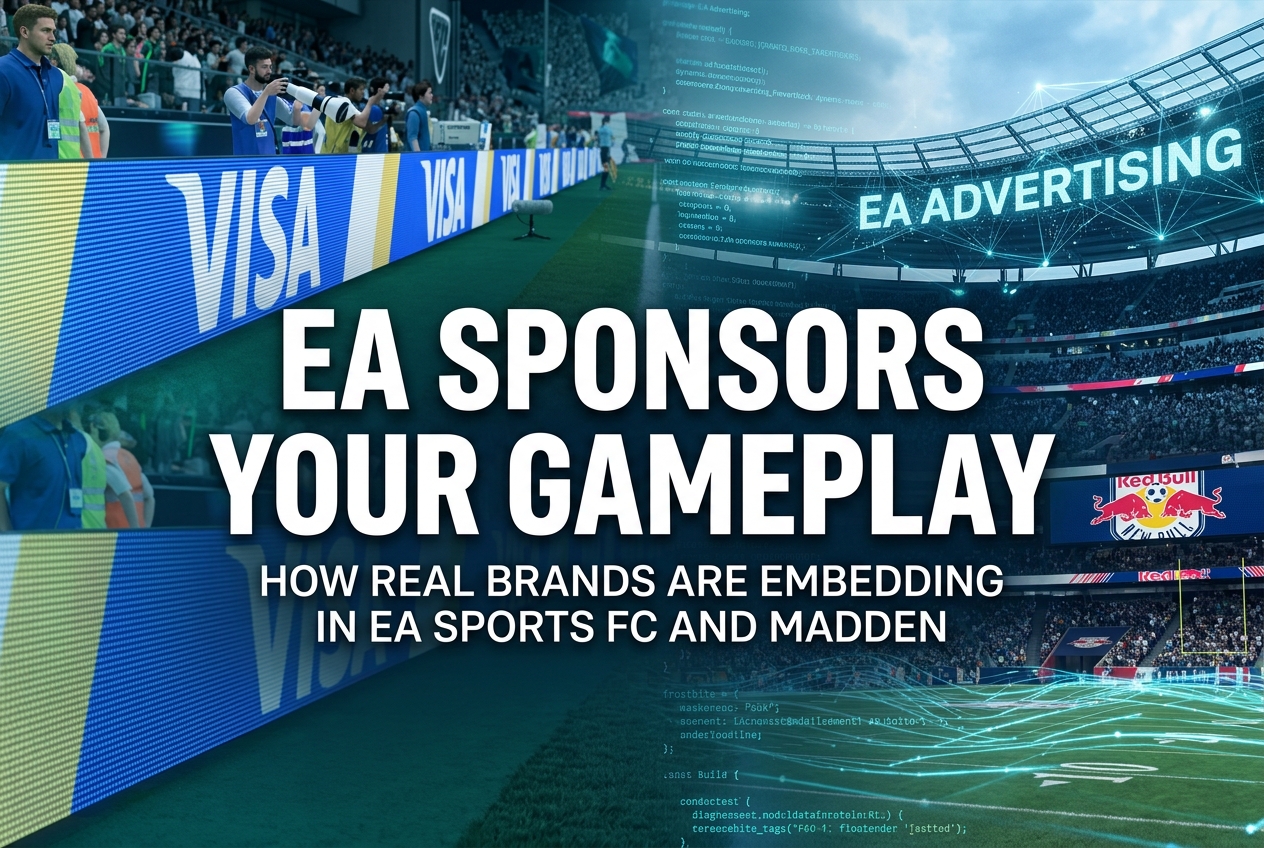
The technical backbone is entirely new. EA built a proprietary ad server and SDK specifically for its Frostbite engine, enabling dynamic, real-time ad placement within 3D game environments. These include digital ad boards, scoreboards, and broadcast-style overlays in sports simulations. Impression measurement is aligned with IAB (Interactive Advertising Bureau) standards, and viewability verification is handled through a partnership with Integral Ad Science. Advertisers can also use LiveRamp’s identity cohorts matched against EA’s first-party ID, which persists across multiple consoles.
Which Games and Brands Are Involved?
At launch, EA Advertising is heavily focused on the company’s sports lineup: EA Sports FC, Madden NFL, EA Sports College Football, and NHL. However, the platform’s official page also highlights skate. and The Sims as available franchises for brand integration. Previous collaborations already demonstrated this range: Coach brought its handbag line into The Sims 4, and Vans integrated exclusive shoes into skate. as a founding sponsor.
The launch partner roster is already substantial:
- Visa: Partnered across EA Sports FC and College Football for immersive in-game and beyond-the-game experiences.
- Lowe’s: Integrated into FC, Madden NFL, and College Football through Ultimate Team challenges and branded player content, generating over 987,000 games played and 200,000 challenges completed.
- Red Bull: Drove 128 million matches played and 1.2 million objectives completed through branded in-game goals, team kits, and athlete ambassador collaborations in EA Sports FC.
- Mountain Dew: Created “DEW University,” a fully playable team experience in College Football 26 with a custom stadium, mascot, and reward ecosystem.
- Xfinity and Peacock: Activated through dynamic in-stadium integrations, broadcast-style placements, custom vanity kits, and Ultimate Team Packs in EA Sports FC 26.
What Does It Cost Advertisers?
According to Adweek’s reporting, EA Advertising’s dynamic media inventory is available on a CPM basis, with prices ranging from $1 to $10 depending on the title and placement type. This positions EA competitively within the broader gaming and entertainment advertising CPM range, which typically sits between $5 and $10 across digital platforms. For comparison, Meta’s average CPM in 2026 runs between $8 and $15, while programmatic display averages $1 to $4.
Beyond CPM-based buys, brands can access the EA Sports Partner Program, which offers three tiers: Premier (deep global strategic collaboration), Experience (multi-title integrations for established brands), and Franchise (partnerships around specific game series and fan communities). These packages extend well beyond standard digital ads into live events, creator tools, social play experiences, and athlete-driven cultural initiatives.
The Bigger Picture: How Large Is the In-Game Ad Market?
EA’s move fits into a rapidly expanding global market. Research estimates for the in-game advertising market in 2025 range from approximately $9 billion to $12 billion, with projected annual growth rates between 10% and 13%. By the early 2030s, the market could exceed $20 billion. Static in-game display ads still account for roughly 43% of the market, but rewarded and interactive formats are growing fastest. Studies indicate that 74% of mobile gamers are willing to watch video ads in exchange for in-game rewards, and contextual ad placements reduce negative player perception by approximately 38%.
The in-game advertising space has also seen recent infrastructure moves from other players. Anzu launched click-enabled intrinsic in-game ad formats in February 2026, while Unity reported 26.7% year-over-year growth in in-app ad revenue during 2024. EA’s entry with a first-party ad server built into its own engine represents one of the most significant publisher-side investments in the category.
How Are Players Reacting?
Player reaction has been divided. EA’s history with in-game ads includes the widely criticized UFC 4 incident in 2020, when full-screen ads for Amazon’s “The Boys” appeared mid-gameplay and were quickly removed after backlash. That history makes the gaming community cautious about any expansion of advertising within premium-priced titles.
The core concern is precedent: if stadium signage and broadcast overlays are accepted today, could interstitial video ads or forced viewing follow tomorrow? Some community voices have also raised concerns about gambling-adjacent advertising potentially appearing on in-game billboards, especially given the existing microtransaction ecosystem in Ultimate Team modes.
On the other side, contextual ads in sports games have a logical foundation. Real-world football matches, NFL games, and hockey arenas are covered in brand signage. Placing those same brands inside sports simulations arguably enhances realism rather than disrupting it. Nielsen research has previously shown that in-game advertising can boost household spending on advertised brands by up to 24%, and roughly 50% of players view contextual in-game ads as contributing to realism.
What Other Publishers Are Doing Differently
EA is not acting in a vacuum. Take-Two Interactive CEO Strauss Zelnick has stated that interstitial ads in premium games would be “unfair,” though he acknowledged that contextual stadium ads in NBA 2K and WWE 2K are appropriate because they mirror real-world environments. Valve has taken a harder line, banning games from Steam that force players to watch ads or interact with advertisements to continue playing.
Meanwhile, Xbox’s strategy chief Matthew Ball has clarified that he personally considers in-game ads disruptive to the player experience, pushing back against reports linking Xbox to in-game advertising plans. The industry appears split between publishers who see advertising as a natural extension of live-service ecosystems and those who view it as incompatible with premium game pricing.
Will Ads Spread Beyond Sports Games?
EA has not confirmed plans to extend EA Advertising’s dynamic ad inventory beyond its sports titles. However, the platform’s official page already lists skate. and The Sims alongside the sports franchises. IGN noted that “there’s nothing to say that similar activity couldn’t eventually bleed elsewhere,” pointing to The Sims’ recent Bridgerton crossover with Netflix as a precedent for brand integration in non-sports titles. Whether games like Apex Legends, Battlefield, or Dragon Age would ever receive advertising placements remains an open question.
Can Players Opt Out?
EA has not disclosed whether players will have any option to disable or reduce ad placements. This is one of the most frequently raised questions in community discussions. The company has also not detailed how player feedback will shape future placement decisions or whether ad frequency caps will apply. For now, the messaging focuses on ads being “designed to enhance, not disrupt, the player experience,” a framing that many players view with skepticism given the company’s microtransaction-heavy monetization history.
Things Worth Knowing About EA’s Ad Platform
Does this affect EA Sports FC gameplay?
The dynamic ad placements in EA Sports FC appear within stadium environments and broadcast layers. They function similarly to how real match broadcasts display sponsor signage. Branded challenges and objectives offer additional gameplay content tied to partner brands, with rewards like exclusive kits or Ultimate Team items.
Is the Frostbite ad server live now?
Yes. EA’s press release confirms that the proprietary ad server and SDK are operational, with initial targeting available by geography and campaign flight date. Several launch partners are already active in EA Sports FC 26 and College Football 26.
How does EA measure ad performance?
EA uses IAB-standard impression measurement within its 3D game environments and partners with Integral Ad Science for viewability and invalid traffic verification. Advertisers can also leverage LiveRamp identity matching for cross-platform audience targeting.
Will this make games cheaper?
EA has not indicated that advertising revenue will reduce game prices. The company’s sports titles remain full-price releases with existing microtransaction systems. The advertising platform represents an additional revenue stream rather than a replacement for current monetization.
How does this compare to ads in free-to-play games?
Unlike free-to-play models where ads fund the game itself, EA Advertising operates within premium-priced titles that already generate revenue through game sales and in-game purchases. This distinction is central to the community debate around the platform’s fairness.
The launch of EA Advertising represents one of the most significant structural changes in how major publishers approach brand monetization within AAA games. Whether it enhances the sports simulation experience with authentic brand presence or crosses a line into over-commercialization will largely depend on how aggressively EA scales its ad inventory in the months ahead.