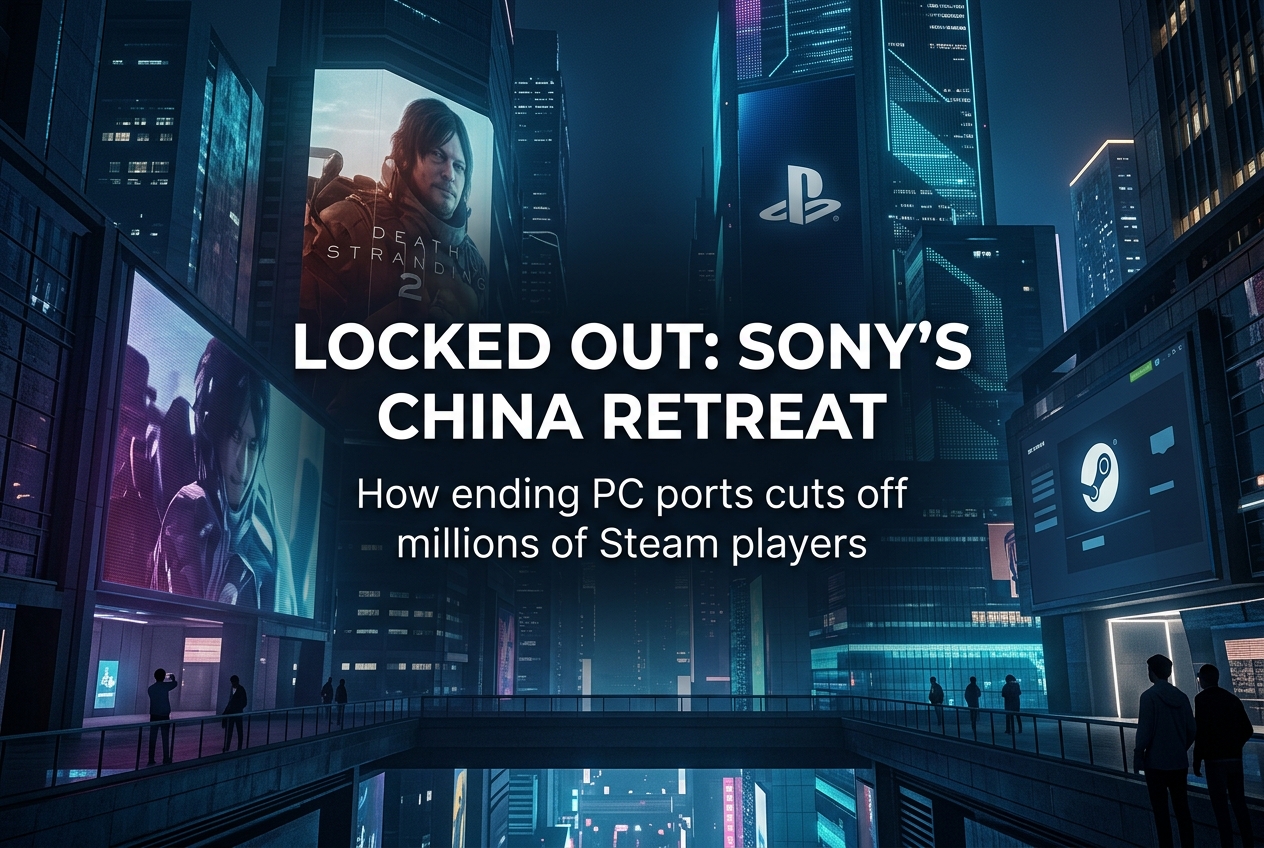
Sony’s decision to end first-party single-player PC ports doesn’t just affect Western PC gamers. It also cuts off millions of Chinese players who rely on Steam as their primary gateway to PlayStation titles.
Sony Interactive Entertainment has officially ended PC ports for its first-party single-player games. PlayStation Studios CEO Hermen Hulst confirmed the decision during an internal town hall on May 19, 2026, telling staff that narrative single-player titles will remain PlayStation exclusives going forward. While the impact on Western PC gamers has dominated headlines, a less-discussed consequence is arguably more damaging: Sony is simultaneously abandoning its most effective route into the Chinese gaming market.
What Exactly Did Sony Decide?
The shift became public in stages. Bloomberg reporter Jason Schreier first indicated in February 2026 that Sony was reconsidering its PC port strategy. In March 2026, he confirmed that Ghost of Yotei’s PC version, which was reportedly “extremely far along,” had been scrapped entirely. Housemarque’s Saros and Insomniac’s Marvel’s Wolverine (launching September 15, 2026, exclusively on PS5) are also affected. Death Stranding 2: On the Beach, which launched on Steam on March 19, 2026, is expected to be the last major Sony single-player title to reach PC for the foreseeable future.
Sony is not leaving PC entirely. Live-service multiplayer titles like Marathon and Marvel Tokon: Fighting Souls (arriving August 6, 2026 on PS5 and PC) will continue to launch across platforms. Third-party published titles such as Kena: Scars of Kosmora will also reach PC. The wall applies specifically to first-party narrative single-player blockbusters: the God of War, Spider-Man, and Horizon lineage.
Why Did Sony Reverse Course?
Sony’s PC strategy generated an estimated $1.2 billion in net revenue from 43 million cumulative Steam sales since 2020. Those are not trivial numbers. However, internal analysis revealed declining returns. According to Alinea Analytics, sequel ports sold less than half of what their predecessors managed on Steam during identical timeframes. Spider-Man 2 was widely criticised as Sony’s worst PC port, damaging trust among PC players.
Five PlayStation titles ported to PC in 2025 underperformed expectations, with most failing to sell over a million copies. Sony leadership concluded that the availability of exclusives on PC was devaluing PS5 hardware and eroding the “must-have” appeal of the console ecosystem. The company wants players back inside its walled garden, where it captures 100% of digital sales revenue and can push PlayStation Plus subscriptions.
Is Valve’s Steam Machine the Real Catalyst?
Multiple industry figures, including former Blizzard president Mike Ybarra, believe the Steam Machine is the primary reason Sony pulled back. Valve’s compact living room console, announced in November 2025 and launched in 2026, runs SteamOS and claims performance levels comparable to or exceeding the PS5. It gives players direct access to their existing Steam libraries on a television, functioning as a console-like PC without a Windows licence.
For Sony, the calculus shifted dramatically. If PlayStation exclusives are available on Steam, and Steam now runs on a dedicated console-format device, then buying a PS5 becomes optional rather than essential. Sony appears to view Valve, not Microsoft, as the more immediate competitive threat.
Why Does This Hit China So Hard?
China banned the sale of home gaming consoles from 2000 to 2015. During those 15 years, an entire generation of Chinese gamers grew up on PC. Internet cafes proliferated, Steam established deep roots, and console culture never took hold the way it did in Japan, Europe, or North America. Even after the ban was lifted, strict censorship regulations and regional PSN restrictions have kept official PS5 penetration in China relatively low, with estimates suggesting Sony sells around 670,000 PS5 units per year in the region.
Steam, by contrast, is massive in China. According to the latest Steam hardware survey, 21.85% of Steam users have their language set to Simplified Chinese, making it the second most popular language on the platform. English leads at 39.48%, and no other language breaks single digits. Conservative estimates place the number of Chinese Steam users above 30 million.
The Numbers That Make Sony’s Decision Look Costly
Alinea Analytics’ data reveals just how central China has become to PlayStation’s PC performance. A full 42% of Death Stranding 2’s Steam sales came from China, making it the game’s largest single Steam market. The title sold at the equivalent of $44 in the region, 37% below the US price due to Steam’s regional pricing.
Stellar Blade’s numbers are even more striking. Over 55% of its Steam players were based in China, and Sensor Tower data shows the game sold approximately 2.4 million copies on Steam for over $100 million in revenue, ranking first in both sales and revenue among hack-and-slash titles on the platform. On launch day alone, Stellar Blade moved 544,000 Steam copies.
China is, for practical purposes, the engine behind PlayStation’s most successful PC ports. By pulling away from Steam, Sony is voluntarily walking away from the single storefront that opens the Chinese market to its games.
Do PC Ports Actually Hurt Console Sales?
This is perhaps the most uncomfortable finding for Sony’s new strategy. Alinea Analytics’ data consistently shows that PC launches boost console sales rather than cannibalising them. Death Stranding 2 experienced its best two-week sales stretch on PS5 after the Steam version launched. The same PlayStation Store discount had been applied twice before with notably weaker results, suggesting the cross-platform buzz generated real incremental demand.
Stellar Blade’s case is cleaner still. When its PC version launched, the PS5 edition was not discounted at all, yet daily active users on PlayStation spiked six times over the previous day, hitting a new all-time high. PC launches drive streaming, social media discussion, and word of mouth that feeds back into console purchase decisions.
Shift Up’s Departure Signals Developer Pushback
One of the most telling reactions to Sony’s strategy shift comes from Shift Up, the Korean studio behind Stellar Blade. The developer announced it will self-publish Stellar Blade 2 rather than continue its publishing partnership with Sony. In an earnings Q&A, Shift Up stated it is “formulating an optimal go-to-market strategy designed to maximize sales and reach a broad global audience from day one.” Analysts widely interpret “broad global audience” as a reference to the Chinese market specifically. Stellar Blade 2 is expected to launch simultaneously on PS5 and PC.
This decision underscores a risk for Sony: studios that have tasted success in China through Steam may choose independence over PlayStation exclusivity, further weakening Sony’s first-party and second-party pipeline.
Which Games Are Affected?
| Title | PC Status | Notes |
|---|---|---|
| Ghost of Yotei | Cancelled | PC port was “extremely far along” before being scrapped |
| Marvel’s Wolverine | No plans | PS5 exclusive, September 15, 2026 |
| Saros | Cancelled | Housemarque’s title stays PS5-only |
| Intergalactic: The Heretic Prophet | No plans | PS5 exclusive |
| Death Stranding 2 | Available on Steam | Launched March 19, 2026; likely the last major single-player port |
| Kena: Scars of Kosmora | Coming to PC | Third-party; contractual obligation |
| Marathon | Coming to PC | Live-service multiplayer; exempt from the policy |
| Marvel Tokon: Fighting Souls | Coming to PC | Multiplayer; PS5 and PC on August 6, 2026 |
What Does This Mean for Competitors?
Sony’s retreat creates a significant opening for Microsoft and Valve in regions with low console adoption. Xbox’s hybrid PC-console strategy and Game Pass model are well-positioned to absorb players who relied on Steam ports to access PlayStation content. Valve’s Steam Machine directly competes for living room gamers who might otherwise have purchased a PS5. In China specifically, where PC dominates and console penetration remains marginal, Sony risks losing brand visibility entirely for its prestige IPs.
Things Worth Knowing
Will games already on Steam be removed?
No. Titles like God of War, Spider-Man, and Ghost of Tsushima that are already available on Steam will remain purchasable and playable. Sony has given no indication of delisting existing ports.
Is Sony leaving PC completely?
Not entirely. Live-service and multiplayer titles will continue to launch on PC. The policy targets first-party narrative single-player games specifically.
Could Sony reverse this decision again?
It is possible but unlikely in the near term. Hermen Hulst confirmed the strategy internally, and the Ghost of Yotei PC port was cancelled despite being nearly complete. This suggests a firm commitment from leadership.
Does this affect PS5 game prices?
Not directly. However, without PC competition and regional pricing, players in price-sensitive markets lose access to more affordable Steam pricing for these titles.
Sony is making a calculated bet that protecting its console ecosystem is worth more than the revenue and visibility it gained from PC. The data, however, tells a more complicated story. PC ports drove console sales upward, opened the world’s second-largest Steam market, and attracted developers like Shift Up who now plan to go independent. Whether this gamble pays off or quietly erodes PlayStation’s global relevance will become clear over the next several years.