
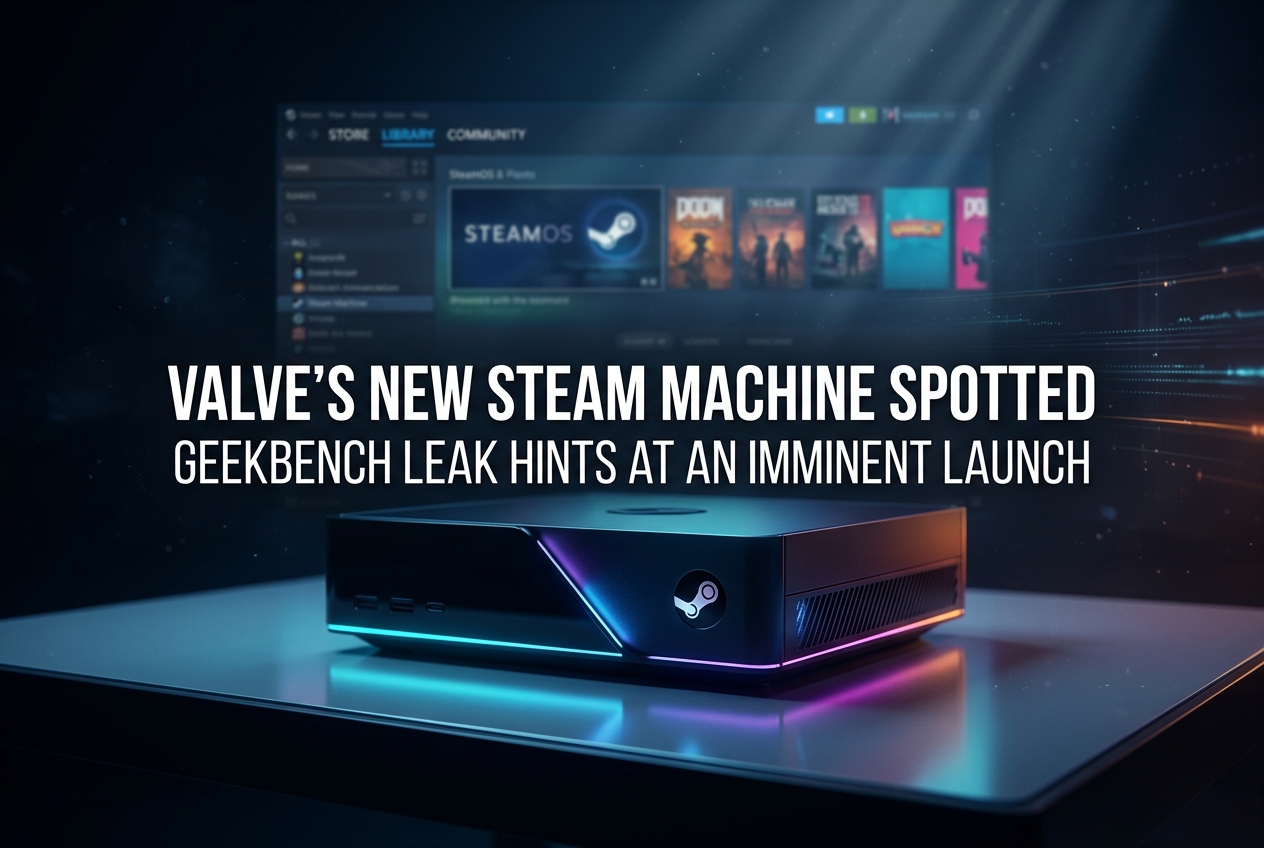
Valve’s upcoming Steam Machine console surfaced on Geekbench on June 15, running SteamOS for the first time. The AMD Zen 4 benchmark scores and timing strongly suggest review units are in the hands of media, pointing to an imminent launch.
Valve’s Steam Machine, codenamed Fremont, appeared in the Geekbench 6.7.1 database on June 15, 2026, with two fresh benchmark entries running SteamOS instead of Windows. This marks the first time the device has been tested under its final consumer operating system, strongly suggesting that review units have reached media outlets and a public launch is very close.
What Do the Benchmark Scores Show?
The two new Geekbench entries for “Valve Fremont” posted single-core scores of 2,334 and 2,282 points, alongside multi-core scores of 7,316 and 7,392 points. These figures are closely aligned with the Windows-based results that first leaked in August 2025, where the device scored 2,412 single-core and 7,451 multi-core. The slight dip falls within Geekbench’s normal margin of error and confirms that SteamOS delivers CPU performance on par with Windows.
For context, the Steam Deck OLED scores roughly 1,353 in single-core and 4,573 in multi-core on Geekbench. The Steam Machine nearly doubles those numbers, validating Valve’s claim that the new console is around six times more powerful than the Steam Deck overall.
Why Does SteamOS Testing Matter?
The critical detail in this leak is the operating system. Previous Geekbench entries from August 2025 ran on Windows 11, which indicated early prototype testing. The shift to SteamOS signals that the hardware has moved past development into its final software environment, the one consumers will actually use.
This timing coincides with Valve’s release of SteamOS 3.8.9 Beta, which contained device-specific support codes for next-generation hardware. The earlier SteamOS 3.8.0 update had already introduced initial Steam Machine support, along with HDR, VRR, and multi-monitor scaling features aimed at living-room setups.
AMD Custom CPU 1772: Processor Breakdown
The Geekbench listing identifies the processor as “AMD Custom CPU 1772,” a semi-custom chip built on AMD’s Zen 4 architecture. The confirmed specifications include:
- Cores/Threads: 6 cores, 12 threads
- L3 cache: 16 MB
- Clock speed: Up to 4.86 GHz under load
- Estimated TDP: 30W
A 30W power draw for this level of CPU throughput is impressive and explains how Valve can keep the compact cube form factor quiet. In single-core performance, the chip trades blows with the PlayStation 5’s Zen 2 processor, though it falls behind desktop Ryzen 5 7600-class chips in multi-threaded workloads due to having six rather than six full-power desktop cores at higher wattages.
Full Steam Machine Hardware Specifications
| Component | Details |
|---|---|
| CPU | Semi-custom AMD Zen 4, 6 cores / 12 threads, up to 4.8 GHz |
| GPU | Semi-custom AMD RDNA 3, 28 CUs, 8 GB GDDR6 VRAM |
| System RAM | 16 GB DDR5 (SO-DIMM, user-upgradeable) |
| Storage | 512 GB or 2 TB NVMe SSD + microSD expansion |
| Operating System | SteamOS 3 (Arch Linux-based) |
| Connectivity | HDMI 2.0, DisplayPort 1.4, Gigabit Ethernet, USB-C, 4x USB-A, Wi-Fi 6E, Bluetooth 5.3 |
| Dimensions | 156 x 152 x 162.4 mm |
| Weight | 2.6 kg |
| Power | Internal PSU (~200W system) |
On the GPU side, the 28-compute-unit RDNA 3 chip performs close to a Radeon RX 7600, with an estimated 8.8 TFLOPS of compute power. Valve claims the Steam Machine can handle every game on Steam at 4K resolution and 60 frames per second when using AMD FSR upscaling. Native 4K performance will vary by title, with 1080p and 1440p being the most consistent targets without upscaling.
Are Review Units Already Out?
Multiple independent sources point to review units being distributed. The Geekbench entries were first spotted by user Olrak29_ on X, and the fact that two separate tests were uploaded in quick succession on June 15 aligns with typical reviewer benchmark workflows. GamesRadar’s Hardware Editor Phil Hayton noted that someone is clearly testing the device for review, as journalists typically run benchmarks well before embargo lifts to account for re-runs and technical issues.
According to the unofficial Steam Hardware Updates account on X, review kits reportedly include the Steam Machine itself, a Steam Controller, and two mounting brackets, with interchangeable faceplates shipped separately. The same source claims the review embargo may lift after June 23, with pricing and reservation announcements expected between June 22 and June 30. NotebookCheck confirmed similar timelines based on leaked logistics data showing hardware shipments arriving in the United States.
Price Expectations and Launch Window
Valve has not confirmed a final price or exact release date. The company initially targeted early 2026 but later widened the window to the first half of 2026 following supply chain delays related to memory component costs. Current leaks and the Geekbench timing make a late June or early July launch the most probable scenario.
Pricing remains the biggest unknown. Analyst predictions range widely. Some estimate $700 to $900 for the base 512 GB model, while placeholder prices found in Czech retailer databases (Smarty.cz and Alza) suggested approximately $950 for the 512 GB variant and $1,070 for the 2 TB model. These figures are widely believed to be retailer estimates with markup rather than Valve’s actual MSRP. Community consensus leans toward a $799 starting price for the base unit, though nothing is confirmed.
How Does It Compare to Current Consoles?
| Spec | Steam Deck OLED | Steam Machine (2026) | PlayStation 5 |
|---|---|---|---|
| CPU | Zen 2, 4C/8T, 2.8 GHz | Zen 4, 6C/12T, 4.8 GHz | Zen 2, 8C/16T, 3.5 GHz |
| GPU | RDNA 2 (integrated) | RDNA 3, 28 CUs (discrete) | RDNA 2, 36 CUs |
| VRAM | Shared | 8 GB GDDR6 | 16 GB GDDR6 (unified) |
| System RAM | 16 GB LPDDR5 | 16 GB DDR5 | Included in unified pool |
| Geekbench SC | ~1,353 | ~2,334 | ~2,300 (estimated) |
| Target resolution | 1280×800 | 4K (via FSR) | 4K native |
| Storage | Up to 1 TB | 512 GB / 2 TB | 825 GB / 1 TB (Pro) |
The Steam Machine’s single-core CPU performance matches or slightly edges out the PS5 in synthetic benchmarks. However, the PS5 has more CPU cores (8 vs 6) and more compute units on its GPU (36 vs 28). The Steam Machine’s real advantage lies in the full Steam library, SteamOS flexibility, the ability to install Windows, and PC-grade customisation options including upgradeable storage and RAM.
What Players Are Asking
Will every Steam game work on the Steam Machine?
Valve has confirmed that any game carrying the Steam Deck Verified badge will automatically be Steam Machine Verified. SteamOS uses the Proton compatibility layer to run Windows games on Linux, and compatibility has improved dramatically since 2024. However, some multiplayer titles with kernel-level anti-cheat may still have issues. The vast majority of the Steam catalogue should run without intervention.
Can you install Windows on the Steam Machine?
Yes. The Steam Machine is a full PC, and Valve explicitly supports installing alternative operating systems. This means access to Xbox Game Pass, Epic Games Store, and any other Windows-exclusive software. However, SteamOS-specific features like fast suspend/resume are lost when running Windows.
Is the GPU powerful enough for real 4K gaming?
At native 4K without upscaling, the 28-CU RDNA 3 GPU will struggle with demanding AAA titles at high settings. Valve’s 4K/60 FPS claim relies on AMD FSR upscaling, which renders at a lower internal resolution and reconstructs the image. For 1080p and 1440p gaming, the GPU should deliver a smooth experience across most modern titles. FSR 4 support is also expected to arrive on RDNA 3 hardware, which could further improve image quality.
When can I pre-order?
No official reservation date has been announced. Leaked information suggests Valve may open hardware reservations between June 22 and June 30, 2026, using a similar reservation queue system to the Steam Deck. Eligibility may require a Steam account in good standing with at least one purchase made before April 2026.
The Steam Machine represents Valve’s most ambitious hardware push since the Steam Deck, combining a compact living-room form factor with genuine PC flexibility. With Geekbench results now confirming stable SteamOS performance and review units reportedly in the wild, the wait appears to be nearly over.