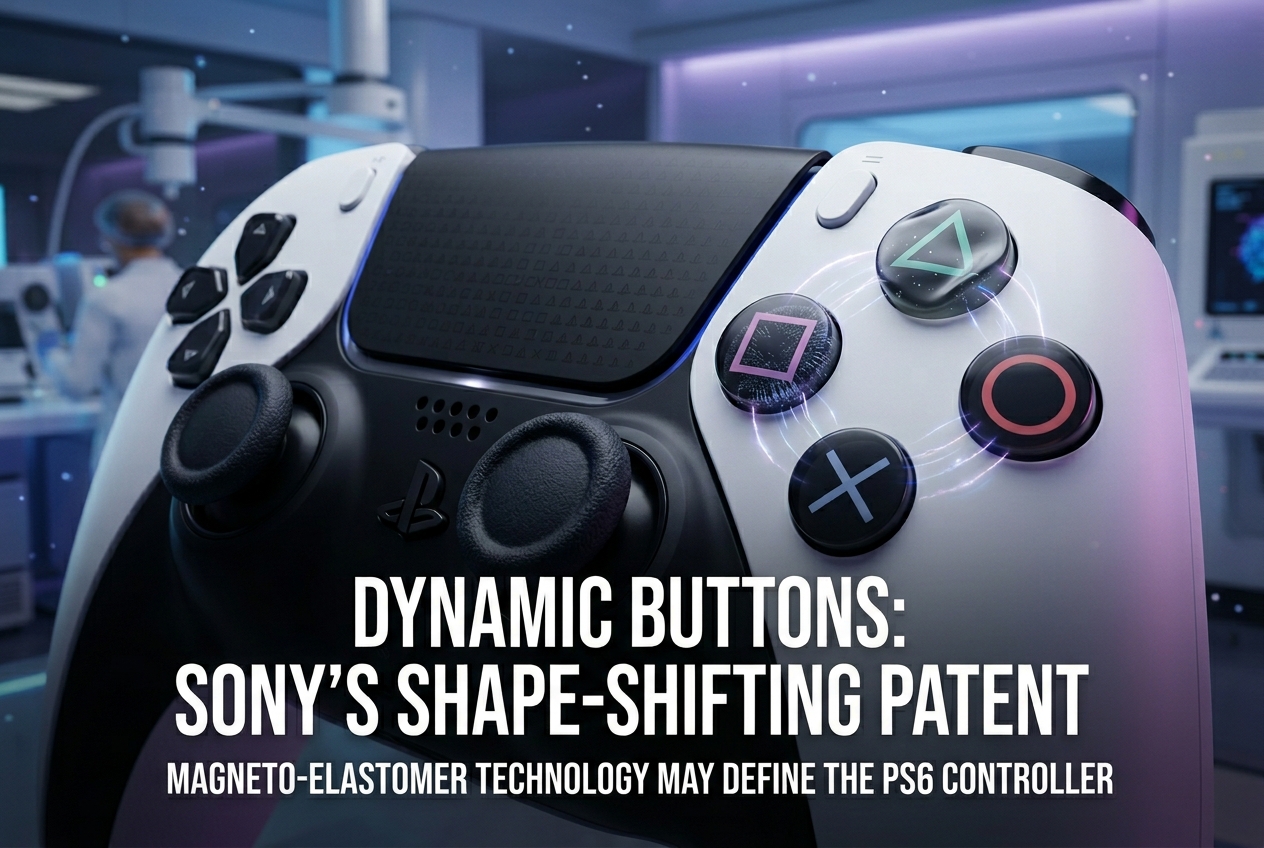
Sony Interactive Entertainment has patented a PlayStation controller whose buttons can physically harden and soften in real time using magneto-viscoelastic elastomer. The technology extends DualSense adaptive trigger logic to every contact surface on the controller.
Sony Interactive Entertainment has filed a patent for a PlayStation controller whose buttons can physically change their stiffness during gameplay. The patent, submitted to the World Intellectual Property Organization (WIPO) in November 2024 and published in May 2026 under number WO2026/110304, was uncovered by Cheat Happens and has since generated significant attention across the gaming world. The concept extends the DualSense’s adaptive trigger technology beyond just L2 and R2, applying dynamic resistance to face buttons, analog sticks, and every surface the player’s fingers touch.
What Does the Patent Actually Describe?
Titled “Operation Device, Information Processing Apparatus, Control Method Thereof, and Program,” the patent outlines a controller with a “hardness control unit” that can dynamically alter the physical resistance of button surfaces. The patent text states: “This operation device is provided with an operation member that receives an operation from a user. The operation device is provided with: a contact part that is disposed on the surface of the operation member and receives a force applied by the user for the operation; and a hardness control unit that changes the hardness of the contact part.”
In practice, this means buttons could physically stiffen or soften depending on in-game events or user preferences. This is not a vibration-based haptic effect. The actual force required to press a button would change, creating a fundamentally different tactile experience from current controller feedback systems.
How Does Magneto-Viscoelastic Elastomer Work?
The primary material Sony proposes is a magneto-viscoelastic elastomer, a composite that changes rigidity when exposed to a magnetic field. Magnets positioned beneath the button surfaces can be modulated in real time by the console, adjusting field strength to make the material harder or softer on command. The game sends control signals, the hardness control unit translates them into magnetic field changes, and the elastomer responds almost instantly.
Sony also describes an alternative approach using fluid-filled membranes. In this design, a central reservoir of liquid connects to smaller chambers positioned directly beneath buttons and sticks. By adjusting pressure within these chambers, the controller can achieve a similar range of tactile variation. The inclusion of multiple engineering solutions suggests Sony is seriously exploring the feasibility of this concept rather than filing a speculative placeholder.
What Would This Feel Like in a Game?
The patent describes dozens of potential use cases. Some of the most compelling scenarios include:
- Hard terrain: When a character walks across rocky ground or touches a solid object, buttons stiffen to simulate that surface texture under your fingertips.
- Swamp traversal: Moving through mud or a swamp causes buttons to become soft and resistant, physically conveying the difficulty of the environment.
- Weapon jams: A reload button could require significantly more force to press when a weapon jams, making the mechanical failure feel tangible.
- The “finger grab” effect: The most striking concept in the patent. A button softens to let a player’s finger sink into it, then hardens around the finger, simulating being physically grabbed. In a horror game, an enemy seizing your character could translate to the controller literally gripping your thumb.
- Custom ergonomics: Buttons could soften to mold around a player’s unique finger shape, then harden to retain that custom form, creating a personalized tactile profile.
How Is This Different from DualSense Adaptive Triggers?
The PS5 DualSense controller’s adaptive triggers use built-in motors and gearing mechanisms to change resistance on the L2 and R2 triggers. Drawing a bowstring in Horizon or pressing the accelerator in Gran Turismo creates varying levels of pushback. This is widely regarded as one of the PS5’s standout hardware innovations, but it remains limited to two trigger inputs.
Sony’s new patent fundamentally expands this logic. Instead of motors and gears on two triggers, the magneto-viscoelastic approach would allow every contact surface on the controller to become dynamic. Face buttons, D-pad, analog sticks, and even palm-rest areas could all respond to gameplay in real time. The shift from mechanical resistance on two inputs to material-level resistance across the entire controller represents a generational leap in tactile feedback design.
Accessibility Implications Worth Noting
An easily overlooked detail in the patent is its explicit mention of accessibility applications. Variable button hardness could allow players with limited mobility or reduced hand strength to use softer, more forgiving inputs. The patent also describes contact surfaces adapting to body parts beyond fingertips, including palms and elbows. For players who use non-standard grip styles or assistive methods, a controller that can dynamically reduce the force required for any input represents a meaningful step toward inclusive design.
Could This Appear in a PS6 Controller?
PlayStation 6 is widely expected to launch in late 2027 or early 2028, according to industry analysts, supply chain reports, and leaked internal documents. Sony has not confirmed any official release date or pricing, though estimates place the console somewhere between $500 and $700. The timing of this patent’s publication aligns naturally with the expected PS6 development timeline.
However, a patent is not a product announcement. Sony files numerous experimental controller patents every year. Recent examples include a touchscreen controller with no physical buttons (patent approved January 2026), a temperature-changing controller concept from 2023, an AI-powered system that uses a camera to predict which button a player will press next (filed 2024), and a flexible, squeezable controller with 25 independent tactile nodes. Most of these concepts have never reached production.
Real engineering hurdles remain for the magneto-viscoelastic approach. Durability under thousands of hardness cycles, pinch safety when buttons harden around fingers, material degradation over time, and manufacturing cost at scale are all unsolved challenges in any publicly available sense. No independent materials testing data has been published by Sony or third-party researchers.
Sony’s Broader Controller R&D Direction
This patent fits into a clear pattern of sustained PlayStation controller innovation. Sony has consistently invested in making the controller a more active participant in the gameplay experience rather than a passive input device. The DualSense’s haptic feedback engine and adaptive triggers were the first major steps. The growing list of patents suggests the company is exploring every conceivable axis of physical interaction: stiffness, temperature, shape, texture, and even AI-predictive responsiveness.
VGC reported that Sony could launch PlayStation 6 alongside a portable Switch-style device, and in a recent earnings call, Sony stated it had not yet decided on PS6’s release timing or price. What is clear is that the next-generation DualSense, whatever form it takes, is being developed with a much broader ambition for physical immersion than the current model.
Things Players Are Curious About
When was this patent published? The patent was filed with WIPO in November 2024 and officially published in May 2026 under number WO2026/110304.
Does it only affect face buttons? No. The patent covers analog sticks, triggers, and all contact surfaces on the controller, including areas that touch the player’s palm.
Can this be added to the current DualSense via a software update? No. The technology requires new hardware components, specifically the magneto-viscoelastic elastomer or fluid-filled membranes and their control units, that do not exist in the current PS5 controller.
Is the “finger grab” effect safe? The patent describes the concept in detail, but no public safety testing data exists. Durability and pinch-risk engineering remain open questions that would need to be resolved before any consumer product could ship.
Will this make controllers more expensive? Potentially. Adding smart materials, additional magnets, and a dedicated hardness control unit would increase component costs. Whether Sony would absorb that cost or pass it to consumers is unknown.