Sony is reportedly considering pushing the PlayStation 6 launch to 2028 or even 2029 as the AI-fueled global memory crisis drives component costs to record highs.
Sony is actively considering delaying the PlayStation 6 launch to 2028 or even 2029, according to a February 2026 Bloomberg report citing sources familiar with the company’s plans. The original target was a holiday 2027 release, consistent with the traditional seven-year PlayStation console cycle that saw the PS4 launch in November 2013 and the PS5 in November 2020. However, a global memory shortage driven by explosive AI demand has forced Sony to rethink its timeline, with DRAM prices surging 75% between December 2025 and January 2026 alone.
Why Is the RAM Crisis Delaying the PS6?
The core issue is straightforward: AI data centres are consuming the world’s memory supply. Companies like OpenAI, Google, and Nvidia are first in line for high-bandwidth memory (HBM) and GDDR components, leaving consumer electronics manufacturers competing for whatever remains. T3 reported that the price of 16 GB of DDR RAM climbed 515% in just a few months, a phenomenon Bloomberg labelled “RAMageddon.”
TrendForce expects mobile DRAM prices to rise another 93-98% quarter-over-quarter in Q2 2026, with major vendors signalling 15-20% additional increases for the second half of the year. The PS6 is expected to use GDDR7 memory, one of the components most directly affected by this supply crunch. Sony CFO Hiroki Totoki acknowledged that rising RAM prices are placing serious pressure on both bill-of-materials costs and overall production expenses.
The global AI infrastructure boom is the driving force. Capital expenditure on AI hardware jumped from roughly $217 billion in 2024 to about $360 billion in 2025, with projections for 2026 approaching $670 billion. That level of spending absorbs memory capacity at a rate the semiconductor industry was not built to handle on current timelines.
What Are Analysts Saying About the PS6 Timeline?
David Gibson, senior analyst at MST Financial, stated in January 2026 that there is a “high likelihood” the PS6 will arrive after 2028. His reasoning combines two factors: the rising component costs make a 2027 launch financially risky, and the PS5 is still performing well commercially. Gibson noted that Sony’s existing memory inventory offers short-term protection but warned that cost increases could become a serious issue by the fiscal year ending March 2027.
PlayStation Lifestyle reported that insider sources now point to 2029 as a realistic launch window, with one established leaker doubling down on that prediction in January 2026. Prediction markets reflected widespread scepticism about an early reveal, with platforms showing only about 25% probability that Sony would announce the PS6 before 2027 as of early April 2026.
The analyst consensus, as summarised by iGenUltra and multiple outlets, currently clusters around a late 2027 announcement followed by a holiday 2028 retail launch as the most likely scenario. A 2029 delay remains possible but would be historically unprecedented for Sony.
Is Sony Deliberately Extending the PS5 Lifecycle?
Yes, and the strategy appears intentional beyond just reacting to the RAM crisis. Sony expects the PS5 lifecycle to be longer than previous console generations. The PS5 Pro, launched in 2024 at $699.99, demonstrates continued investment in the current platform rather than a rush toward PS6. Strong holiday 2025 sales, aggressive discount campaigns, and robust game revenue have all reinforced the case for keeping PS5 on the market longer.
A MENAFN report from January 2026 noted that Sony’s current strategy “points to a longer runway for the PS5, underpinned by mid-cycle hardware upgrades, software optimisation, and a deepening focus on artificial intelligence tools.” Sony CFO comments describing the PS5 as still in the “middle of its journey” have been widely interpreted as a signal of deliberate lifecycle extension.
If the delay pushes PS6 to 2029 or 2030, Console Creatures pointed out it would make the PS5 generation the longest in PlayStation history.
What Hardware Specs Are Expected for the PS6?
Despite the timeline uncertainty, credible leaks have painted a detailed picture of PS6 hardware. Based on information from sources including Moore’s Law Is Dead, AMD hardware specialist KeplerL2, and Notebookcheck’s roundup of leaked specifications:
- CPU: Custom AMD APU based on Zen 6 architecture, up to 8 cores
- GPU: RDNA 5 with 40-48 compute units clocked above 3 GHz, targeting 34-40 TFlops and up to 12x ray tracing performance over the base PS5
- Memory: 30 GB or 40 GB GDDR7 on a 160-bit bus at 32 GT/s, delivering approximately 640 GB/s bandwidth (a 43% increase over PS5’s 448 GB/s)
- Storage: 1 TB or 2 TB NVMe SSD
- Connectivity: Wi-Fi 7 and HDMI 2.2 support
- AI Features: Dedicated machine-learning tensor cores for dynamic resolution scaling, frame generation, and enhanced NPC behaviour
- Backward Compatibility: Full PS5 and PS4 support confirmed in leaks, with PS3 software emulation speculated
The performance target is reportedly native 4K at 120 fps with advanced upscaling, alongside full path-tracing capabilities. Sony’s choice between 30 GB and 40 GB of RAM will depend heavily on where memory prices sit closer to the production decision date.
How Much Will the PS6 Cost?
Most industry estimates place the standard PS6 at $599-$699 at launch, though some analysts have pushed that figure as high as $749 depending on memory costs at the time of production. With the PS5 now at $649.99 and the PS5 Pro at $899.99 in the US, Sony faces a delicate pricing balancing act. CNET and iGenUltra both noted that Sony is unlikely to launch above $699 given the current community backlash over PS5 pricing.
Leaked documents also suggest Sony may be preparing multiple PS6 models: a budget-friendly Lite variant ($350-550), a standard model ($500-700), and a portable version ($700-1,000). Moore’s Law Is Dead estimated the handheld could come in at around $400-500, meaning the full PS6 ecosystem might require an investment exceeding $1,000 for early adopters wanting both home and portable hardware.
Is a PS6 Handheld Really Happening?
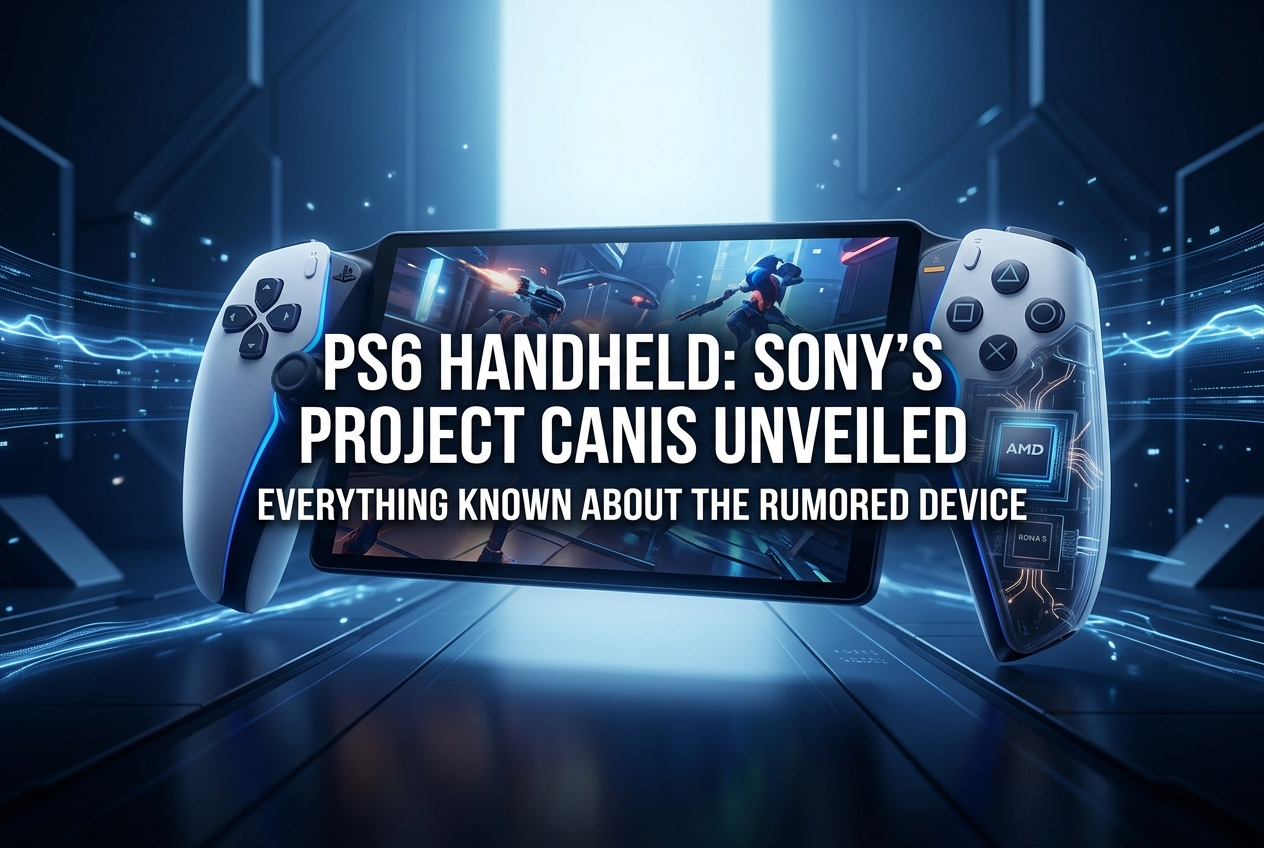
Multiple sources point to a Nintendo Switch-style PlayStation portable codenamed “Canis.” This device is expected to deliver PS5-level performance in a handheld form factor and could launch shortly after the main PS6 console. Game Cicada reported that manufacturing for the portable could ramp up in mid-2027 for a fall 2027 retail target, though this timeline is subject to the same RAM-related delays affecting the home console.
VGChartz summarised the rumoured strategy: a compact, affordable home console version (essentially a repackaged PS5-level device at $399) alongside the more powerful handheld at $449-$499. Whether Sony actually ships two distinct PS6 products simultaneously remains unconfirmed.
What Does This Mean for Gamers Right Now?
The most practical takeaway is that the PS5 and PS5 Pro will remain Sony’s flagship hardware for at least two to three more years. Sony’s extended lifecycle strategy means continued first-party game support, software optimisation, and potential further price adjustments for the current generation. Gamers who have not yet upgraded to a PS5 Pro may find it a worthwhile investment given the extended wait.
There is a potential silver lining to the delay. If memory prices begin normalising by late 2027, as new fab capacity from SK Hynix (M15X facility, H2 2026) and Micron (new Boise fab, 2027) comes online, Sony could produce a more powerful console at a more accessible price point than a rushed 2027 launch would have allowed.
Questions Worth Knowing the Answers To
Has Sony officially confirmed any delay?
No. Sony has not made any public statement about PS6 timing. All delay reports come from analyst forecasts, Bloomberg’s sourcing, and insider leaks. Polygon noted that no final decision to postpone has been confirmed, but the RAM crisis has prompted Sony to seriously consider 2028 or 2029 as viable launch windows.
Could Microsoft release a new Xbox before the PS6?
Microsoft faces the same component cost pressures, with reports indicating both PS6 and the next Xbox could slip beyond 2027-2028. However, if Microsoft moves first, it could create competitive pressure on Sony to accelerate its own timeline.
Will the PS6 support backward compatibility?
All credible leaks point to full PS5 and PS4 backward compatibility. Some speculation extends to PS3 support through software emulation, though this has not been confirmed by reliable sources.
When will memory prices stabilise?
New semiconductor facilities are expected to begin adding meaningful supply in 2027, but analysts caution that AI demand will continue growing. The Register reported that elevated DRAM prices are expected to persist through at least 2028, suggesting the memory market may not fully normalise within the next two years.