Microsoft has reportedly frozen all new third-party Game Pass licensing deals, leaving studios mid-negotiation and raising questions about the service’s future catalog. The pause comes as new Xbox CEO Asha Sharma executes a sweeping business reset that includes price cuts, studio closures, and a shift from subscriber growth to daily player engagement.
Microsoft has stopped signing new third-party deals for Xbox Game Pass. The report comes from Fernando Rizo, former chief sales and business development officer at Raw Fury and current partner at Kaboodle Games, who revealed on The Business of Video Games podcast that multiple studios with Game Pass agreements in advanced negotiations were abruptly told their deals were put on hold. The freeze surfaced after Rizo spoke with developers at the First Playable trade show in Florence, Italy, held June 10-12, 2026.
What Exactly Happened to Game Pass Deals?
According to Rizo, the situation is not limited to a handful of studios. Speaking alongside Arrowhead Studios CEO Shams Jorjani on the podcast, he described a sector-wide pattern: developers who were deep into Game Pass negotiations suddenly had their agreements pulled before anything was signed. These were not exploratory conversations but deals at advanced stages where studios had already built financial plans around the expected revenue.
“I definitely don’t want to oversell what I know,” Rizo said. “I’m not privy to any internal Microsoft conversations. But I had spoken to a number of devs that had Game Pass deals in various stages of negotiation who were told the deals were on hold.” He explicitly pushed back against the idea that this signals “the death of Game Pass,” framing it instead as a temporary pause tied to leadership changes.
Why Now? Asha Sharma’s 100-Day Reset
The freeze did not happen in a vacuum. New Xbox CEO Asha Sharma, who replaced Phil Spencer in February 2026, has been executing a comprehensive business reset since day one. Speaking at a Bloomberg Tech event in June, Sharma said plainly that Xbox is “not in a healthy spot” and that the next 100 days would be about fundamentally restructuring how the division invests, prioritizes, and operates.
Sharma’s first major move came on April 21, 2026, when Microsoft cut the monthly price of Game Pass Ultimate from $29.99 to $22.99 and PC Game Pass from $16.49 to $13.99. The trade-off: new Call of Duty titles will no longer launch day one on Game Pass, instead arriving roughly a year later during the following holiday season. Sharma acknowledged that Game Pass had “become too expensive for too many players” and that the service had suffered an eight-month subscriber decline before her price cuts reversed the trend.
The pricing shift reflected a broader philosophical change. Microsoft is moving away from aggressive subscriber growth as its north-star metric, replacing it with daily active players (DAU). This rewards retention and engagement over raw subscriber numbers, aligning incentives with games people return to repeatedly, such as Halo, Forza, and Minecraft.
How Will the Game Pass Library Be Affected?
Short-term impact on subscribers is likely minimal. Publishing deals are typically arranged months to over a year in advance, so the existing pipeline should continue filling out the catalog for some time. In fact, Game Pass added 47 more games than it removed during the first half of 2026, a 51-game improvement over the same stretch in 2025.
The real concern lies 12 to 18 months down the road. If no new third-party agreements are being signed now, the pipeline of indie and mid-tier titles arriving in late 2027 and 2028 could look noticeably thinner. Independent developers stand to be the most affected, since Game Pass deals often serve as a critical revenue source that funds development. Studios that built their business plans around expected Game Pass income are now left scrambling for alternative financing.
Studio Closures Add to the Uncertainty
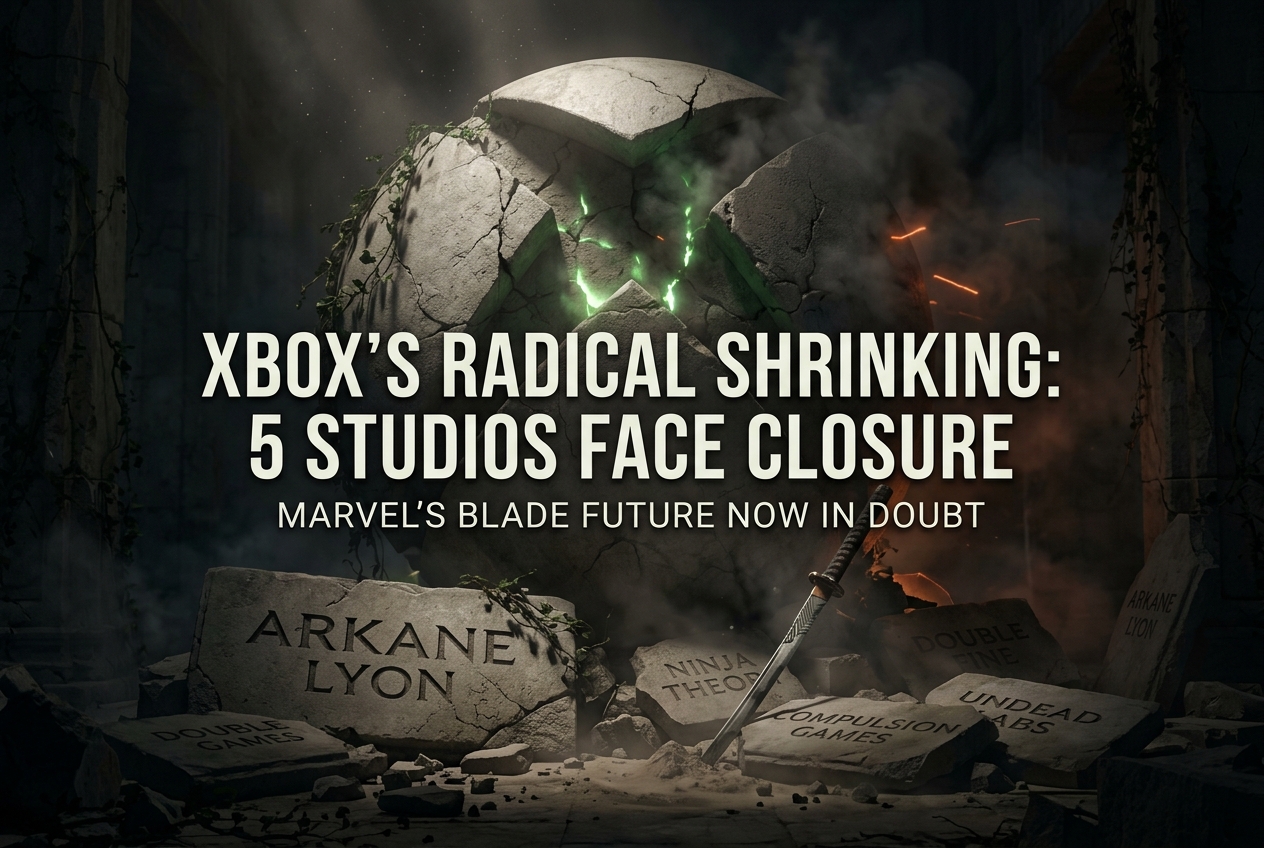
The licensing freeze is part of a much larger restructuring. Bloomberg’s Jason Schreier reported in mid-June that several Xbox-owned studios face potential closure, with Ninja Theory (Hellblade), Double Fine (Psychonauts, Kiln), and Compulsion Games (South of Midnight) all in active negotiations to either spin off or find external buyers. According to The Verge, Ninja Theory staff were informed of the closure just eight days after the studio unveiled its new game Senua at the Xbox Games Showcase.
Giant Bomb reported that approximately 1,000 employees could be affected by layoffs expected to begin in July 2026, immediately after Microsoft’s fiscal year closes on June 30. This would mark the fifth major round of cuts at Microsoft Gaming since the Activision Blizzard King acquisition closed. Previous rounds already shuttered studios like Arkane Austin, Alpha Dog Games, and The Initiative, and cancelled projects including Perfect Dark and Everwild.
Microsoft’s New Strategy: Quality Over Volume
Sharma’s reset is built around five operational commitments that represent a sharp departure from Xbox’s previous approach of acquiring studios to maintain a constant Game Pass content stream:
- Return of console exclusives: Regular “Signature Exclusives” are back, with Gears of War: E-Day and Clockwork Revolution confirmed as the model. Exclusivity is being re-evaluated title by title.
- Sustainable Game Pass economics: The strategy of buying content to fuel subscriber growth at any cost is over. Sharma described the focus as getting subscribers who “love the subscription, stay longer, and are happy.”
- Hardware business overhaul: The current console subsidy model is under review. Xbox Series console prices are set to increase by $100-$150 in August 2026, and third-party hardware partnerships are being explored.
- Strict cost discipline: Every investment faces tighter scrutiny. Budget cuts, project cancellations, and further studio closures remain possible.
- No AI in creative pipelines: Sharma banned generative AI from auto-generating dialogue, art, or level design, calling low-quality AI content “soulless AI slop.”
Is This Temporary or Permanent?
Industry opinion is split. At least one publishing figure pushed back hard on the reports, calling them “not remotely accurate.” A trusted source at Windows Central suggested the frozen negotiations are specifically tied to Microsoft’s fiscal year ending and the ongoing business reset, not a permanent change in strategy.
Rizo himself was careful to frame the situation as a pause: “I don’t personally think this is the death of Game Pass or anything, probably just a new CEO wanting to get her feet under her desk and everyone aligned on strategy before the Game Pass team starts cutting cheques again.” He noted that his own company, Kaboodle Games, completed a Game Pass deal earlier in 2026 and suspects it may have been among the last to go through before the freeze.
Microsoft has not issued an official statement confirming or denying the reports.
What This Means for Game Pass Subscribers Right Now
- Your current library is safe for now. Games already in the catalog remain playable as long as your subscription is active and the licensing period has not expired.
- Track departing titles. Games regularly rotate out of Game Pass. Eight titles including Rise of the Tomb Raider, Payday 2, and Slay the Spire were scheduled for removal by June 30, 2026.
- First-party titles are unaffected. Microsoft’s own studios will continue releasing games on Game Pass day one. Gears of War: E-Day, Fable, and Clockwork Revolution are all expected to launch directly into the service.
- Re-evaluate your plan. With Call of Duty no longer arriving day one, the value equation for Ultimate ($22.99/month) versus cheaper tiers like Premium ($14.99) or Essential ($9.99) has shifted. Consider whether your plan still matches how you use the service.
The Bigger Picture: Where Is Xbox Heading?
After spending $75.4 billion to acquire Activision Blizzard, Microsoft is now confronting the economic reality of running a subscription service that lost millions of subscribers during 2025’s price hikes. The Game Pass model, once Xbox’s most compelling competitive advantage, is being fundamentally reshaped under Sharma’s leadership.
The direction is clear: fewer third-party deals, more first-party focus, sustainable economics over growth-at-all-costs, and a platform strategy that prioritizes daily engagement over raw subscriber counts. Whether this produces a stronger, more focused Game Pass or a diminished one with a thinner catalog will depend entirely on execution over the next 12 to 18 months.
For now, Game Pass subscribers and the development community are left in the same position: waiting for answers from a company that has not yet spoken publicly about where the line between “pause” and “permanent shift” actually falls.