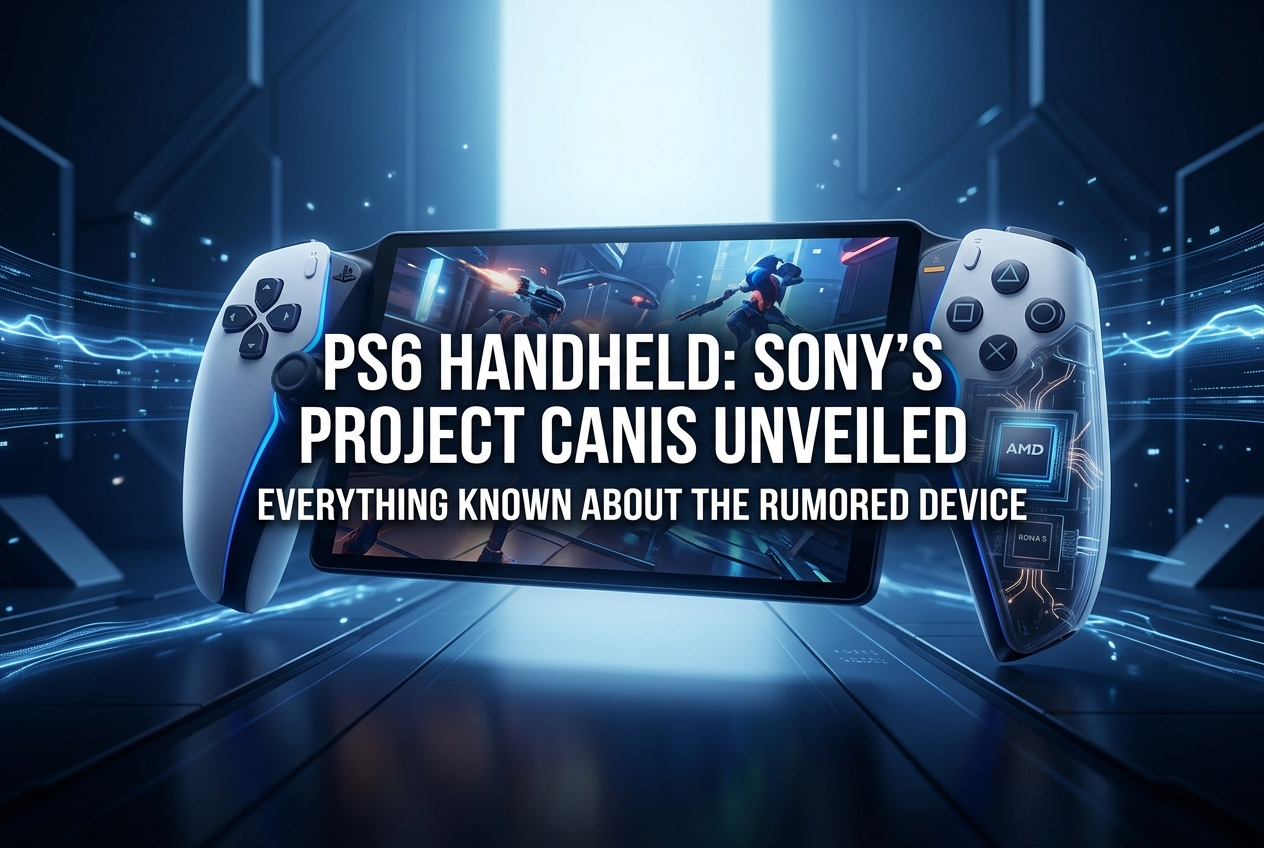
Sony is developing a standalone PS6 handheld codenamed Project Canis, featuring AMD Zen 6 CPU cores, RDNA 5 GPU, and native PS4/PS5 backward compatibility. With dock mode via USB-C and an estimated $399-$499 price point, the device is positioned to rival the Nintendo Switch 2 and outperform every portable gaming device currently on the market.
Sony is building a standalone gaming handheld alongside the PlayStation 6, internally codenamed “Project Canis.” Unlike the PlayStation Portal, which streams games from a PS5 over Wi-Fi, Project Canis will have its own processing hardware and run games natively without any internet dependency. Powered by a monolithic AMD APU fabricated on TSMC’s 3nm process node at roughly 135 mm², the device is expected to enter manufacturing by mid-2027 with a launch window targeting late 2027 or early 2028.
Core Hardware: Zen 6 CPU and RDNA 5 GPU Under the Hood
According to leaked specifications shared by Moore’s Law is Dead (MLID), who cited internal AMD documentation, the PS6 handheld will feature a hybrid CPU configuration: four Zen 6c performance cores for gaming workloads, plus two Zen 6 low-power cores dedicated to running the PlayStation operating system. This split frees up approximately 20% more CPU headroom for games. On the graphics side, 16 RDNA 5 Compute Units clock at 1.20 GHz in handheld mode and 1.65 GHz in docked mode.
The memory subsystem uses a 192-bit LPDDR5X-8533 bus capable of delivering over 200 GB/s of bandwidth, roughly double what the ROG Ally X offers. While documents reference support for up to 48 GB of RAM, developers speaking to MLID indicated 24 GB as the minimum needed for PS6-era titles, with most pushing for 32 GB or higher. The total SoC power draw sits at approximately 15W, matching the Steam Deck but well below the 28-30W range typical of Windows-based PC handhelds.
Dock Mode: A Switch 2-Style Hybrid Experience
One of the most notable features is a USB-C video output enabling a docked mode, mirroring Nintendo Switch 2’s hybrid concept. When docked, the GPU clock speed increases from 1.20 GHz to 1.65 GHz, delivering a meaningful performance boost. MLID estimates docked rasterisation performance at 55-75% of the base PS5, while ray tracing performance could reach 1.3x to 2.6x the PS5 level thanks to RDNA 5’s architectural improvements per Compute Unit.
RDNA 5 delivers roughly 40-50% more rasterisation performance per CU compared to RDNA 3.5, with even larger ray tracing gains. Combined with the higher memory bandwidth, this makes the PS6 handheld considerably more powerful than any portable gaming device currently available, including the ROG Ally X and Nintendo Switch 2.
PS4 and PS5 Backward Compatibility
Leaked AMD documents indicate the PS6 handheld will natively run PS4 and PS5 games. Because the Canis APU shares the same Zen 6 and RDNA 5 architecture as the main PS6 console (codenamed “Orion”), backward compatibility is architecturally straightforward. There is no mention of PS3 support in any of the leaked materials, likely due to the enduring difficulty of emulating the PS3’s unique Cell processor architecture.
The RAM gap between the handheld and the main PS6 console is projected to stay below 30%. Sony is reportedly planning an automatic asset delivery system that downloads hardware-appropriate texture and resolution packs to each device, eliminating the need for developers to build entirely separate game versions. SIE President Hideaki Nishino has spoken about creating flexible gaming experiences that adapt to how people’s lifestyles are changing, which aligns with a portable companion device strategy.
Physical Design and Additional Features
Based on the collective leaks, the PS6 handheld will include the following hardware features:
- Display: 1080p resolution, expected at 60 Hz or 120 Hz (Digital Foundry suggests Sony may adapt the PlayStation Portal’s 8-inch panel)
- Storage: MicroSD card slot and M.2 SSD support
- Input: Touchscreen, haptic vibration, dual microphones
- Connectivity: USB-C with video output for docked play
- Power: ~15W TDP at the SoC level
The 3nm fabrication process is the key enabler for this efficiency profile. By comparison, the Steam Deck uses a 7nm AMD APU, and the Nintendo Switch 2 runs on an 8nm Nvidia chip. The generational leap in process technology allows Project Canis to deliver substantially higher performance within a comparable power envelope.
Estimated Price: Targeting the Switch 2
MLID’s bill-of-materials analysis places the PS6 handheld between $399 and $499 at retail. Sony’s primary pricing target appears to be competitive parity with the Nintendo Switch 2, which sells for $449.99 in the US. Some later estimates from industry sources have pushed the range higher, between $500 and $700, particularly as the 2026 global memory crisis (driven by AI data centre demand for high-bandwidth memory) continues to inflate component costs.
It is important to note that Sony has not confirmed the existence of this device, let alone any pricing. All price estimates come from leaker analysis and bill-of-materials projections, not official retail announcements. European pricing would typically include VAT and could be higher than US dollar estimates.
Release Window: 2027 or Pushed to 2028?
Original leaked timelines pointed to mass production starting mid-2027 with a fall 2027 launch, coinciding with the main PS6 console. Leaker KeplerL2 corroborated this window on NeoGAF, noting that both next-gen Xbox and PS6 hardware were targeting Holiday 2027. However, a February 2026 Bloomberg report indicated Sony was considering delaying the entire PS6 family to 2028 or even 2029 due to surging memory costs.
The root cause is “RAMmageddon,” as Digital Trends describes it. Explosive growth in generative AI infrastructure has created enormous demand for GDDR7 and LPDDR5X chips, directly competing with consumer electronics for limited supply. Sony needs millions of memory units for a console launch, and current market conditions make that far more expensive than projections from the original 2023 AMD documents assumed. Late 2028 is now considered the most realistic estimate by multiple industry analysts.
How Does It Compare to Current Handhelds?
| Specification | PS6 Handheld (Rumoured) | Nintendo Switch 2 | Steam Deck OLED |
|---|---|---|---|
| CPU | 4x Zen 6c + 2x Zen 6 LP | 8x ARM Cortex-A78C | 4x Zen 2 |
| GPU | RDNA 5, 16 CU | Nvidia Ampere (~1536 CUDA) | RDNA 2, 8 CU |
| RAM | 24-48 GB LPDDR5X | 12 GB LPDDR5X | 16 GB LPDDR5 |
| Process Node | 3nm | 8nm | 7nm |
| TDP | ~15W | ~12W (system) | ~15W |
| Dock Mode | Yes (USB-C video out) | Yes | Via external dock |
| Backward Compatibility | PS4 + PS5 (native) | Switch 1 games | Full Steam library |
| Estimated Price | $399-$499 | $449.99 | $549 (512 GB) |
The generational advantage is stark. Project Canis is projected to be roughly three times faster than the Switch 2 in docked mode and significantly more powerful than the Steam Deck’s ageing Zen 2 architecture. Its 3nm process and dedicated AI upscaling hardware (PSSR 3, based on AMD’s FSR 5) give it capabilities that no current handheld can match.
Project Amethyst: AI-Powered Gaming Hardware
Sony and AMD’s joint initiative, Project Amethyst, brings dedicated AI silicon to both the PS6 console and its handheld companion. The architecture includes Neural Arrays that link directly to Compute Units for hardware-accelerated AI upscaling via PSSR (PlayStation Spectral Super Resolution). Radiance Cores handle advanced ray tracing lighting effects, while Universal Compression improves data streaming efficiency to GPU memory.
For the handheld specifically, AI upscaling is critical. A 16 CU GPU running at 1.20 GHz in portable mode needs intelligent upscaling to render games at visually appealing quality levels from lower internal resolutions. PSSR 3 is expected to bridge this gap, allowing PS5-class visual fidelity on a 15W power budget. This is a fundamentally different approach from the Steam Deck, which relies on AMD’s more general FSR implementation, or the Switch 2, which uses Nvidia’s DLSS.
The Three-Device PS6 Strategy
Sony appears to be planning a multi-tier hardware launch for the PS6 generation. According to MLID’s April 2026 analysis, the lineup could include:
- PS6 Lite (Canis APU): A budget console at $349-$549, sharing the handheld’s chip in a home console form factor
- PS6 Handheld (Canis APU): The portable device at $399-$499, with dock mode for TV play
- PS6 Standard (Orion APU): The flagship console at $699-$999, featuring 8 Zen 6 cores and 40-54 RDNA 5 CUs
This strategy lets Sony cover multiple price points and use cases. The Canis APU powers both the affordable home console and the handheld, while the more powerful Orion APU drives the flagship experience. All three devices share the same game ecosystem and backward compatibility with PS4 and PS5 libraries.
What Has Sony Actually Confirmed?
Sony has not officially announced the PS6 handheld, confirmed Project Canis, or shared any technical specifications. At SIE’s June 2025 business presentation, CEO Hideaki Nishino acknowledged the PlayStation Portal’s strong sales performance and stated the company “remains committed to exploring new ways for players to access our content and services.” PlayStation architect Mark Cerny has discussed multi-year hardware development work with AMD, including Project Amethyst’s AI acceleration technology, but has not tied it to specific product announcements.
All specifications, pricing, and release timing referenced in this article come from leaker sources, primarily Moore’s Law is Dead and KeplerL2, both of whom have established track records with hardware leaks. However, leaked information from 2023-era AMD documentation may not reflect final production decisions, particularly given the significant impact of the 2026 memory crisis on Sony’s bill of materials and launch timeline.
Questions Most Players Are Asking
Will the PS6 handheld replace the PlayStation Portal?
No. The PlayStation Portal is a remote play accessory for PS5 owners, priced at $249.99 after a 2026 price increase. The PS6 handheld would be a fully independent device with its own processing hardware, running games locally. Both could coexist in Sony’s product lineup, serving different price points and use cases.
Can the PS6 handheld run PS6 games natively?
Yes, it shares the same Zen 6 and RDNA 5 architecture as the main PS6. Games would run at adjusted resolution and frame rate settings appropriate to the handheld’s lower GPU clock speeds and TDP, with AI upscaling (PSSR 3) compensating for the reduced rendering resolution.
Is it more powerful than the Steam Deck?
Significantly. The Steam Deck uses a 7nm Zen 2 CPU and 8 RDNA 2 CUs. The PS6 handheld’s 3nm Zen 6c cores and 16 RDNA 5 CUs represent a multi-generational leap in both CPU and GPU architecture, with double the memory bandwidth and far more advanced AI acceleration.
When will Sony officially reveal it?
No announcement date is known. Based on past PlayStation hardware cycles, a formal reveal would typically occur six to twelve months before launch. If the PS6 family targets late 2028, a reveal in early to mid-2028 would be consistent with Sony’s historical approach.