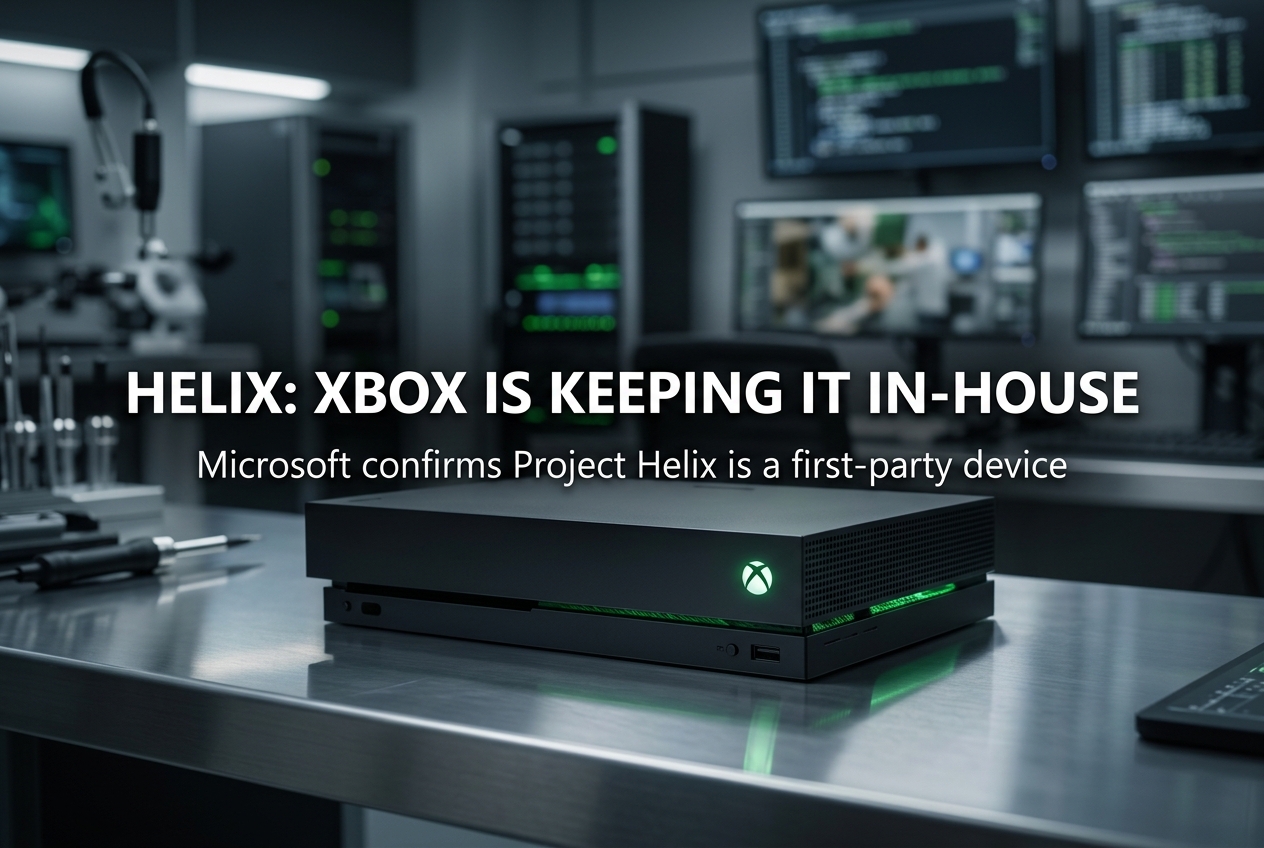
Xbox VP Jason Ronald shut down rumors that ASUS and MSI would manufacture third-party Xbox consoles. Project Helix will launch as a first-party device, though the door to future OEM hardware isn’t fully closed.
Microsoft has officially confirmed that its next-generation Xbox console, Project Helix, will be manufactured and sold directly by Microsoft as a first-party device. Jason Ronald, Vice President of Xbox Gaming Devices and Ecosystem, made the statement on April 21, 2026, responding to viral rumors that companies like ASUS and MSI would be the ones producing next-gen Xbox hardware. The confirmation comes months after Project Helix was revealed at GDC 2026 as a hybrid console/PC powered by a custom AMD SoC capable of playing both Xbox and PC games natively.
Where Did the ASUS and MSI Xbox Rumors Come From?
The speculation originated from KeplerL2, a well-known and generally reliable hardware leaker in the tech community. Posting on NeoGAF, KeplerL2 claimed that the Project Helix chip “won’t be sold directly to consumers, but you will be able to buy an ASUS / MSI / etc Helix machine.” The statement was picked up across social media and quickly misinterpreted by some as confirmation that Microsoft would not be making its own console at all.
The nuance mattered. KeplerL2 was describing a scenario where third-party manufacturers could produce their own devices using the Helix chipset, not that Microsoft was stepping away from hardware entirely. Jason Ronald’s response addressed the most alarming version of the rumor directly: “Project Helix will be available as a 1st party Xbox console.” Notably, Ronald did not deny that third-party Helix devices might exist in the future, leaving that possibility open while firmly establishing Microsoft’s own hardware commitment.
What Is Project Helix and Why Does It Matter?
Project Helix is Microsoft’s next-generation Xbox console, formally announced at the 2026 Game Developer Conference. According to the official Xbox Wire blog post by Asha Sharma, the device is designed to play both Xbox console games and PC games, delivering what Microsoft calls “leading performance” for the next generation of gaming. It is powered by a custom AMD SoC (codenamed Magnus) co-designed for next-gen DirectX and AMD FSR Diamond upscaling technology.
Microsoft claims Project Helix will deliver “an order of magnitude leap in ray tracing performance,” integrate AI intelligence directly into the graphics pipeline, and drive major gains in efficiency and visual ambition. The Xbox Play Anywhere catalog has already grown to over 1,500 games with 500 development teams shipping titles, signaling how deeply Microsoft is investing in the cross-platform ecosystem that Helix will anchor.
Confirmed and Leaked Specifications
While Microsoft has been selective about official spec confirmations, a combination of verified announcements and credible leaks paints a detailed picture of what to expect from Project Helix.
| Component | Detail | Status |
|---|---|---|
| SoC | Custom AMD Magnus (RDNA 5 GPU + Zen 6 CPU) | Confirmed |
| Upscaling | AMD FSR Diamond with NPU-driven multi-frame generation | Confirmed |
| Ray Tracing | Order-of-magnitude leap over Series X | Confirmed |
| NPU | Up to 110 TOPS at 6W | Leaked |
| Memory | 36-48 GB GDDR7, 192-bit bus | Leaked |
| Target Performance | Native 4K at 120 FPS | Leaked |
| PC Game Support | Native playback of Xbox and PC games | Confirmed |
| Backward Compatibility | Four Xbox generations | Confirmed |
| Storage | High-speed NVMe SSD with upgraded DirectStorage | Confirmed |
Leaker Moore’s Law is Dead has estimated the consumer-facing hardware value at around $1,000 when individual components are priced at retail equivalents, factoring in the RDNA 5 GPU (comparable to a 70 or 80 class desktop card), a custom CPU, GDDR7 RAM, and NVMe storage. This positions Project Helix as the most expensive Xbox console ever, but also far closer to a mid-to-high-end gaming PC than any previous console generation.
Release Window and Pricing Expectations
Microsoft confirmed at GDC 2026 that alpha developer hardware kits will ship to studios in 2027. A consumer launch before late 2027 is considered unlikely by most industry analysts, with 2028 being a realistic scenario if component shortages continue. AMD has publicly stated it is on track to support a 2027 launch for Project Helix’s custom silicon, but Microsoft has not “fully internally committed” to that window according to a Windows Central report.
No official price has been announced. Xbox CEO Asha Sharma has described the device as a “very premium, very high-end curated experience” and acknowledged that the ongoing global memory shortage will directly impact pricing. Most analyst projections place the launch price above $999. The device is expected to compete in the same launch window as Sony’s PlayStation 6, which is also targeting 2027 but faces similar component cost pressures.
Could Third-Party Xbox Hardware Still Happen?
Jason Ronald’s statement confirmed Project Helix as first-party but deliberately left room for interpretation. He never denied that third-party devices could use the Helix chipset in the future. ASUS already has a deep partnership with Microsoft through the ROG Xbox Ally and Xbox Ally X handhelds, which run the Xbox Full Screen Experience on Windows 11. This existing collaboration makes it plausible that ASUS could eventually produce a desktop or living-room device built around the Helix chip.
The likely model, if it happens, would resemble how Nvidia operates with its graphics cards: Microsoft produces a first-party reference console, while third-party manufacturers like ASUS or MSI create their own variants with custom cooling, different form factors, or slightly overclocked specifications. These would not be “Xbox” consoles in the branded sense but rather Helix-powered machines running Xbox Mode on Windows. As PC Gamer noted, ASUS is not a strong candidate for undercutting Microsoft on price given the premium positioning of its ROG hardware line.
The Bigger Xbox Strategy
Project Helix does not exist in isolation. Microsoft is executing a broader strategy to unify Xbox and Windows gaming under a single ecosystem. Xbox Mode began rolling out to Windows 11 PCs in select markets in April 2026, bringing the console-like full-screen experience to any compatible PC. The ROG Xbox Ally handhelds serve as the first physical embodiment of this vision, while Project Helix will be the flagship living-room anchor.
Under new CEO Asha Sharma, Xbox has also undergone a brand refresh. The “We Are Xbox” campaign launched alongside a new logo and the dissolution of the separate “Microsoft Gaming” branding. Game Pass pricing has been reduced, with the Ultimate tier dropping from $29.99 to $22.99 per month in the US. These moves collectively position Xbox as more than a console brand: it is becoming a platform layer that runs across consoles, PCs, handhelds, and potentially third-party hardware.
Questions Gamers Are Asking
Will Project Helix run Steam games?
Microsoft has confirmed that Project Helix will play PC games natively. However, whether Steam and other third-party storefronts will have direct access remains uncertain. Epic Games has announced plans to be available on the device at launch, but Steam support is not confirmed. Recent reports suggest the question is still unresolved internally at Microsoft.
Will my Xbox Series X games work on Project Helix?
Yes. Microsoft has confirmed backward compatibility spanning four generations of Xbox hardware: original Xbox, Xbox 360, Xbox One, and Xbox Series.
Is $1,000+ too much for a console?
Project Helix is not a traditional console. It functions as a hybrid console/PC with specifications comparable to a mid-to-high-end gaming desktop. Building a similar PC from individual components would likely cost more, which is the value proposition Microsoft is banking on.
When will we know more?
Microsoft has indicated that more details about Project Helix will be shared later in 2026, likely tied to its 25th Xbox anniversary celebrations. Developer kits shipping in 2027 will also trigger a wave of third-party information as studios begin building for the platform.
Staying Connected to the Xbox Ecosystem
While Project Helix is still at least 18 months from consumer availability, the current Xbox ecosystem continues to expand. For those looking to top up their Xbox balance for Game Pass subscriptions or digital purchases, Xbox Gift Cards are available on GamerMarkt with fast delivery and secure transactions.
The bottom line is clear: Microsoft is not handing Xbox hardware to third parties. Project Helix will be a first-party console with PC-level specifications, a hybrid operating model, and a price tag to match its ambitions. Third-party Helix devices may eventually follow, but the next Xbox will carry Microsoft’s name first.