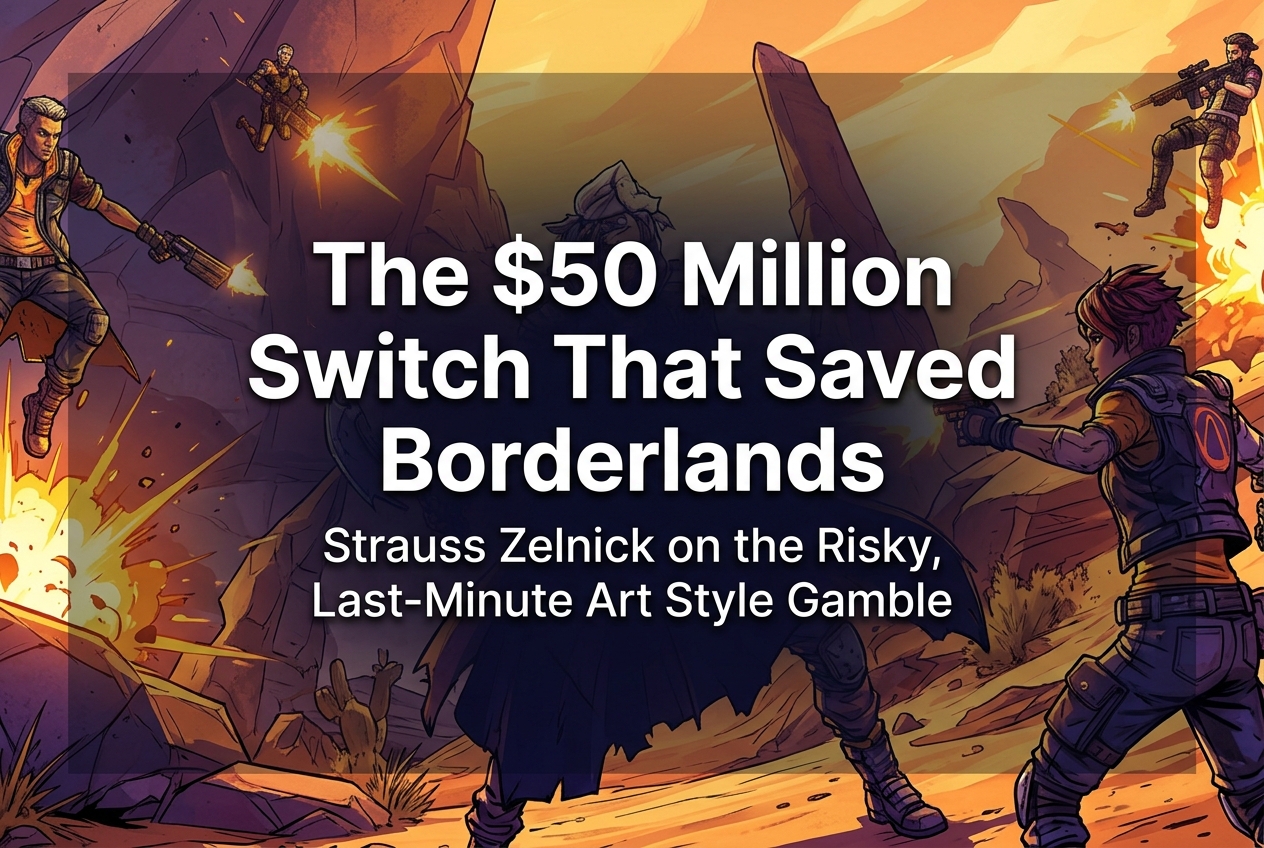
Borderlands nearly shipped as a generic brown shooter before a $50 million last-minute art overhaul transformed it into one of gaming’s most recognizable franchises, now past 100 million copies sold.
Take-Two Interactive CEO Strauss Zelnick has revealed that the original Borderlands’ now-iconic art style was a last-minute overhaul that cost approximately $50 million and pushed the game’s release back by over a year. In an interview with podcaster David Senra, Zelnick explained how the franchise that has now surpassed 100 million copies sold nearly launched as a forgettable, generic shooter lost among the brown-toned games dominating the late 2000s.
What Did Borderlands Originally Look Like?
When Borderlands was first shown publicly at the 2007 Leipzig Games Convention and E3 2008, it looked almost indistinguishable from other shooters of its era. Muted browns, greys, and realistic textures gave it a visual identity nearly identical to Fallout 3, Rage, Gears of War, and dozens of other titles fighting for shelf space. Gearbox Software had chosen what it considered the “safe” approach from six different art style concepts developed early in the project.
By October 2008, internal alarm bells started ringing. Gearbox’s “Truth Team,” a group of testers with psychology backgrounds assembled to give projects critical reviews, concluded that players found the game’s visuals too similar to Bethesda’s freshly released Fallout 3. Chief creative officer Brian Martel put the concern bluntly in a later GDC 2010 presentation covered by GameSpot: “We didn’t want to be considered a poor man’s Rage.”
How Did the $50 Million Decision Happen?
According to Zelnick, the crisis point arrived roughly two months before the game’s planned launch. A division head walked into his office and admitted the team had made a mistake. “The art style is not appropriate and it’s not differentiated, we want to remake the game,” Zelnick recounted. At this point, Take-Two had “very limited capital” and had not yet completed its corporate turnaround. The game was essentially finished.
Zelnick said he “dug in and did my homework” before backing the decision, but acknowledged it was “non-obvious” and that “no one else in the business would have done it.” The final cost: approximately $50 million and a full extra year of development. For context, Borderlands 2’s entire estimated budget was around $35 million, according to figures attributed to Gearbox CEO Randy Pitchford. The art style change alone cost more than an entire sequel.
The Secret Prototype That Changed Everything
The solution came from within the game’s own concept art. Art director Brian Martel noticed that Borderlands’ 2D concept sketches had an ink-lined, quasi-comic-book energy that the 3D game completely lacked. He secretly built a prototype using this style, hiding in a closet to avoid what he feared would be a “producer riot” among staff who had spent three years on the realistic version.
A pivotal moment came when concept artist Scott Kester sketched a stylized character that would become Captain Flint. Adam May, who went on to become art director for Borderlands 4, translated this 2D sketch into 3D alongside Kester and Brian Cozzens. When the art team presented their reworked version of the Firestone area to Gearbox CEO Randy Pitchford, he had planned to reject it but couldn’t deny the results. As a 2025 Game Informer retrospective detailed, Pitchford then flew from Gearbox’s headquarters in Plano, Texas, to 2K’s offices in Novato, California, to pitch the overhaul to the publisher and secured full support.
Rebuilding a Nearly Finished Game From Scratch
The scope of the rework was staggering. Lead level designer Graham Timmins described the process in the Game Informer feature: “We basically threw out all of the levels. I think only Trash Coast and, like, one other level made it through. Everything else, we remade basically from scratch.” From January to roughly August or September of that year, the entire level design team rebuilt the game to match the new aesthetic.
The overhaul went far beyond swapping textures. A fourth playable Vault Hunter, Brick, was created specifically for the new art style, making him the only original character to have never existed in the realistic version. The fan-favourite Claptrap robot was born during this period, conceived as a likeable mascot to soften the world’s grit. Even the iconic Psycho enemies were redesigned from gas-mask-wearing grunts into the recognizable masked figures that now grace every mainline game’s box art, with their mask design reportedly inspired by an unexpected source: ball-gags, toned down into bladed respirators.
Gearbox saved time by importing technology from other internal projects like Brothers in Arms: Hell’s Highway and using clever shortcuts, such as creating a fictional stationary moon to produce a single fixed light source with dramatic shadows.
Not Cel-Shading: What Borderlands Actually Uses
Despite common shorthand, Gearbox has consistently maintained that Borderlands does not use traditional cel-shading. The studio describes the technique as a “concept art style” or “graphic novel style.” As the developers explained to Destructoid in 2009, the process involves hand-drawn textures scanned and coloured in Photoshop, combined with software that draws graphic-novel-style outlines around characters and objects, sharpens shadows, and draws lines on terrain. Character models were revamped with exaggerated proportions, creating what Gearbox called “the appearance of a detailed comic book in motion.”
True cel-shading creates flat, cartoon-like surfaces. Borderlands’ approach is more complex, featuring gradients within textures, advanced shadowing, and highly detailed surfaces with a stylised presentation layered on top.
Did the Gamble Pay Off?
The numbers speak for themselves. Borderlands launched in October 2009 and sold over 4.5 million copies in its first few years. By the time of GDC 2010, Pitchford was already calling it a “3 million-unit game.” The franchise then exploded: Borderlands 2 became 2K Games’ best-selling title with over 30 million units sold, while Borderlands 3 moved 22 million copies and became 2K’s fastest-selling game at the time with 5 million copies in its first five days.
According to Take-Two’s February 2026 financial report, the Borderlands series has officially surpassed 100 million copies sold worldwide. The most recent entry, Borderlands 4, launched on 12 September 2025 for PS5, Xbox Series X/S, and PC. It achieved the franchise’s biggest-ever Steam launch and outsold Borderlands 3 by 30% in the US, though CEO Zelnick acknowledged it experienced “a little bit of softness out of the gate.”
A Turning Point for the Entire Shooter Genre
Borderlands’ art style pivot did not just save one franchise. As PC Gamer noted, the game’s success with a stylised aesthetic helped steer the industry away from an era of uniformly muddy shooters and towards a visual landscape where Destiny, No Man’s Sky, and Fortnite could later thrive with vibrant, colourful art directions. Cel-shading had been a niche technique associated with early 2000s titles like Jet Set Radio and The Legend of Zelda: The Wind Waker. Borderlands proved it could work in a mature, first-person shooter context and attract a massive audience.
Zelnick’s own assessment is definitive: “Had we not done that, Borderlands wouldn’t have been a hit.” A decision that seemed financially reckless in 2008, spending $50 million to redo a nearly complete game, ultimately built one of gaming’s most valuable and recognisable properties.
What Players Often Wonder
How much did changing Borderlands’ art style cost?
According to Take-Two CEO Strauss Zelnick, approximately $50 million and one additional year of development time. This figure exceeds the estimated total budget of Borderlands 2, which was reported at around $35 million.
Was the original Borderlands really almost finished before the change?
Yes. Multiple sources, including the GDC 2010 presentation by Gearbox developers, confirm the game was roughly 75% complete when the art overhaul was approved. Zelnick described it as a game “about to be released two months later.”
Is Borderlands actually cel-shaded?
Not technically. Gearbox describes their technique as a “concept art style” or “graphic novel style.” It uses hand-drawn textures with software-rendered outlines and stylised shading, rather than the flat, cartoon-like surfaces of traditional cel-shading. The result is visually richer and more detailed than classic cel-shading techniques.
Who made the final call on the art style change?
The push came from within Gearbox, with art directors Brian Martel and Adam May driving the creative vision. CEO Randy Pitchford approved it internally, then secured backing from publisher 2K Games. At the corporate level, Strauss Zelnick at Take-Two gave the green light despite the enormous financial risk.
How many copies has the Borderlands series sold?
As of Take-Two’s February 2026 financial report, the series has surpassed 100 million copies worldwide. The breakdown includes over 30 million for Borderlands 2 and 22 million for Borderlands 3, with Borderlands 4 contributing additional sales since its September 2025 launch.