Microsoft CEO Satya Nadella has declared that Xbox’s 25-year subsidization era is over. With gaming revenue down 7%, hardware sales collapsing 33%, and a 3% profit margin, Xbox faces its most dramatic strategic reset ever under new CEO Asha Sharma.
Microsoft CEO Satya Nadella has publicly stated that Xbox needs to become a self-sustaining business after a quarter-century of heavy corporate investment. Speaking on the Hard Fork podcast in June 2026, Nadella acknowledged that Microsoft has been subsidizing Xbox rather than earning from it, delivering one of the bluntest assessments of the gaming division’s financial health ever made by a sitting Microsoft CEO. The numbers back it up: Xbox gaming revenue fell 7% year-over-year to $5.3 billion in Q3 FY2026, while hardware revenue plunged 33%.
What Exactly Did Nadella Say?
Nadella’s comments were remarkably direct. “No one can accuse Microsoft of not having invested for the last 25 years. Now we have to turn this into a sustainable business that delivers what is fundamentally one of the best sources of entertainment,” he told Hard Fork hosts. The most striking line came next: “The challenge we have is we’ve not been monetizing that entertainment. In fact, if anything we’ve been subsidizing that entertainment. In fact, there’s more monetization of Xbox games happening on YouTube than at Microsoft.” He chuckled after the remark, but the underlying message was serious.
When pressed by host Casey Newton on whether this meant players should expect to pay more, Nadella avoided a direct answer. Instead, he stated: “I think we have to find ways to deliver the games which are economically relevant for the customer and for us.” He also acknowledged that cloud computing and AI are driving component prices higher across PCs, phones, and Xbox alike, but insisted Microsoft would not “do things that are unnatural.” The goal, he said, remains building great games and great hardware, just in an economically viable way.
Asha Sharma’s 100-Day Reset: The Hard Numbers
Nadella’s comments arrived alongside a sweeping internal memo from new Xbox CEO Asha Sharma, published on the Xbox blog on June 10, 2026. Sharma, who replaced the retiring Phil Spencer in February 2026 after serving as a former Instacart COO and Meta product executive, co-signed the memo with Xbox Chief Content Officer Matt Booty. The document laid bare the scale of Xbox’s financial challenges.
Key figures from the memo paint a stark picture. Xbox will end its current fiscal year at approximately a 3% “accountability margin,” an internal profitability metric. Excluding Activision Blizzard King, Microsoft has spent over $20 billion on content, platform, and hardware subsidies over the past five years, yet annual revenue declined by nearly half a billion dollars during that same period. “Going forward, this cannot continue,” Sharma and Booty wrote.
Microsoft’s Q3 FY2026 earnings confirmed the trajectory. Total company revenue hit $82.9 billion (up 18%), driven by Azure’s 40% growth and a $37 billion AI revenue run rate. Xbox, however, was the outlier: hardware revenue dropped 33% year-over-year for the second consecutive quarter, content and services revenue fell 5%, and total gaming revenue came in at $5.34 billion, roughly $380 million less than the same period a year earlier. CFO Amy Hood guided for Q4 content and services to decline in the low teens.
The Hardware Component Crisis
One of the most alarming revelations in Sharma’s memo was the scale of the hardware component crisis. When she joined as CEO in February 2026, console storage component prices were already over 2x what they had been the previous autumn. Those costs then doubled again. As Xbox plans for the 2027 holiday season, prices are expected to exceed 5x the levels from just two years earlier. Memory costs have followed a broadly similar trajectory.
According to Windows Central reporting, Xbox is currently losing “not dozens, but more in the hundreds of dollars per Xbox Series X/S console sold.” The traditional console business model of selling hardware at a loss and recouping through software and services has become untenable at this scale. Sharma stated directly that Xbox “is currently unable to make as many consoles as players want to buy” and needs a “new business model and partnerships for hardware.”
Project Helix: The Next-Gen Gamble
At the centre of Xbox’s hardware future sits Project Helix, officially detailed at GDC 2026 by Xbox VP Jason Ronald. Unlike any previous Xbox, Project Helix is a console-PC hybrid designed to natively run both Xbox console games and PC titles from storefronts like Steam and Epic Games Store. The confirmed technical specifications include a custom AMD Magnus system-on-chip featuring RDNA 5 GPU architecture, Zen 6 CPU cores (up to 11 in a hybrid configuration), a dedicated neural processing unit rated at up to 110 TOPS, AMD FSR Diamond with multi-frame generation, next-generation DirectX support, and full path tracing capability.
Alpha developer kits are scheduled to ship to studios in 2027, with a consumer launch expected no earlier than late 2027 and more realistically in 2028. No official price has been announced, but industry analysts widely expect a launch price above $999, making it the most expensive Xbox console ever. Microsoft has internally described it as a “very premium, very high-end curated experience.” Two pricing approaches are reportedly under consideration: a heavily subsidized console model offset by subscriptions and software, or a $1,000+ unsubsidized premium device sold at or near cost.
Could Xbox Be Spun Off Entirely?
In what may be the most dramatic long-term scenario, The Information reported on June 12, 2026, that Microsoft has considered spinning out Xbox or restructuring it as a wholly owned subsidiary. The report, citing three people with direct knowledge of the discussions, also mentioned joint ventures with investor partners as an option that could make the gaming business easier to sell. While no restructuring is imminent, all options reportedly remain on the table.
CEO Nadella and CFO Amy Hood are said not to be opposed to a reorganisation “if doing so would make Xbox a more successful business.” Given Xbox’s 3% margin, nine consecutive quarters of hardware revenue decline, and multiple underperforming first-party titles (including Avowed, Hellblade 2, and The Outer Worlds 2, according to Windows Central), the business case for structural change is growing.
Game Pass and the Ad-Supported Future
Game Pass remains Xbox’s strongest revenue driver, with Nadella confirming on the Q3 FY2026 earnings call that Game Pass annual revenue hit nearly $5 billion for the first time. However, the service experienced more than eight months of subscriber decline before recently returning to growth, according to Sharma’s memo. In Europe, Game Pass Ultimate currently costs €20.99 per month after a price reduction from €26.99 in April 2026, while PC Game Pass dropped from €14.99 to €12.99.
New Xbox Chief Strategy Officer Matthew Ball has floated the concept of an ad-supported subscription tier. In an interview with The Game Business, Ball compared the idea to Netflix and Disney+’s ad tiers, which offer the same content at roughly half the price. He specifically clarified that he was not discussing in-game advertising: “I personally believe interrupting the gameplay experience would be bad.” The model would add a new lower-cost option alongside existing ad-free tiers rather than inserting ads into current plans.
The Return to Console Exclusives
Under Sharma’s leadership, Xbox has reversed its multiplatform strategy. At the Xbox Games Showcase, Gears of War: E-Day and Clockwork Revolution were announced as Xbox console exclusives. Bloomberg reported that a PlayStation 5 version of the new Gears of War had been in development and was cancelled before the announcement. Xbox CCO Matt Booty clarified the scope: “When we say ‘console exclusives,’ it means Xbox console. It’ll still show up on all the normal places where we sell the PC version and our cloud.”
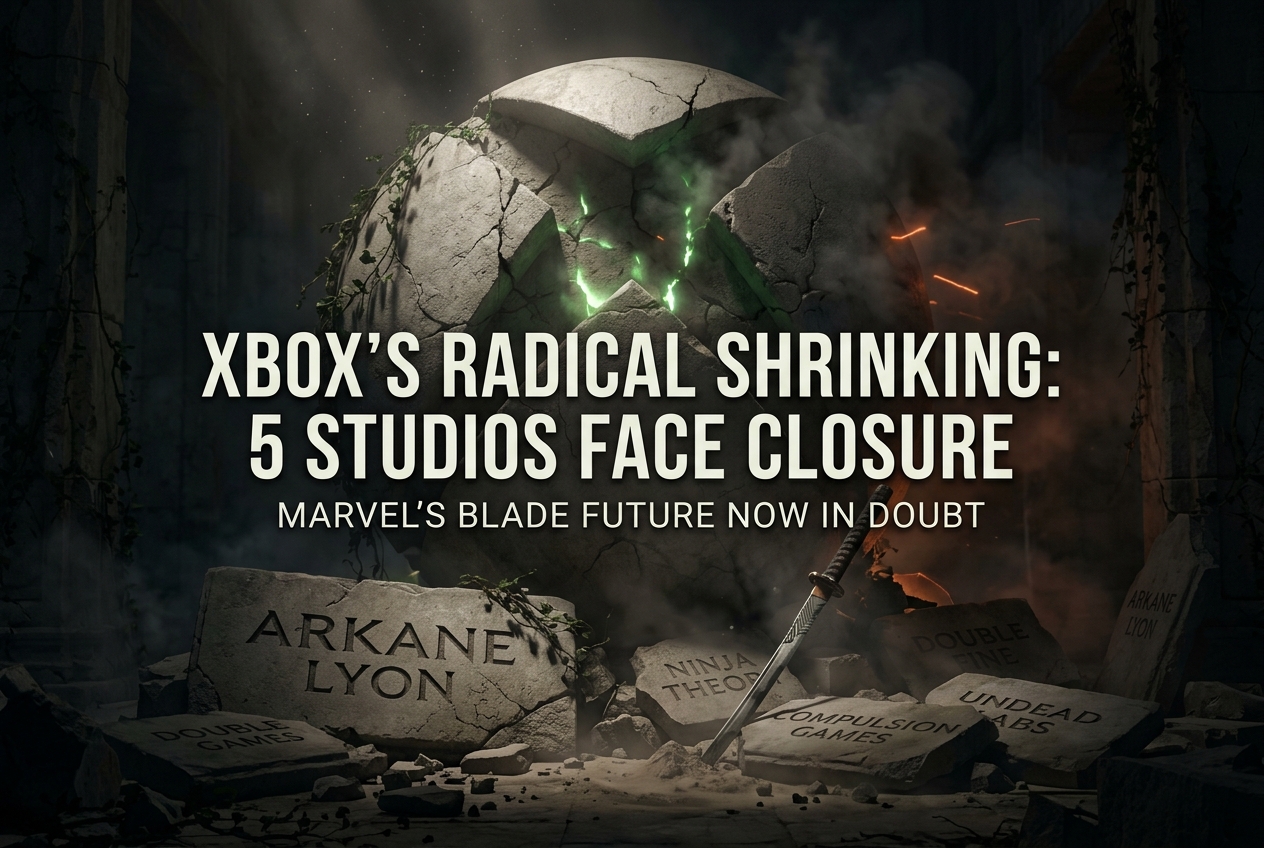
The content strategy going forward will prioritise a smaller number of high-impact franchises. Halo, Fallout, The Elder Scrolls, and Gears of War are expected to receive increased investment. At the same time, Sharma is reportedly preparing significant layoffs and budget cuts across less-popular studios immediately after Microsoft’s fiscal year ends on June 30, 2026. Bloomberg and The Verge have both reported the impending cuts, though the exact scale remains unclear.
What This Means for Players
Will Xbox games cost more?
Nadella did not announce price increases but acknowledged that component costs driven by AI and cloud demand are affecting the entire hardware industry. The introduction of ad-supported tiers could provide a lower-cost alternative rather than simply raising prices across the board. However, with Project Helix expected to launch above $999, next-generation hardware will clearly be more expensive.
Is Game Pass being discontinued?
No. Game Pass remains central to Xbox’s strategy and is approaching $5 billion in annual revenue. Changes to tier structure, pricing, and content policies are expected, but the service itself is being strengthened, not wound down.
Will Xbox stop making consoles?
No. Microsoft remains committed to Project Helix as a first-party console. However, the traditional subsidised-hardware model is being reconsidered. Whether Helix launches as a premium unsubsidised device or a subsidised console offset by services will depend on component pricing decisions expected to be finalised in early 2027.
Could Microsoft sell Xbox?
It is being discussed at a strategic level, but no imminent restructuring is planned. A spin-off, wholly owned subsidiary, or joint venture are all reportedly on the table as long-term options. Whether any of these materialise depends on whether the current reset improves Xbox’s financial performance.
The Road Ahead
Nadella’s public declaration that Xbox must generate its own revenue marks a historic shift. For 25 years, Xbox operated with the implicit safety net of Microsoft’s broader profitability. That era is over. With a 3% margin, over $20 billion invested with declining returns, hardware losses in the hundreds of dollars per unit, and a next-generation console that could cost over $1,000, Xbox faces the most consequential period in its history. Sharma’s next 100 days, beginning now, will determine whether the brand can transform from a subsidised entertainment arm into a genuinely self-sustaining business, or whether more dramatic structural changes become necessary.