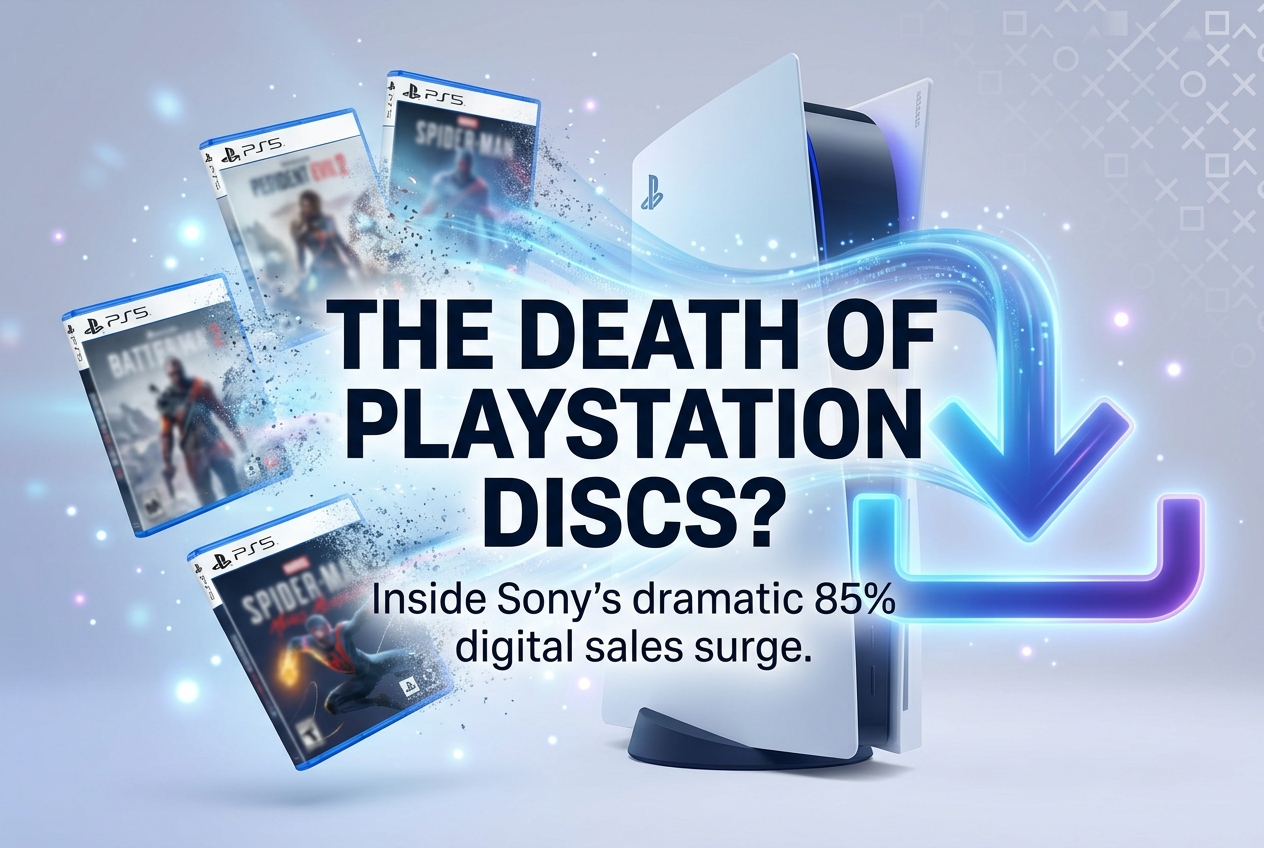
Sony’s latest financial report shows that 85% of PS5 and PS4 game sales were digital in Q4 FY2025, the highest ratio ever recorded. Physical game spending has hit historic lows globally. Here’s what it all means for the future of gaming.
Sony’s FY2025 Q4 financial results, published on May 8, 2026, confirm that 85% of all full game sales on PS5 and PS4 were digital downloads. Physical copies accounted for just 15% of total software sales during the quarter ending March 31, 2026. This is the highest digital download ratio Sony has ever recorded, and it arrives alongside a lifetime PS5 install base of 93.7 million units and 125 million monthly active users.
What Sony’s Latest Numbers Actually Show
The 85% figure represents a quarterly peak, but even the full-year average tells a striking story. Across FY2025 (April 2025 to March 2026), the digital download ratio averaged 78%, a 2% increase year-over-year. Total software unit sales reached 317.9 million for the fiscal year, with first-party titles contributing 5.8 million units in Q4 alone. These are not projections or estimates; they come directly from Sony Interactive Entertainment’s official business data.
For context, digital sales represented just 19% of PlayStation’s software revenue a decade ago. The pandemic pushed that number to 65% in 2020, and it has climbed steadily every year since. Reaching 85% in a single quarter is a landmark moment that reshapes how the industry thinks about distribution, retail, and the very concept of game ownership.
Physical Game Sales Are at Historic Lows
The decline is not limited to PlayStation. In the United States, spending on new physical video games fell 11% in 2025 compared to 2024, reaching just $1.5 billion. According to games industry analyst Mat Piscatella, that is the lowest figure tracked since records began in 1995 and marks the seventeenth consecutive year of decline. The peak was $11.6 billion in 2008.
Across Europe, the picture is similarly stark. In the UK, almost 90% of game sales were digital as of 2022, and Ubisoft reported a 35% drop in UK physical game sales during FY25. In Germany, 70% of game purchases were digital as of 2025. Even when looking only at games that have both physical and digital versions available (excluding digital-only titles), PS5 digital sales in Europe jumped from 55% in 2023 to 64% in 2024. The sports franchise EA Sports FC 25 hit 62% digital across Europe, up from 55% for its predecessor.
The UK games market as a whole reached a record £8.8 billion in 2025, but the growth was overwhelmingly driven by digital software. Digital console software alone generated nearly £2.5 billion, up 9% year-over-year, while physical boxed game revenue continued to shrink.
Why Digital Is Winning
Several forces are driving digital dominance simultaneously. The most obvious is convenience: players can purchase, download, and start playing a game within minutes without leaving their home. Digital storefronts run frequent sales and bundle promotions. Subscription services like PS Plus and Xbox Game Pass provide access to hundreds of titles for a monthly fee, further reducing the incentive to buy physical copies.
Hardware design is accelerating the shift as well. The PS5 was Sony’s first home console to launch with a disc-less SKU. The PS5 Pro shipped without any built-in optical drive at all. In Japan, the PS5 Digital Edition outsold the disc model by a staggering margin: Famitsu data from early April 2026 showed 12,141 digital PS5 units sold in a single week versus just 558 disc models. The disc-less Xbox Series S accounted for 75% of Xbox platform sales in 2025.
On the publishing side, an increasing number of titles are released as digital-only products. Many live-service games never receive a physical release. Even when discs exist, they often function more as installation keys that still require large downloads, diminishing one of physical media’s traditional advantages.
What This Means for PS6
Sony has not officially revealed the PlayStation 6, but the signals are hard to ignore. Sources cited by Insider Gaming in September 2025 indicated that PS6 will launch with two models: a fully digital edition and a model with a detachable disc drive. Sony reportedly views the detachable drive approach, first tested on the PS5 Slim, as a success that met all internal targets.
Multiple analysts and commentators have suggested that PS6 will not ship with a built-in disc drive in its base configuration. This would be a first in PlayStation history. The 85% digital sales ratio serves as the strongest data-driven argument for that direction. Additionally, rising memory and SSD prices have reportedly prompted Sony to consider delaying PS6 into 2028 while the company optimises component costs and evaluates business model changes, potentially including a cheaper, disc-less launch price.
The broader implication is clear: Sony is building its next-generation ecosystem around digital distribution as the default, with physical media becoming an optional add-on rather than a core feature.
Are Physical Games Really Dying?
Not entirely, but the trajectory is undeniable. Physical games still matter to collectors, to players who value resale rights, and to those who worry about digital ownership and long-term access. Technically, purchasing a digital game means buying a licence that a platform holder could theoretically revoke. Sony’s own recent introduction of a 30-day online check-in DRM system for newly purchased digital titles on PS5 has intensified those concerns.
Physical copies offer tangible ownership, the ability to lend or resell, and (in many cases) offline playability. There is also a growing collector’s market that may mirror what happened with vinyl records in the music industry: as digital becomes the default, physical editions could evolve into premium, collectible products rather than a mass-market distribution format.
However, even among younger gamers who express nostalgia or preference for physical media, the spending data does not support a reversal. Piscatella noted that while Gen Z may express interest in physical media, the numbers show spending continues to fall. The slowing rate of decline is more likely a sign of the market approaching its floor than evidence of a comeback.
The Ownership Debate: What Do You Actually Own?
This is perhaps the most important question for the long term. When a digital storefront shuts down or a publisher pulls a game, players lose access. The delisting of titles from PlayStation Store, the shutdown of live-service games like Anthem, and the DRM controversies of 2026 have all fuelled this debate. Physical discs do not solve every preservation problem (they degrade, require compatible hardware, and often still need patches), but they provide a degree of independence that purely digital purchases cannot.
For gamers who want to build a library they can access indefinitely, the shift to digital raises legitimate concerns. The industry has not yet offered a universally satisfying answer to the question of digital ownership rights, and the push toward 85% digital makes that conversation more urgent than ever.
What Players Usually Ask
What is PlayStation’s current digital game sales ratio?
In Q4 FY2025 (January to March 2026), 85% of all PS5 and PS4 full game sales were digital. The full-year average for FY2025 was 78%, up from 76% the previous year.
Will PS6 have a disc drive?
According to current rumours and leaks, PS6 will offer a detachable disc drive as an optional accessory. The base model is widely expected to be digital-only, making it the first mainline PlayStation console to launch without a built-in disc reader.
Are physical game sales declining everywhere?
Yes. In the US, physical game spending hit $1.5 billion in 2025, the lowest since tracking began in 1995. In the UK, physical sales dropped 35% in FY25. Germany is at 70% digital. The decline is global, though the rate varies by region and platform.
Is it better to buy games digitally or on disc?
Digital offers instant access, frequent discounts, and no storage clutter. Physical offers resale value, lending ability, and a degree of ownership independence. The best choice depends on your priorities. If long-term access and ownership matter most, physical still has advantages. If convenience and instant play are your priority, digital is the clear winner.
Could physical games become collectible?
Many analysts and industry observers believe physical editions will increasingly become premium, collector-oriented products rather than a mainstream distribution method, similar to how vinyl records found a niche audience after digital music took over.
The Bottom Line
PlayStation’s 85% digital sales figure is not just a quarterly data point; it is the clearest indicator yet that the gaming industry’s centre of gravity has permanently shifted. Physical media is not dead, but its role is rapidly changing from mainstream distribution channel to niche collector’s format. With PS6 reportedly designed around a digital-first philosophy and global physical sales hitting historic lows year after year, the disc era is not ending overnight, but it is undeniably winding down.