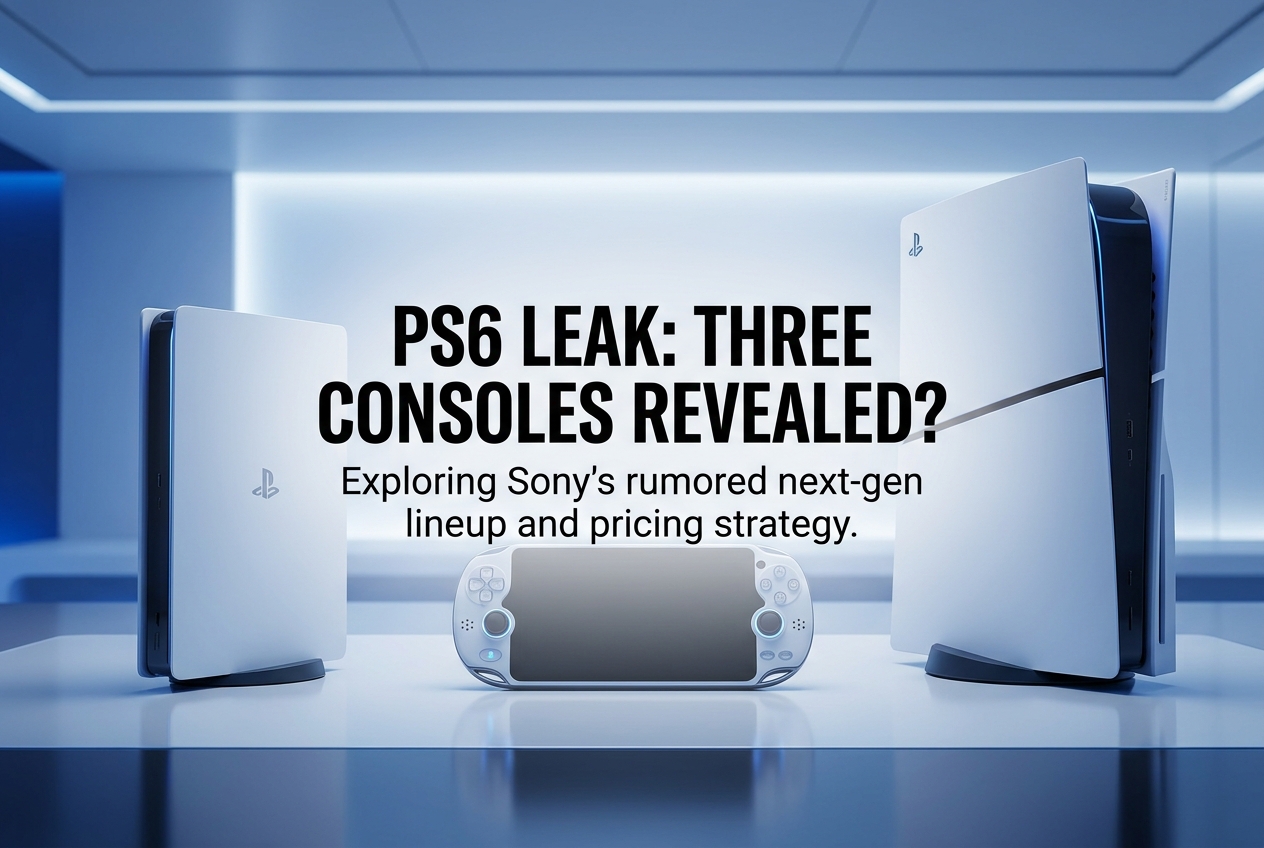
A new leak from Moore’s Law is Dead claims Sony will launch three PS6 devices simultaneously: a budget PS6 Lite, a standalone handheld, and a full-power PS6 console. Estimated prices range from $350 to $1,000. Here is what we know and what it means for next-gen gaming.
Sony’s PlayStation 6 may arrive not as a single console but as a family of three devices spanning a massive price range. According to a recent leak from YouTube channel Moore’s Law is Dead (MLID), Sony is planning to release a budget PS6 Lite, a standalone PS6 handheld, and a full-power PS6 console simultaneously, with prices estimated between $350 and $1,000. This comes just weeks after Sony raised PS5 prices globally by up to $150 on April 2, 2026, pushing the PS5 Pro to $899.99 in the US alone.
The Three PS6 Models Explained
MLID claims Sony is adopting a multi-device strategy similar to Microsoft’s Xbox Series X/S approach but expanding it further with a handheld. The rumored lineup consists of:
- PS6 S (or PS6 Lite): A lower-cost console comparable to the Xbox Series S. It would use AMD’s 3nm Canis chipset and serve as an affordable entry point into the new generation.
- PS6 Handheld: A fully standalone portable device, also powered by the AMD Canis chipset. Previous leaks suggest it would outperform the Xbox Series S and Nintendo Switch 2 while falling short of the base PS5.
- Full PS6: The flagship console, powered by AMD’s custom Orion APU. It could launch in two configurations: a digital-only version and a disc-based variant, though Sony may default to discless and offer the drive as an optional add-on.
Both the Lite and handheld sharing the Canis chip would allow Sony to reduce component costs across two products. The Orion-powered full console represents the ceiling of next-gen performance, with separate leaks suggesting it could target 4K at 120 FPS with advanced ray tracing.
Leaked Price Estimates
| Model | Chipset | Estimated Price (USD) |
|---|---|---|
| PS6 Lite / PS6 S | AMD Canis (3nm) | $349 – $549 |
| PS6 Handheld | AMD Canis (3nm) | $499 – $699 |
| Full PS6 | AMD Orion APU | $699 – $999 |
These estimates from MLID are said to factor in tariffs but were reportedly calculated before the full impact of the ongoing DRAM crisis. TechRadar notes that due to increasing component costs, RAM shortages, and rising tariffs, these figures could shift upward before launch. For context, the original PS5 launched at $499 in November 2020. Just five and a half years later, after two rounds of price increases, the standard PS5 now costs $649.99 in the United States.
Why Three Models? Sony’s Strategic Bet
Sony has traditionally launched each PlayStation generation as a single device (sometimes with a digital variant). The shift to three products signals a significant strategic pivot driven by several market forces:
The handheld resurgence: Steam Deck, Nintendo Switch 2, and the growing portable gaming market have demonstrated massive consumer appetite for gaming on the go. A standalone PS6 handheld would let Sony compete directly in this space, going beyond the PS Portal’s streaming-only approach. Bloomberg reported in November 2024 that Sony had already built a prototype handheld capable of running PS5 games natively.
Price barrier management: With the full PS6 potentially crossing the $700 mark, a budget Lite model between $349 and $549 gives Sony an entry-level option to keep the install base growing. This mirrors Microsoft’s approach with the Xbox Series S, which brought millions of players into the ecosystem who might not have bought the pricier Series X.
Component cost optimisation: Using the same Canis chipset across two products (Lite and handheld) creates manufacturing efficiencies that could help manage margins during a period of elevated semiconductor costs.
The PS5 Price Hikes: A Troubling Precedent
Sony’s decision to raise PS5 prices globally on April 2, 2026 adds an uncomfortable backdrop to PS6 pricing speculation. Here is what changed in key markets:
- US: PS5 $649.99 (was $549.99), PS5 Digital $599.99 (was $499.99), PS5 Pro $899.99 (was $749.99)
- Europe: PS5 €649.99, PS5 Digital €599.99, PS5 Pro €899.99
- UK: PS5 £569.99, PS5 Digital £519.99, PS5 Pro £789.99
Sony’s VP of Global Marketing, Isabelle Tomatis, cited “continued pressures in the global economic landscape” as the reason. This was the second price increase in under a year, following a $50 hike in August 2025. The PS5 Pro has now climbed $200 from its September 2024 launch price of $699.99 to $899.99 in less than two years.
If Sony cannot hold prices steady on current-gen hardware, the outlook for next-gen affordability looks even more challenging. Industry analysts have noted that the $999 ceiling for the full PS6 is “not impossible” given the trajectory of component costs.
The RAM Crisis Looming Over Next-Gen
The biggest uncertainty hanging over PS6 development is the global memory chip shortage, driven primarily by AI data centres consuming an outsized share of DRAM and HBM production. Bloomberg reported in February 2026 that Sony is “considering pushing back the debut of its next PlayStation console to 2028 or even 2029” because of this crisis.
A separate leak from hardware insider Kepler L2 suggests the PS6 will use 30 GB of GDDR7 RAM in a clamshell configuration. At current memory prices, this alone represents a significant chunk of the bill of materials. One industry analysis estimated that PS6 component costs could reach $760, making a sub-$700 retail price extremely difficult without Sony absorbing a loss on each unit sold.
MLID has countered the delay narrative, claiming that internal documents show the PS6 is on track for manufacturing readiness by Q2 2027 and that Sony is “too deep into the manufacturing pipeline” for a major delay. The channel argues that delaying would actually cost Sony more than launching, due to contractual obligations with AMD, TSMC, and other suppliers.
When Will the PS6 Actually Launch?
The release timeline remains contested. Here is where the main sources stand:
- Moore’s Law is Dead: Late 2027 launch, with all three devices arriving simultaneously.
- Bloomberg (February 2026): Sony considering a delay to 2028 or 2029 due to memory costs.
- Vice / SandStoneInsights: Delay “longer than many expected,” potentially 2029.
- Kalshi betting market (April 2026): Only 25.6% of bettors believe PS6 will be announced before 2027.
PlayStation architect Mark Cerny has said the next-generation console is “still several years away” without committing to a specific date. The traditional seven-year PlayStation cycle would point to late 2027 (seven years after PS5’s November 2020 launch), but the memory crisis introduces genuine uncertainty.
How Does This Compare to Xbox’s Next-Gen Plans?
Microsoft has confirmed a multi-year partnership with AMD to co-engineer next-generation silicon for the next Xbox (reportedly codenamed Project Helix). AMD has indicated that the next Xbox is on track for 2027 with OEM partners building hardware at multiple price points. Leaker Kepler L2 has suggested the next Xbox could also reach around $1,000 for its top-tier model.
The competitive pressure between Sony and Microsoft could be the deciding factor in whether PS6 makes a 2027 launch. Neither company wants to cede a full year of market momentum to its rival. The timing of major software releases, particularly Grand Theft Auto VI (now scheduled for November 19, 2026), also creates a strategic window that could influence console launch decisions.
The Digital-Only Direction
Another notable detail from the leak: Sony may ship all PS6 models without a disc drive by default. Players wanting physical media would need to purchase a separate disc drive accessory, extending the approach Sony started with the PS5 Slim’s detachable drive. This strategy could shave meaningful cost off each unit’s bill of materials while accelerating the industry’s shift toward digital distribution.
Key Questions Gamers Are Asking
Is Sony definitely releasing three PS6 models?
Nothing is confirmed. These claims originate entirely from MLID’s leak. Sony has not officially announced the PS6 or any details about its configuration. Treat this as informed speculation, not fact.
Could the PS6 really cost $1,000?
For the full console, yes, it is within the realm of possibility. The PS5 Pro already costs $899.99 after its latest price increase, and component costs continue to rise. Multiple industry analysts have described a $999 PS6 as “not impossible.” The Lite model at $349 to $549 would serve as the more accessible option.
Will the PS6 handheld replace the PS Portal?
Likely not as a direct replacement but as a major upgrade. The PS Portal is a remote play streaming device priced at $249.99. A PS6 handheld running games natively at $499 to $699 would be a fundamentally different product targeting a higher performance tier.
How does the RAM shortage affect the PS6?
The AI-driven memory crisis has caused DRAM prices to spike dramatically, with some reports citing a 171% year-on-year increase. This affects both the PS6’s bill of materials and potentially its launch timeline. Sony may need to choose between launching with less RAM, absorbing higher costs, or delaying further.
Should I wait to buy a PS5?
With PS6 potentially arriving in late 2027 at the earliest, and PS5 prices having just increased, the calculus depends on your budget and patience. The PS5 still has major upcoming titles including GTA VI in November 2026. For many players, the current generation has plenty of life left.
The PS6 rumor mill is spinning faster than ever. A three-model strategy would represent Sony’s boldest hardware bet since the original PlayStation, spanning from a budget-friendly Lite to a potentially $1,000 flagship. Whether Sony can deliver this ambitious lineup amid a global memory crisis and rising costs will define the next generation of console gaming.