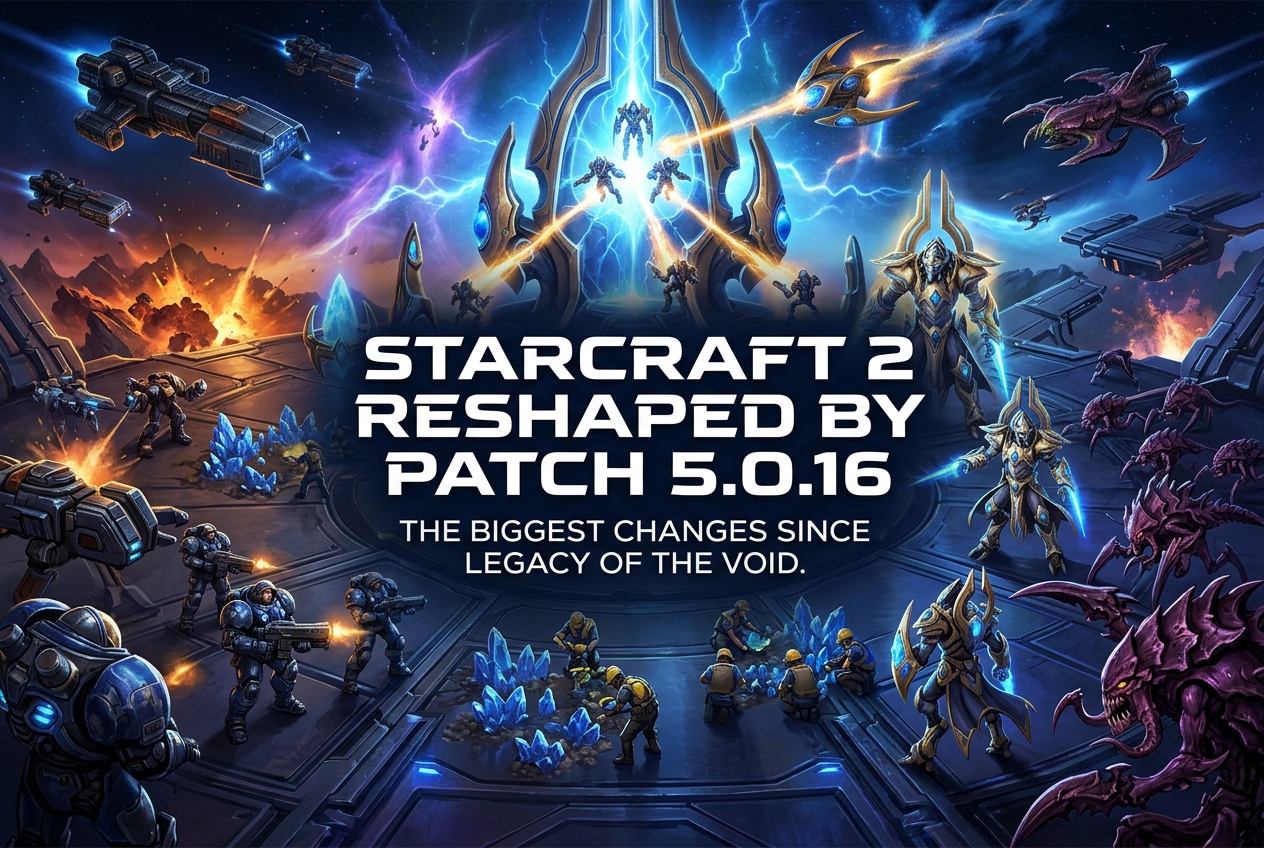
Blizzard has released StarCraft 2’s most transformative update since Legacy of the Void in 2015. Patch 5.0.16 reduces starting workers from 12 to 8, overhauls the Protoss Warpgate system, and rebalances all three races with sweeping economy and unit changes.
Blizzard released StarCraft II patch 5.0.16 on the Public Test Realm on 28 May 2026, delivering the most fundamental gameplay overhaul since Legacy of the Void launched in November 2015. The patch slashes starting workers from 12 to 8, redesigns the Protoss Warpgate mechanic, rebalances the economy across all bases, and ships dozens of quality-of-life fixes. In Blizzard’s own words, the goal is “extending the early and mid-game experience, allowing players to remain competitive on one to three bases for longer periods.”
Why Is Blizzard Updating StarCraft 2 Now?
StarCraft 2 effectively lost direct Blizzard support around 2020. For years, balance changes were handled by a community balance council of pro players and content creators. In September 2025, patch 5.0.15 broke that silence as Blizzard’s first official update in over five years. Now, 5.0.16 goes dramatically further by touching the game’s core economy for the first time in a decade.
The timing is not coincidental. In April 2025, South Korean gaming giant Nexon secured a content development agreement with Blizzard for the StarCraft intellectual property. Reports from Korean outlet dnews and subsequent coverage indicate that Nexon’s Shooter Division is working on a new StarCraft project, while Blizzard is also reportedly developing its own StarCraft shooter internally. Bloomberg’s Jason Schreier confirmed in late 2024 that a StarCraft shooter was in development at Blizzard, led by a former Far Cry series executive producer. This multi-front revival of the franchise provides clear motivation for keeping StarCraft 2 alive, visible, and exciting.
Economy Overhaul: From 12 Workers Down to 8
The headline change is the reduction of starting workers from 12 to 8. When Legacy of the Void raised the count from 6 to 12 in 2015, it eliminated the slow early-game ramp-up but also killed off iconic strategies like the Zerg 6 Pool, Protoss Proxy 2 Gate, and Terran Proxy 2 Rax. Pulling workers back to 8 reopens the window for aggressive early plays and entirely new opening builds that the community has not explored before.
Alongside this, Blizzard has retuned resource counts at every base. Large mineral patches drop from 1,800 to 1,600, while small patches rise from 900 to 1,200, narrowing the gap between them. Total minerals per base increase from 10,800 to 11,200, and total gas per base goes from 4,500 to 5,000. Rich Vespene Geysers now return 6 per trip instead of 8, making them slightly less dominant. The net effect: individual bases last longer, one-to-two-base strategies become more viable, and the pressure to constantly expand is reduced.
To compensate for the lower starting worker count, supply provided by all three factions’ main structures has been reduced. Hatchery/Lair/Hive drops from 6 to 4 supply, while Command Centers and Nexuses go from 15 to 13.
Protoss Warpgate Rework: The Biggest Structural Shift
Protoss players face the most homework with this patch. Warpgate research has been moved from the Cybernetics Core to the Gateway itself. Once researched, it speeds up normal Gateway unit production by 35 percent. However, transforming each Gateway into a Warpgate now costs 50 minerals and 50 gas, turning the switch into a genuine economic decision rather than an automatic upgrade.
The “slow power field” mechanic is gone entirely. Warp-in time is now a flat 3 seconds regardless of proximity to a Gateway or Nexus, down from 3.6 seconds (fast) and 11.4 seconds (slow). Individual Warpgate cooldowns have been adjusted: Zealot and Adept go from 20 to 22 seconds, Stalker and Sentry from 23 to 22, while High Templar and Dark Templar increase from 32 to 35 seconds.
Post-research Gateway production times have also been rebalanced. Zealot, Adept, and Stalker now produce in 18 seconds, Sentry in 16, and High Templar and Dark Templar in 26. This makes staying on regular Gateways without converting to Warpgates a genuinely competitive alternative for the first time. Psi Storm total damage has been reduced from 110 to 100, and Disruptors now have a “phantom attack” weapon that helps them behave more predictably during attack-move commands.
Zerg Changes: Cheaper Armour, Stronger Spellcasters
Zerg loses some early-game convenience but gains stronger mid-to-late tools. Creep spread and recede rate has been slowed from 0.45 to 0.55, reducing early map vision. Carapace upgrades are significantly cheaper at all three tiers (Level 1 down to 100/100, Level 2 to 150/150, Level 3 to 200/200), making defensive upgrades easier to fit into standard builds.
Infestors receive a major buff package. Microbial Shroud range jumps from 9 to 12, the ability no longer requires an Infestation Pit upgrade, and Infestors now have an auto-attack weapon so they contribute during regular engagements. Neural Parasite on builder SCVs will only expire when the captured structure finishes building, making those steals more consistent. Vipers can once again Abduct Siege Tanks in siege mode, reversing a previous restriction that heavily favoured Terran positional play.
Spore Crawlers deal more bonus damage against biological units (+15 instead of +10). Mutalisks get better glaive target prioritisation and a wider arc, making them behave more predictably in larger groups. Overlords gain a “Load Nearby Units” command but move more slowly before Pneumatized Carapace research (0.7 instead of 0.9). Changelings now copy the caster’s order queue and their deaths are contagious to nearby Changelings, reducing micro busywork.
Terran: A Redefined Ghost
Terran receives the fewest changes, and most are concentrated on the Ghost. Supply cost increases from 2 to 3, and health drops from 125 to 100, making each Ghost a bigger investment. In return, the basic attack is now a flat 20 damage (instead of 10 +10 vs Light) with range increased from 6 to 7, making the Ghost effective against all unit types rather than specialised against light targets.
Steady Targeting has been reworked significantly. Damage becomes a flat 170 (up from 130 +40 vs Psionic), energy cost rises from 50 to 75, and critically, the ability can no longer be cancelled by dealing damage to the Ghost. A full-energy Ghost can now fire only two Steady Targeting shots instead of four, but each one lands with certainty. This makes the Ghost a higher-impact, higher-risk unit that rewards careful positioning rather than mass-snipe spam.
Command Centers provide 2 less supply (13 instead of 15). Medivacs gain the “Load Nearby Units” command and an updated subgroup priority order that places Ghosts first, making bio army control smoother.
Quality-of-Life Fixes: Years of Issues Addressed
The patch includes an extensive quality-of-life section that addresses long-standing community complaints. Carrier Interceptors under Neural Parasite now correctly inherit the opponent’s upgrades. EMP visuals clearly display the effect radius. Guardian Shield visuals no longer persist when units are loaded into transports. Colossus drop positioning from Warp Prisms is more consistent. Melee units no longer lose their attack order when an SCV passes through a structure under construction.
Xel’naga Towers can now be selected through the fog of war and display their vision radius when selected. Worker gathering logic has been improved so that workers near a geyser automatically switch to a gather order when a refinery is built. Active Creep Tumors take selection priority over inactive ones. Larva and Eggs no longer block player structures or units. Mule repair has been set to auto-cast by default. Several spell visual and audio indicators across all three races have been polished for better readability during fights.
Community Reaction: Shock, Then Excitement
The response from professional players and content creators has been overwhelmingly positive, though mixed with disbelief. Former Protoss pro MaNa described himself as “in shock” at the scope of the changes, while noting that the reduced worker count could benefit newer players who find the current fast-expanding meta overwhelming. Popular YouTuber and caster Lowko called it “the biggest fundamental change to the game since Legacy of the Void.”
PCGamesN’s coverage summarised the community mood: “It’s mostly shock to see that Blizzard has remembered the game exists, but the promise of a meta shakeup after so long is just rather exciting.” Some players have raised concerns about specific changes, particularly whether moving Warpgate research to the Gateway enables overly aggressive early Protoss play, and whether the Ghost changes make the unit too dominant. These are exactly the kinds of issues the PTR testing period is designed to surface.
What This Means for the StarCraft Franchise
Patch 5.0.16 is not an isolated event. It fits into a broader pattern of StarCraft franchise activity that began accelerating in 2025. The Nexon licensing deal, rumours of at least two StarCraft shooter projects in development, Archon Studio’s StarCraft tabletop miniatures game planned for 2026, and the return of active Blizzard patching all point toward a coordinated revival strategy. Whether Nexon is building a mobile free-to-play title, a competitive shooter, or something else entirely remains unconfirmed, but the franchise is clearly receiving more attention than it has in years.
The patch is currently live on the PTR only, and there is no guarantee that every change will reach live servers in its current form. But the fact that Blizzard is willing to touch the game’s core economy, something many players assumed would never change again, sends a strong signal about StarCraft 2’s future. For a game that went most of a decade with only incremental balance tweaks, 2026 is shaping up to be a pivotal year.
Questions Players Are Already Asking
Is patch 5.0.16 live on ranked ladder?
No. As of 30 May 2026, the patch is available only on the PTR (Public Test Realm) for testing. There is no confirmed date for the live server release, and Blizzard may revise changes based on community feedback and testing data before pushing them live.
Will my existing build orders still work?
Most current build orders will need significant reworking. The drop from 12 to 8 starting workers changes every early-game timing, and the adjusted mineral, gas, and supply values mean that standard macro sequences no longer line up as before. Pro players have already started experimenting on the PTR, and new optimised builds will likely emerge over the coming weeks.
Did Blizzard remove Warpgates?
No. Warpgates still exist, but transforming a Gateway into a Warpgate now costs 50 minerals and 50 gas each. The research has also moved from the Cybernetics Core to the Gateway, and normal Gateway production is 35 percent faster once the research completes. This makes choosing between standard Gateway production and Warpgate warp-ins a real strategic decision rather than an automatic upgrade.
Is StarCraft 2 still free to play?
Yes. StarCraft 2’s Wings of Liberty campaign, multiplayer, co-op mode, and ranked ladder remain free to play. The Heart of the Swarm and Legacy of the Void campaigns require purchase, but the core competitive and casual experience costs nothing.
Does this patch hint at StarCraft 3?
Blizzard has not announced StarCraft 3. However, the combination of active patching, the Nexon partnership, and multiple reported StarCraft projects in development suggests that the franchise is being positioned for a broader comeback. Whether that includes a traditional RTS sequel remains unknown, but the IP is clearly no longer dormant.