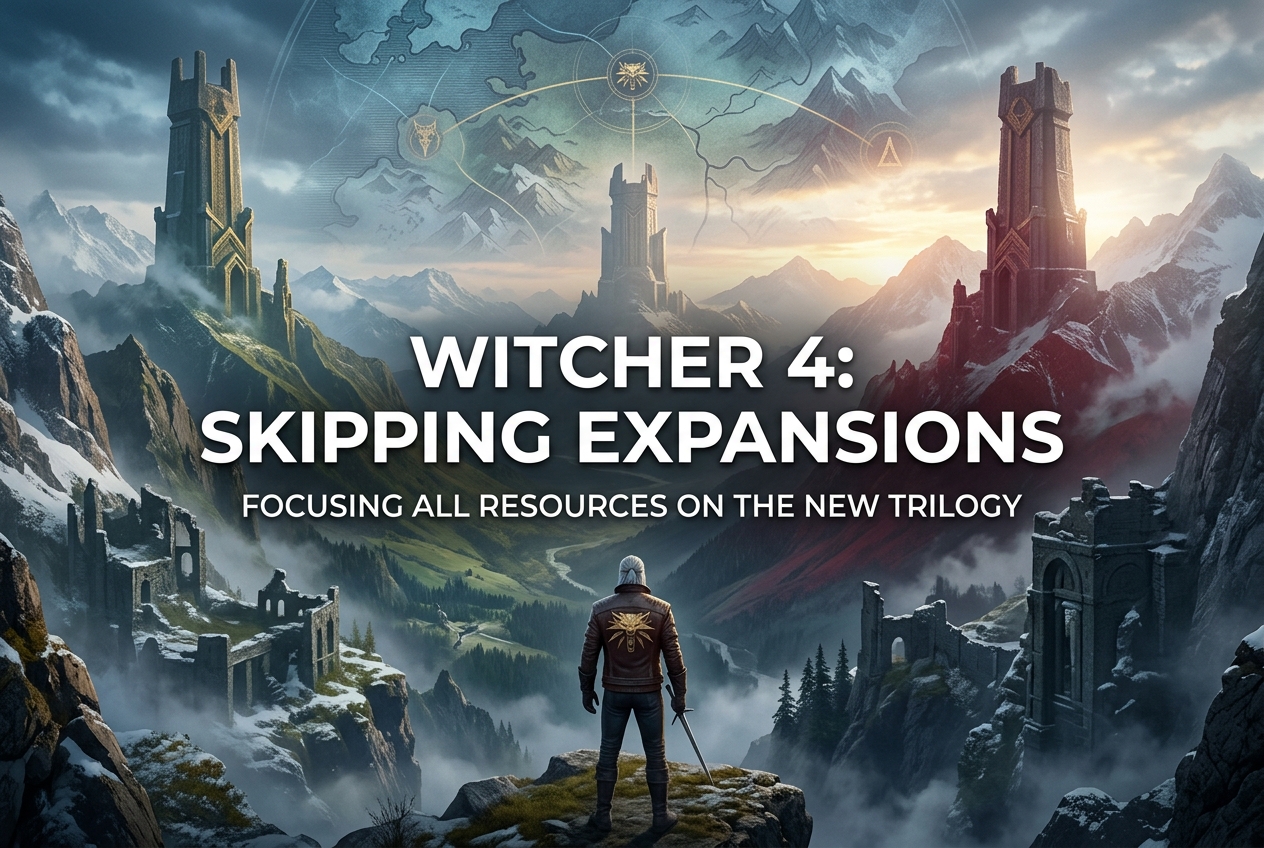
CD Projekt Red has confirmed that The Witcher 4 and its sequels won’t receive expansions like Blood and Wine. The studio’s ambitious plan to release three Witcher games in six years is the reason.
CD Projekt Red has confirmed that The Witcher 4 will not receive expansions. During the company’s Q1 2026 earnings call, joint CEO Michał Nowakowski directly addressed the question, stating that the studio’s plan to release three Witcher games within six years leaves no room for major add-ons. The Witcher 3: Wild Hunt, which has sold over 65 million copies, set a high bar with expansions like Hearts of Stone and Blood and Wine, but that model is not carrying forward.
What Exactly Did CDPR Say?
An investor asked Nowakowski a pointed question: “Given the very ambitious project pipeline, does the company see room for developing expansions for the new Witcher saga?” His response left little ambiguity: “As you mentioned in the question, the plans are pretty ambitious. Specifically, it’s to release three Witcher games within a six-year period. It would be difficult, to be very honest, for us to add an expansion to the upcoming trilogy. This is where we are here and now with this particular issue.”
This statement covers not just The Witcher 4, but the entire new saga. The Witcher 5 and The Witcher 6 are equally unlikely to receive standalone expansions. CDPR is essentially trading the expansion model for a faster release cadence across full games.
The Six-Year Trilogy Plan Explained
CDPR first outlined this timeline during its Q3 2025 earnings call in November 2025. Nowakowski confirmed: “Our plan still is to launch the whole trilogy within a six-year period, so yes, that would mean we would plan to have a shorter development time between TW4 and TW5, between TW5 and TW6 and so on.” The studio also confirmed The Witcher 4 would not launch in 2026, pointing to 2027 at the earliest.
If The Witcher 4 releases in late 2027 or 2028, the math suggests The Witcher 5 could arrive around 2030 and The Witcher 6 by 2033. For context, The Witcher 3 took roughly five years to develop. Compressing three games of similar scope into six years is unprecedented for a studio of CDPR’s ambition, especially while Cyberpunk 2 (codenamed Project Orion) is also in pre-production.
The shift to Unreal Engine 5 is part of the strategy. CDPR moved away from its proprietary REDengine to reduce iteration time and benefit from shared tooling across projects. Nowakowski noted the team has been pleased with how UE5 handles a large open-world game of The Witcher 4’s scale.
Songs of the Past: The Final Major Witcher Expansion?
On May 27, 2026, CDPR announced Songs of the Past, a third expansion for The Witcher 3: Wild Hunt. Coming 10 years after Blood and Wine and 11 years after the base game’s launch, the expansion arrives in 2027 for PC, PS5, and Xbox Series X|S. It is being co-developed with Fool’s Theory, a Polish studio founded by Witcher 3 veterans that also developed The Thaumaturge in 2024 and is working on The Witcher Remake.
Nowakowski compared its scope directly to Blood and Wine: “When it comes to the scope, I’d say it’s actually a little bit closer to Blood and Wine. But we’re definitely making a proper big expansion, is the message I would send out there.” Blood and Wine offered over 30 hours of content, 90+ quests, an entirely new region in Toussaint, and won Best RPG at The Game Awards 2016.
CDPR was emphatic about terminology. The studio distinguishes between DLCs (small free content drops like outfits) and expansions (major paid content with new story and characters). Social media manager Marcin Łukaszewski clarified: “For us at CDPR, DLCs are small pieces of content we release for free. Expansions, on the other hand, are major pieces of content providing lots of hours of gameplay, including new story, characters, etc.”
What Songs of the Past Means for The Witcher 4
Songs of the Past is widely expected to serve as a narrative bridge between The Witcher 3 and The Witcher 4. Geralt returns as the protagonist, but The Witcher 4 will feature Ciri as the lead character. The expansion’s release in 2027 also signals that The Witcher 4 is still further out, with analysts projecting late 2028 or even 2029 as more realistic launch windows.
Interestingly, CDPR hinted at additional unrevealed content during the earnings call. CFO Piotr Nielubowicz noted that Songs of the Past was originally planned for 2026 but was pushed to 2027 for quality reasons. He added: “We obviously have some other content currently at an advanced production phase as well. And while it’s obviously not on the same scale as the major expansion, we will plan to release it this year.” This suggests smaller Witcher 3 content may arrive before the expansion itself.
CDPR has also confirmed that Songs of the Past will be shown at Gamescom 2026 (August 26-30), though without a hands-on demo. More details will follow in late summer 2026.
What We Know About The Witcher 4
The Witcher 4, codenamed Project Polaris, is the first entry in a new Witcher saga. Key confirmed details include:
- Protagonist: Ciri, with Geralt confirmed to appear but not as the main character
- Engine: Unreal Engine 5, replacing CDPR’s proprietary REDengine
- Genre: Story-driven open-world RPG
- New locations: Kovir region and previously unexplored areas of the Continent
- Team size: Approximately 450 developers (roughly 90% of CDPR’s workforce)
- Platforms: PS5, Xbox Series X|S, and PC
- Release: Not before 2027; analysts estimate late 2027 to 2028
- Features: Gwent card game confirmed to return
The game was first announced in March 2022 when CDPR confirmed a new Witcher project built on Unreal Engine 5. A cinematic trailer debuted at The Game Awards 2024, revealing Ciri as the protagonist and showcasing a darker tone with new combat elements including chain-based weapons.
What Does No Expansion Mean for Players?
The Witcher 3’s expansions are widely considered some of the best additional content in RPG history. Blood and Wine alone was practically a standalone game, with 14,000 lines of dialogue, over 20 new monsters, and 100 individual armour pieces. Hearts of Stone delivered one of the series’ most acclaimed storylines in a tighter package. The absence of similar content for The Witcher 4 may disappoint fans who expected the same treatment.
However, the trade-off is clear. Instead of waiting years for an expansion after each game, CDPR is promising a new full Witcher game every two to three years. If the studio can maintain quality across all three entries, players will receive substantially more content overall than a single game with two expansions. The counter-argument is that game development rarely sticks to aggressive timelines, and some scepticism about the six-year plan is warranted.
Common Questions About the Witcher 4 and DLC
Will The Witcher 4 have any post-launch content at all?
CDPR has not ruled out smaller free DLC in the vein of outfit packs or minor additions. What they have ruled out is major paid expansions on the scale of Blood and Wine or Phantom Liberty.
Is Songs of the Past the last expansion CDPR will ever make?
Based on Nowakowski’s comments, none of the new trilogy games will receive expansions. Songs of the Past may indeed be the last major Witcher expansion for the foreseeable future, though CDPR has not made a permanent commitment against the concept.
When will The Witcher 4 release?
No official date has been given. CDPR confirmed it will not launch in 2026. Most analysts and industry observers point to late 2027 or 2028 as the most likely window.
Can CDPR realistically ship three Witcher games in six years?
It is an extraordinarily ambitious target. CDPR’s restructured pipeline, UE5 adoption, and expanded team size support the goal, but game development delays are common. The studio itself used careful language, saying this is “where we are here and now,” leaving room for adjustments.
Will Songs of the Past connect to The Witcher 4’s story?
CDPR has not confirmed direct narrative connections, but the expansion is widely expected to bridge the gap between Geralt’s story and Ciri’s new saga. Developers teased that the Belleteyn festival will play a significant role, and community speculation points to possible setup for Witcher 4 plotlines.
The era of massive Witcher expansions appears to be ending with Songs of the Past. In its place, CDPR is betting on a rapid trilogy release strategy that promises more full games in less time. Whether the studio can deliver on that promise will define the next decade of the franchise.