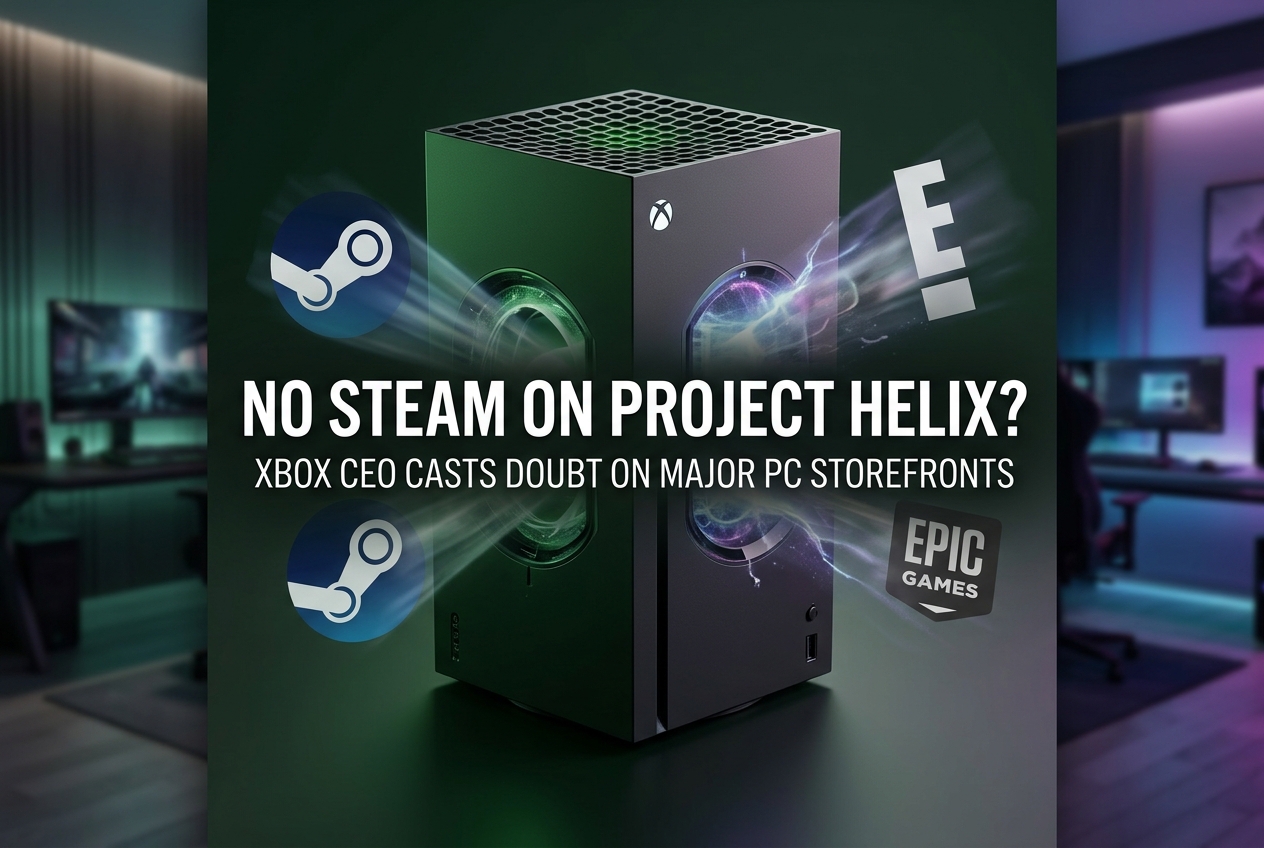
Microsoft’s next-gen Xbox console Project Helix is confirmed to play PC games, but Xbox CEO Asha Sharma’s latest comments have cast serious doubt on whether Steam and Epic Games Store will actually be available on the device.
Microsoft’s next-generation console Project Helix will play both Xbox and PC games, but Steam and Epic Games Store access is no longer a sure thing. New Xbox CEO Asha Sharma told Game File journalist Stephen Totilo that the third-party storefront discussions happened under previous leadership, and that future decisions will be made fresh. With alpha dev kits shipping to developers in early 2027 and a consumer launch expected no earlier than 2028, the storefront question is one of the biggest unknowns hanging over the next Xbox generation.
What Is Xbox Project Helix?
Project Helix is the codename for the fifth-generation Xbox console, succeeding the Xbox Series X and Series S. Asha Sharma officially announced it on March 5, 2026, confirming that the system would “lead in performance and play your Xbox and PC games.” At GDC 2026, Vice President of Next Generation Jason Ronald detailed the hardware during the Xbox Developer Summit keynote, revealing a custom AMD SoC co-designed for the next generation of DirectX and FSR.
According to the official Xbox Wire summary, Project Helix promises “an order of magnitude leap in ray tracing performance and capability” along with machine learning upscaling, multi-frame generation, and neural texture compression. The Xbox Play Anywhere catalogue already spans over 1,500 games and 500 development teams, giving the next-gen platform a significant software runway from day one.
Why Is Steam Support Suddenly in Question?
The expectation that Project Helix would support Steam and other PC storefronts did not come out of nowhere. Windows Central journalist Jez Corden reported in March 2026 that the console would be “the most open Xbox ever,” essentially functioning as a gaming PC with the Xbox Full Screen Experience as its front-end. He stated users would be able to “boot up the Windows Desktop from here, and install other PC stores such as Steam, Epic Games, GOG, Riot Client, Battle.net, and much more.”
Epic Games Store VP Steve Allison reinforced this narrative in February 2026, telling Game File that his team had been in discussions with Microsoft and planned to have a native Epic Games Store app on the new Xbox “on day one.” Allison said, “If they let Steam and Epic Games Store on next-gen Xbox console hardware, we’ll be there.”
Then came Sharma’s interview. When Totilo pressed her on whether these plans were still active, the Xbox CEO distanced herself from the earlier promises. She explained that the conversations Allison referenced happened with a prior leadership team during the Phil Spencer era, and that she was not part of them. “I’ll make those decisions going forward as a team, and with our partners. We’ll share more when we’re ready,” Sharma said. The response stopped short of a denial but was far from a confirmation.
What Could Be Driving Microsoft’s Hesitation?
Revenue sharing is the most obvious factor. If players purchase games through Steam or Epic Games Store on an Xbox console, Valve and Epic collect their platform cut rather than Microsoft. Keeping purchases within the Xbox Store ecosystem protects Microsoft’s revenue margins on every software transaction. For a device that will likely carry a premium price tag, maximizing per-unit software revenue becomes strategically important.
Exclusivity also plays a role. Sharma mentioned in the same interview that she is reconsidering the exclusivity approach. A more closed storefront environment would make Xbox-exclusive titles a stronger selling point, something that has been a weak spot for the brand in recent years. The ROG Xbox Ally handheld currently supports all third-party storefronts through its Windows environment, but that openness may not carry over to the dedicated console.
Competition with Valve adds another layer. The Steam Machine, Valve’s upcoming desktop gaming PC, is expected to launch in 2026. Allowing Steam on Project Helix would effectively validate Valve’s ecosystem inside Microsoft’s own hardware. Blocking it would force gamers to choose between platforms, a risky but potentially market-defining move.
Confirmed Technical Specifications
While storefront access remains unclear, Microsoft has shared concrete hardware details through the GDC 2026 keynote and subsequent reports:
- Custom AMD SoC: Co-designed for next-gen DirectX with GPU-directed work graph execution
- Ray tracing: An “order of magnitude leap” in RT performance, enabling console path tracing for the first time
- AMD FSR Next: Next-gen ML upscaling, multi-frame generation, and ray regeneration
- Deep texture compression: Neural texture compression with DirectStorage and Zstd support
- Backwards compatibility: Four generations of Xbox games supported with AI-enhanced visuals
Leaked specifications point to up to 68 RDNA 5 compute units, a Zen 6 CPU architecture, and up to 48 GB of GDDR7 memory. If accurate, Project Helix would significantly outperform both the current Xbox Series X and PlayStation 5 in raw hardware capability.
Release Timeline and Pricing Outlook
Alpha dev kits will begin shipping to developers in early 2027, which places the earliest realistic consumer launch in late 2027 or 2028. Most analysts lean toward 2028 as the likely window, especially given the ongoing RAM supply crisis caused by AI data centre demand for GDDR memory.
Bloomberg reported in February 2026 that Sony may delay the PS6 to 2028 or 2029 for the same reason. The Xbox Series X already saw a price increase to $649.99 in the US due to macroeconomic pressures, and GamesRadar’s hardware team expects next-gen pricing to exceed current-gen levels on both sides. No European or global pricing has been indicated by Microsoft.
What Does “Open Platform” Actually Mean?
Sharma described her vision as keeping the platform “open” so that more people can create and more players can personalise and expand their experience. The problem is that “open” can mean very different things depending on context. It could mean full Windows desktop access with unrestricted storefront installation, similar to the ROG Xbox Ally. It could also mean an open development environment where studios can port games easily, without necessarily opening the consumer-facing storefront.
Xbox mode, the full-screen console UI that debuted on the ROG Xbox Ally, began rolling out to Windows 11 PCs in April 2026. This interface sits on top of Windows and lets users switch between a console-like gaming experience and a productivity desktop. Project Helix is expected to use this same architecture, but whether users will have free access to the underlying Windows environment, and therefore to Steam and other launchers, remains the central unanswered question.
The Wider Console-PC Convergence Picture
Project Helix exists in a broader moment where the line between console and PC gaming is dissolving. Valve is preparing its Steam Machine as a living-room PC alternative. Sony has been pulling back from PC ports, reportedly in response to the threat posed by a console that can natively run PC games. Nintendo’s Switch 2 is carving its own hybrid path. Microsoft’s decision on storefront openness will shape the competitive landscape for the entire next generation.
From a developer perspective, Microsoft’s unified Game Development Kit (GDK) is designed to let studios build once and deploy across PC, Xbox console, handhelds, and smart TVs. Xbox indie director Guy Richards noted at GDC 2026 that this approach could drive more sales for smaller studios. If Steam is supported, developers could reach Project Helix users through Valve directly; if not, the Xbox Store becomes the mandatory gateway, increasing Microsoft’s leverage but potentially limiting the library’s breadth.
Key Questions Players Are Asking
Will my existing Steam library work on Project Helix?
Not confirmed. While earlier reports from Windows Central and statements from Epic Games suggested full third-party storefront access, Asha Sharma has not endorsed those plans. Until Microsoft makes an official statement, Steam library compatibility remains speculative.
Is Project Helix backwards compatible?
Yes. Jason Ronald confirmed at GDC 2026 that four generations of Xbox games will be supported, with AI-enhanced upscaling bringing older titles to 4K resolution and up to 120 FPS. Microsoft has committed to keeping legacy games “playable for years to come.”
When will Project Helix launch?
Alpha dev kits ship in early 2027. The most commonly cited consumer launch window is late 2027 to 2028, though RAM supply issues could push it further. A reveal event is anticipated around November 2026, coinciding with Xbox’s 25th anniversary celebrations.
How does Xbox Game Pass fit in?
Microsoft has been restructuring Game Pass with cheaper tiers and new partnership models. Sharma has publicly acknowledged that Game Pass pricing needs to become more accessible. The full next-gen Game Pass strategy has not been detailed yet. If you want to explore the current Xbox ecosystem, Xbox gift cards on GamerMarkt offer a straightforward way to add balance for Game Pass subscriptions and digital purchases.
What Happens Next
The storefront question will likely dominate Xbox coverage throughout the rest of 2026. Sharma has promised to share more details “when we’re ready,” and insiders expect a significant hardware reveal event later this year. The November 2026 Xbox 25th anniversary is widely seen as the most probable timing for a full Project Helix showcase, including clarity on third-party store support.
For now, the situation is defined by a gap between what insiders and third-party executives have suggested and what the current Xbox leadership is willing to confirm. That gap is not a rejection, but it is a clear signal that plans are being reconsidered under new management. For more context on Microsoft’s broader strategy, the Xbox new roadmap and Project Helix strategy breakdown covers the full picture of where the brand is heading.