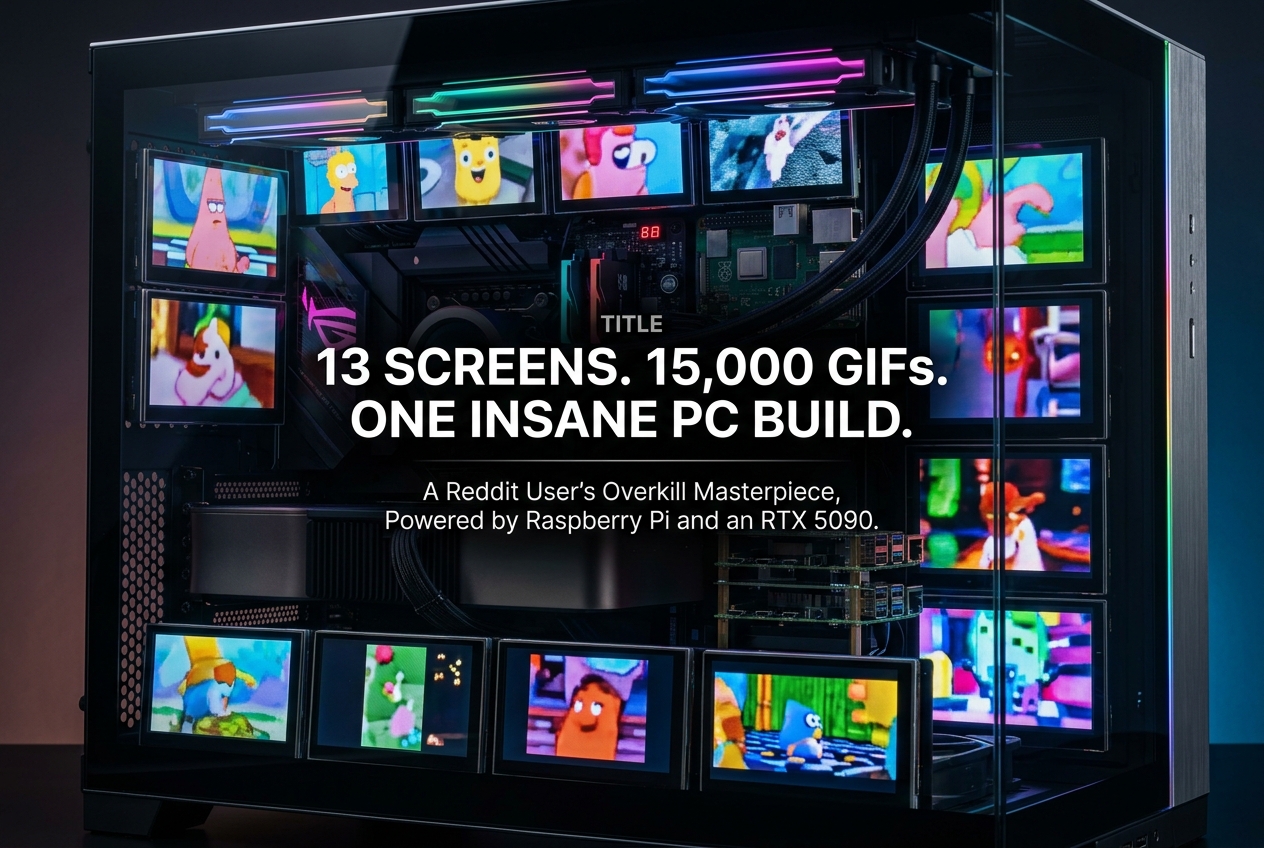
Reddit user Several-Bar-6512 crammed 13 displays into a Lian Li O11 Dynamic Evo XL case, running 15,000 animated GIFs on a 13.5-hour loop. Powered by three Raspberry Pi 5 boards, an RTX 5090, and a Ryzen 9 9950X3D, the build took around 200 hours to complete.
Reddit user Several-Bar-6512 has built a gaming PC with 13 separate screens crammed inside a single Lian Li O11 Dynamic Evo XL case, each one continuously cycling through a curated library of roughly 15,000 animated GIFs. The project took approximately 200 hours of work and runs on top-tier hardware including an NVIDIA RTX 5090 and an AMD Ryzen 9 9950X3D.
How Do 13 Screens Run Without Killing Performance?
The key engineering decision behind this build is that none of the screens rely on the main PC hardware for content delivery. The larger displays are powered by three dedicated Raspberry Pi 5 single-board computers, which handle all decoding and output duties independently. The nine smaller screens pull their imagery directly from microSD cards, bypassing the main system entirely.
This means the RTX 5090 and Ryzen 9 9950X3D are completely free for gaming and workloads. Every screen turns on and off with the PC itself, so pressing the power button triggers an instant cascade of animated imagery across the entire case interior.
Full Hardware Specs
Beyond the visual spectacle, the PC underneath is a high-end build in its own right. According to reports covering the project, the system packs an AMD Ryzen 9 9950X3D processor, an NVIDIA RTX 5090 graphics card, 96 GB of DDR5 RAM, and a 4 TB Samsung 9100 Pro SSD. This is not a display-only showpiece; it is a fully functional gaming and productivity machine capable of handling anything thrown at it.
The Lian Li O11 Dynamic Evo XL was chosen for its generous internal volume and flexible mounting options, both critical for fitting 13 displays along with all the supporting hardware.
17,000 GIFs Downloaded, 15,000 Made the Cut
The content curation process was arguably more time-consuming than the hardware assembly. Several-Bar-6512 reported spending “countless hours” scouring the internet and downloading over 17,000 GIF files. After an editing and organisation phase, roughly 15,000 GIFs survived the cut and were included in the final rotation.
To prevent visual repetition, the GIFs were randomly named and then sequentially renamed so that animations from the same category would not appear next to each other across adjacent screens. Each screen block runs its own GIF category, and the full library takes approximately 13.5 hours to play through without a single repeat.
200 Hours of Assembly and Configuration
The total build time was estimated at around 200 hours. That figure covers not just the physical mounting of 13 screens and three Raspberry Pi boards, but also the resolution calibration for each display, frame rate adjustments, GIF sorting, and the painstaking cable management required to keep everything functional inside a single chassis.
As PC Gamer noted in its coverage, there are still visible gaps inside the case, which could suggest that even more screens may be added in the future. Given the project owner’s evident commitment to maximising every available surface, this would not be surprising.
Why the Lian Li O11 Dynamic Evo XL Works for This Build
The O11 Dynamic Evo XL is widely regarded in the modding community as one of the most versatile full-tower cases available. Its dual-chamber layout, extensive fan mount positions, and large tempered glass panels make it a favourite for showcase builds. The case supports multiple radiator configurations and offers enough clearance for vertically mounted GPUs, which frees up additional surface area for screen placement.
The modular interior also accommodates the Raspberry Pi boards and microSD card readers without creating a cable management nightmare, something that would be nearly impossible in a smaller or more rigid chassis design.
The Rise of In-Case Display Modding
Putting screens inside a PC case is not entirely new. Manufacturers like Lian Li and NZXT have been selling LCD-equipped fans and AIO coolers for several years, and the Raspberry Pi community has long experimented with using single-board computers to drive in-case displays without taxing the main GPU. The Brutus 2 case, for example, used a Raspberry Pi to power a semi-transparent animated side panel years ago.
What sets Several-Bar-6512’s project apart is the sheer scale: 13 displays, 15,000 GIFs, three Raspberry Pi boards, and a 13.5-hour content loop. It takes the concept of case customisation well beyond RGB lighting or a single sensor panel and turns the PC into a living digital gallery.
Things People Usually Ask
Does running 13 screens affect gaming performance?
No. All screens are powered independently by Raspberry Pi 5 boards and microSD cards. The main PC components (RTX 5090, Ryzen 9 9950X3D, 96 GB RAM) remain entirely free for games and other workloads.
How long does it take to see every GIF without a repeat?
Approximately 13.5 hours. The library contains around 15,000 curated GIFs, each assigned to specific screen categories and sequenced to avoid same-topic repetition across adjacent displays.
What kind of case do you need for a project like this?
A large, modular case with ample internal volume is essential. The Lian Li O11 Dynamic Evo XL used in this build offers a dual-chamber design, multiple fan mount positions, and enough clearance for numerous screens and additional hardware like Raspberry Pi boards.
How much time and effort does a build like this require?
The creator estimated roughly 200 hours of total work. This includes hardware assembly, screen mounting, resolution and frame rate calibration, GIF downloading, sorting, renaming, and cable management across all 13 displays and three Raspberry Pi units.
Can the screens display anything other than GIFs?
In principle, yes. Raspberry Pi boards can output virtually any visual content to connected displays. However, the microSD-based smaller screens are configured specifically for GIF playback in this build, while the Pi-driven displays could theoretically run video, system stats, or custom animations with different software configurations.