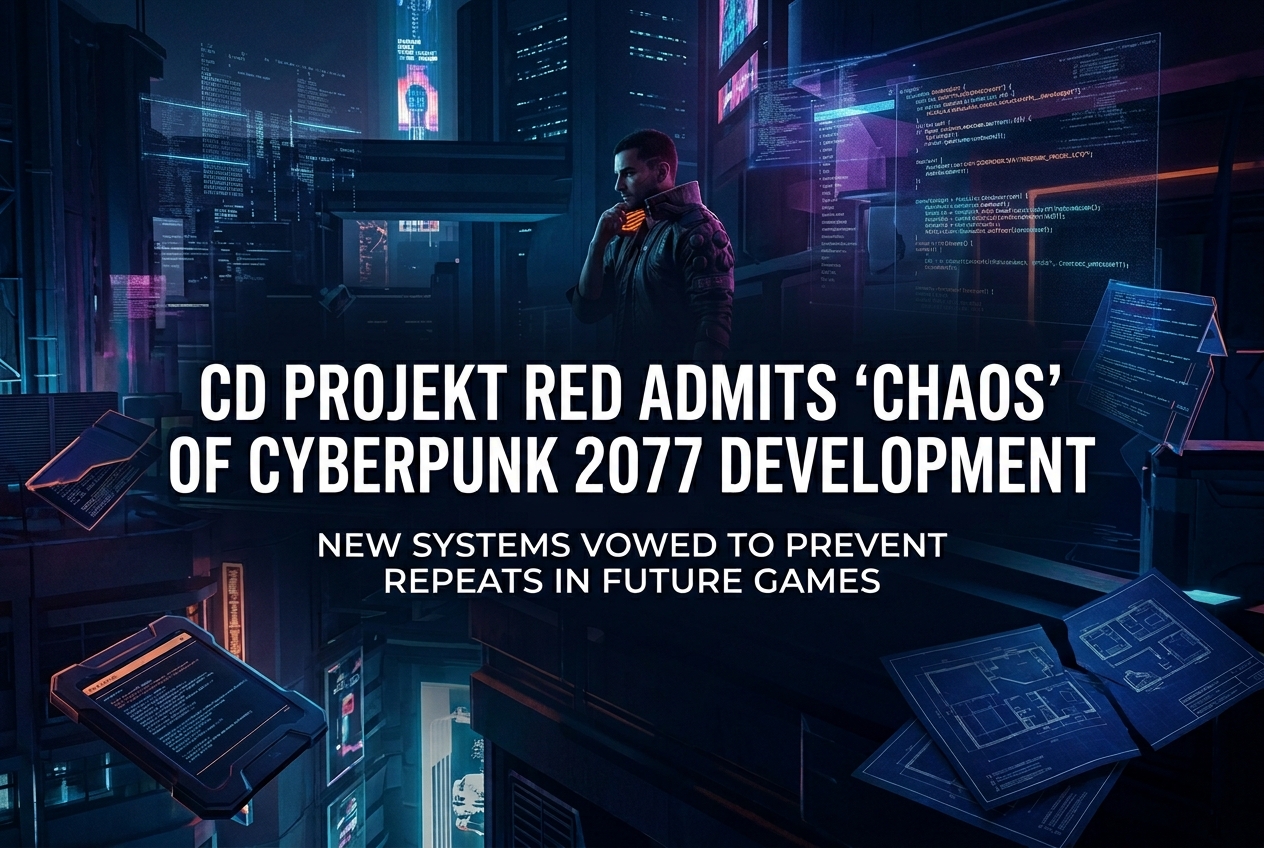
At Digital Dragons 2026, CD Projekt Red developers explained how 8,000 pages of broken documentation created chaos during Cyberpunk 2077’s development and detailed the new system that will prevent it from happening with The Witcher 4 and Cyberpunk 2.
CD Projekt Red has openly discussed the chaotic documentation issues experienced during the development of Cyberpunk 2077 for the first time. The studio’s lead technical writer Jarosław Ruciński and senior technical writer Adrian Fulneczek took the stage at the Digital Dragons conference and stated that these mistakes will not be repeated in The Witcher 4 and Cyberpunk 2 projects. Although Cyberpunk 2077 sold 35 million copies by November 2025 and became one of the best-selling games of all time, the development issues seriously damaged the studio’s reputation.
What Happened During Cyberpunk 2077’s Development?
Fulneczek described the development process of Cyberpunk 2077 as “chaos.” The roots of the problem actually go much further back: there was no technical documentation left from the eras of The Witcher 1 and The Witcher 2. Fulneczek explained this by saying, “Back then, nobody was thinking 20 years ahead.” The team was small, and knowledge was transferred between people instead of being stored in a database.
Similar problems also occurred during The Witcher 3. The team working on modding tools for players could barely find any documentation about the engine. Fulneczek said, “There was nothing in our engine documentation. And honestly, it wasn’t the most intuitive engine ever created.”
Why Didn’t the 8,000-Page Documentation Archive Work?
For Cyberpunk 2077, the studio decided to make a “clean start” and began using a documentation tool called Confluence. However, what started with good intentions eventually turned into a massive pile of over 8,000 pages, almost none of which were properly maintained. Fulneczek stated that documentation maintenance was considered a “low priority.”
When development on Cyberpunk 2077’s only major expansion, Phantom Liberty, began, the situation became even worse. New documents were moved to Confluence’s cloud version, while older documents remained on company servers. Fulneczek summarized the situation clearly: “There was chaos. Two spaces, two instances. It was very difficult for us to understand, and also for our outsourcing partners. If possible, don’t split platforms or tools. You need to create very clear connections between them.”
Did the Chaotic Documentation Cause Burnout?
According to Fulneczek, the fragmented documentation structure was directly connected to burnout-related problems. During sprint periods, while teams were trying to finish features and ship updates, documents remained scattered across different servers. Developers were trying both to fix the game and understand the complex documentation structure. This became one of the biggest behind-the-scenes reasons for Cyberpunk 2077’s troubled launch.
These structural issues also influenced the studio’s decision to move from RED Engine to Unreal Engine 5. RED Engine created serious friction during hiring and onboarding because new developers had to learn the studio’s proprietary toolset, slowing development considerably.
What Changed for The Witcher 4 and Cyberpunk 2?
Fulneczek stated, “Our future looks really promising. We learned our lesson.” The studio introduced mandatory documentation gates at every stage of development. Meeting documentation requirements is now necessary before progressing to the next phase. Fulneczek explained it like this: “We now have new requirements, especially a new definition of ‘done.’ Every project and every game goes through development stages, and now every stage ends with a gate. One of the requirements to pass that gate is documentation. It wasn’t like this before.”
Ruciński emphasized the transformation in knowledge sharing: “Unlike the past, our knowledge is no longer locked behind the permissions of certain teams. It’s a shared asset. If a team working on The Witcher solves a specific problem, the Cyberpunk team can see it, benefit from it, adapt it into their own code, and probably improve it further.” Thanks to this approach, “problems are no longer solved repeatedly by different teams, and if a breakthrough happens in one project, the entire company benefits from it.”
What Stage Is The Witcher 4 In?
The Witcher 4 entered full-scale production at the end of 2024. As of February 2026, 499 developers are working on the game, which represents more than half of the studio’s total workforce of 933 developers. CD Projekt Red has hired more than 220 new developers since February 2025, with most of them assigned to The Witcher 4.
The game is being developed with Unreal Engine 5, and the engine is being customized for open-world experiences as part of a long-term strategic partnership with Epic Games. Revealed with a cinematic trailer at The Game Awards 2024, the game introduced Ciri as the main protagonist. In June 2025, a technical demo running at 60 FPS on a standard PS5 was showcased at Unreal Fest. CD Projekt CFO Piotr Nielubowicz stated that the game will not release in 2026 and is expected no earlier than 2027. The studio plans to release three Witcher games within six years.
What About Cyberpunk 2?
Cyberpunk 2, codenamed “Project Orion,” entered pre-production in May 2025. As of February 2026, it is being developed by a team of 149 people. The project is jointly handled between the Warsaw team in Poland and the Boston office in the United States. The team is expected to grow to 300–400 people by the end of 2027.
Cyberpunk universe creator Mike Pondsmith revealed at the Digital Dragons conference that Cyberpunk 2 will feature a new city alongside Night City. Pondsmith described this city as “a Chicago gone wrong” and stated that its aesthetic will differ from the Blade Runner-inspired style of the first game. Realistic estimates suggest that Cyberpunk 2 could release around 2029–2030.
What Else Is on the Studio’s Roadmap?
CD Projekt Red is not only working on The Witcher 4 and Cyberpunk 2. The studio is handling several projects simultaneously:
- The Witcher 1 Remake: Developed by Fool’s Theory. It is expected to launch after The Witcher 4. Former CDPR developers at Fool’s Theory played a critical role in recovering lost technical knowledge.
- Project Sirius: A multiplayer project set in the Witcher universe aimed at a broader audience. It is currently in early development with a team of 56 people.
- Project Hadar: A completely new RPG universe created by CD Projekt Red. As of March 2026, it is in the concept phase with a core team of 26 people. The studio stated that this IP is intended to serve as a foundation not only for games but also for future products.
Why Is the Unreal Engine 5 Transition So Important?
All previous major CD Projekt Red games (The Witcher 2, The Witcher 3, Cyberpunk 2077) were built on the studio’s proprietary RED Engine. Moving to Unreal Engine 5 offers several critical advantages. First, onboarding new developers becomes significantly easier because Unreal Engine is a widely known industry-standard tool. Second, the studio plans to shorten development cycles between Witcher games and release three games within six years. Fulneczek also admitted during the documentation panel that the old engine “wasn’t the most intuitive engine.”
The studio has been using Unreal Engine 5 for The Witcher 4 for around four years and stated that it is satisfied with the results. The partnership with Epic Games includes not only licensing but also technical engine development and potential future versions.
What Is the Story Behind Cyberpunk 2077?
When Cyberpunk 2077 launched in December 2020, it suffered from severe performance problems and bugs, especially on consoles. Sony temporarily removed the game from the PlayStation Store. The studio later recovered much of its reputation through patches, the 2.0 update, and the critically acclaimed Phantom Liberty expansion. Today, with 35 million copies sold, it stands among the best-selling games of all time.
The clearest lesson CD Projekt Red learned from this experience was related to marketing and expectation management. In 2021, the company announced that future games would be marketed much closer to release, with real gameplay footage instead of concepts, and showcased across all target platforms. These new statements at Digital Dragons now show that the problems were not only related to marketing but also to internal processes, which the studio claims to have fixed.
What Does This Mean for Players?
CD Projekt Red honestly acknowledging its past mistakes creates cautious optimism regarding the studio’s future projects. While documentation problems may seem like a “boring” topic, communication breakdowns and poor knowledge sharing in large-scale game development directly affect game quality, release schedules, and developer working conditions.
The fact that The Witcher 4 is already in full production with a massive team of 499 developers, Cyberpunk 2 is rapidly expanding in pre-production, and the studio has implemented a cross-project knowledge-sharing system demonstrates that CD Projekt Red is taking concrete steps to avoid repeating the disastrous 2020 launch. For players, the real test will come on the release day of The Witcher 4, when we finally see how effective these systems truly are.