CS2 semi-pro MAUschine was banned for at least 10 years by DACH CS Masters and Fragster after sucker-punching opponent Spidergum during the CAGGTUS Leipzig 2026 award ceremony. The incident has been reported to ESIC.
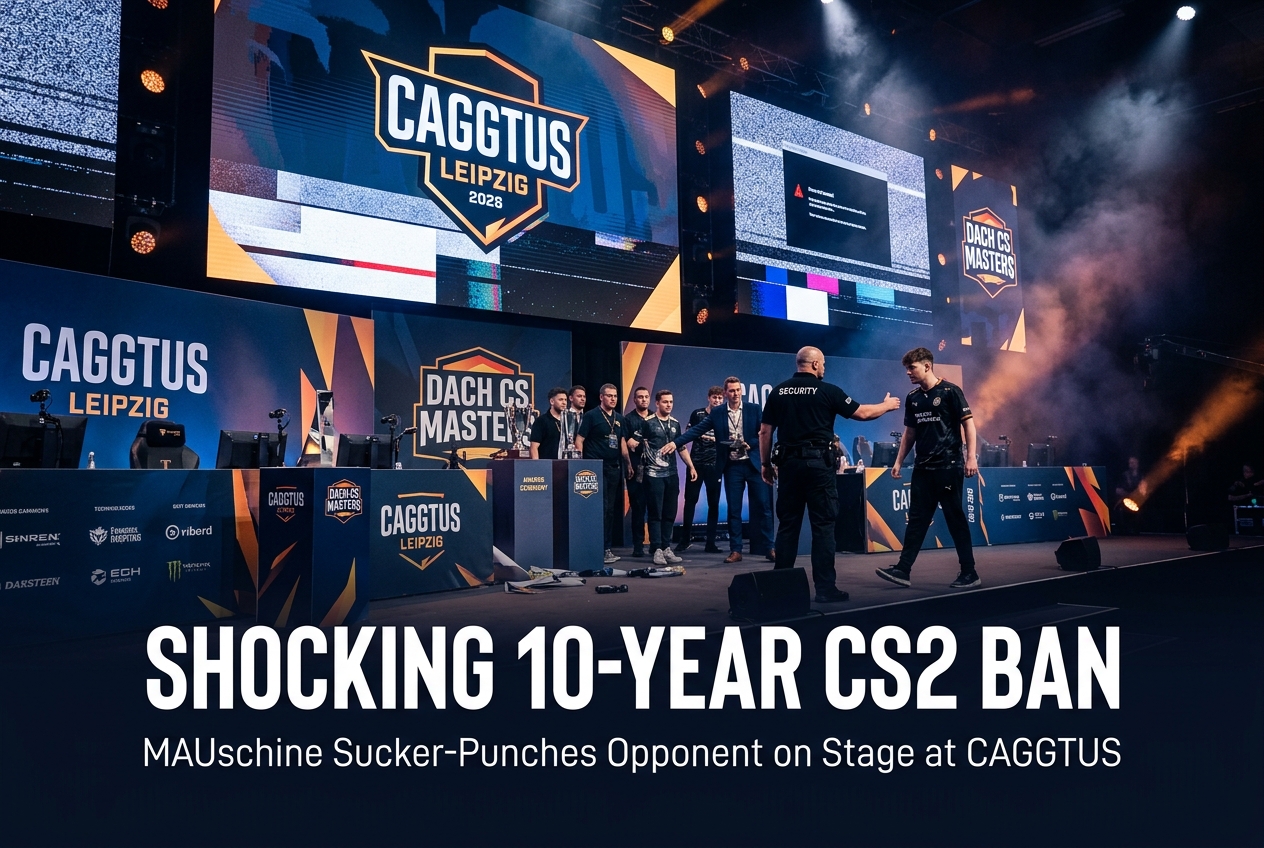
Counter-Strike 2 semi-professional player MAUschine has been banned for at least 10 years after sucker-punching opponent Fabian “Spidergum” Salomon live on stage at the CAGGTUS Leipzig 2026 gaming festival. The 31-year-old Berlin-based player and Twitch streamer struck Spidergum in the face during the award ceremony, knocking off his glasses and stunning him in front of the live audience and broadcast viewers. Tournament organizers DACH CS Masters and Fragster both issued decade-long bans, and the incident has been reported to the Esports Integrity Commission (ESIC).
What Happened at CAGGTUS Leipzig?
CAGGTUS Leipzig is the largest LAN party in the German-speaking world, with 2,360 LAN seats nearly sold out for its 2026 edition held from April 17 to 19. The event featured a semi-professional CS2 tournament organized under the DACH CS Masters banner, where MAUschine’s team “Full Shock” faced Spidergum’s “Legendenlobby” (part of the Regnum4games organization) in the grand final.
After Legendenlobby won the final, the top three teams were called onto the stage for the award ceremony. As players lined up, MAUschine walked past Spidergum and struck him in the side of the head with a closed fist. The blow knocked Spidergum’s glasses off and left him visibly stunned. The event host immediately called for MAUschine to be removed from the stage. The entire incident was captured on the live broadcast and quickly went viral, accumulating tens of thousands of views across social media platforms.
Why Did MAUschine Attack Spidergum?
Reports from eyewitnesses and social media indicate the altercation stemmed from trash talk during the previous day’s final. Spidergum reportedly mimicked MAUschine’s in-game celebrations and shouted provocative quotes from MAUschine across the LAN hall. According to German outlet mein-mmo.de, MAUschine later saw a clip of the taunting on Twitch and said: “If I had seen this earlier, I would have punched him.” He apparently held onto this anger overnight and acted on it during the next day’s ceremony.
Regnum4games, Spidergum’s organization, claimed in their statement that MAUschine had made threats toward Spidergum before the match took place. Notably, there was no monetary prize at stake in the tournament. The winning team would only have received an invitation to next year’s local LAN event.
What Punishments Has MAUschine Received?
DACH CS Masters issued a swift statement on X: “Surprisingly, we do not tolerate physical assaults against other players at LAN and have acted accordingly. MAUschine is banned for at least ten years and the incident has additionally been reported to ESIC. In case it wasn’t clear: We think violence is pretty sh*tty and it has no place in our league.” Fragster, another German tournament organizer, also confirmed a 10-year ban from all its events.
Many in the community noted that a 10-year ban is effectively career-ending for a 31-year-old semi-professional player. By the time the ban expires, competitive relevance and opportunities are typically long gone. MAUschine’s Instagram, X, and Twitch accounts have gone dark since the incident, and he has not made a public statement.
What Role Does ESIC Play?
The Esports Integrity Commission (ESIC) is the leading independent integrity body in competitive esports. It has previously handled major investigations including the 2020 CS:GO coaching bug scandal, where nearly 100 coaches received bans after exploiting a spectator camera glitch. More recently, in early 2026, ESIC banned CS2 player Dmytro “nifee” Tediashvili for four years over match-fixing and betting violations.
ESIC’s investigation into the MAUschine incident could result in a cross-platform ban applying to all ESIC member tournament organizers. This would effectively prevent MAUschine from competing in any recognized esports event globally, not just DACH-organized tournaments. Physical assault cases are rare in ESIC’s history, making this a potentially precedent-setting case for how the body handles violence.
Has This Happened Before in Esports?
Physical altercations at esports events are uncommon but not unprecedented. In January 2023, an Italian Super Smash Bros. Ultimate player known as “Boom” slapped his opponent “Best Mario” after losing 3-0, earning a permanent ban from Smash Bros. Italia events. In the same community, player “ZD” was banned indefinitely after throwing a controller into the crowd following a loss. A separate Smash incident saw a player punch a tournament organizer who tried to calm him down.
However, a deliberate physical attack captured on a live broadcast during an award ceremony at an organized LAN event of CAGGTUS’s scale is exceptional. The swift 10-year response from multiple tournament organizers sends a strong signal across the esports ecosystem.
How Did Spidergum React?
Spidergum took the incident surprisingly well. After the initial shock, he was seen smiling on stage with his hand raised in disbelief. On social media, he leaned into humor, posting that he is “better at slapping than AWPing.” His organization Regnum4games released a formal statement condemning the assault and confirming that MAUschine had allegedly made threats prior to the event.
What Does This Mean for Esports Safety?
The 2026 CS2 competitive calendar is packed with major events: IEM Cologne Major in June ($1.25 million prize pool), the Esports World Cup in August ($2 million), and PGL Singapore Major in November. While tier-one events typically maintain robust security protocols, the CAGGTUS incident raises questions about safety standards at semi-professional and grassroots LAN events where players, opponents, and fans interact more freely.
Tournament organizers across the scene are expected to re-evaluate their behavioral codes and stage security measures. The zero-tolerance stance taken by DACH CS Masters and Fragster could push other regional organizers to formalize similar policies to protect participants and maintain the integrity of competitive play.
Questions Players Are Asking
Who is MAUschine?
MAUschine is a 31-year-old semi-professional CS2 player and Twitch streamer based in Berlin, Germany. He competed with team “Full Shock” and finished as the runner-up at the CAGGTUS Leipzig 2026 CS2 tournament.
Was there a cash prize at stake?
No. The DACH CS Masters tournament at CAGGTUS had a modest prize pool of approximately $5,895. The winning team’s primary reward was an invitation to the following year’s LAN event, making the violent outburst even more disproportionate.
Could MAUschine face criminal charges?
It remains unclear whether German authorities have been informed. As of publication, Leipzig police records do not mention the incident. Physical assault is a criminal offense under German law, so legal consequences are theoretically possible.
Will Twitch take action?
No Twitch sanction has been announced yet. The assault occurred during a live broadcast, which could potentially violate Twitch’s community guidelines regarding violent conduct on stream.
Is a 10-year ban permanent?
The ban is officially “at least 10 years,” leaving the door technically open for review. In practice, most esports analysts consider a decade-long ban effectively career-ending, as competitive relevance fades well before such a suspension expires.