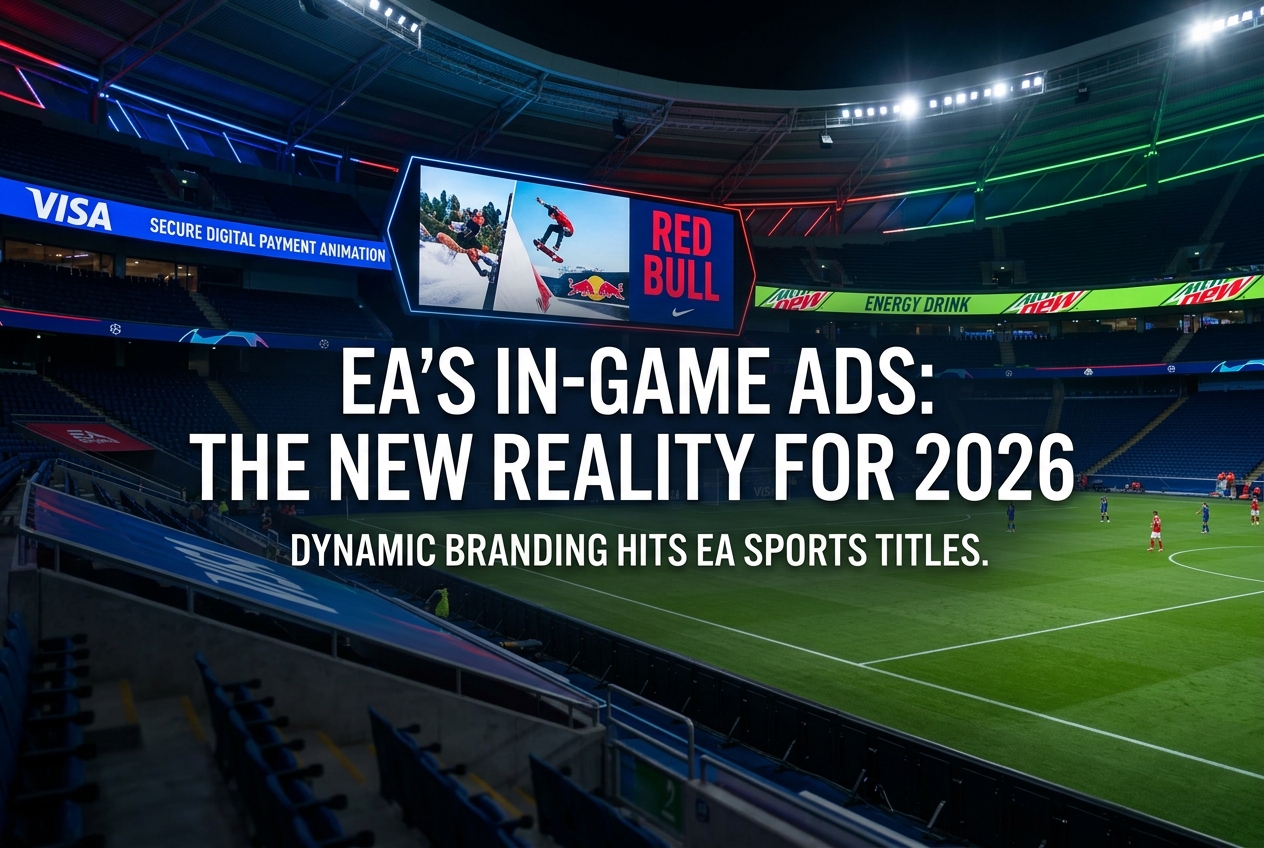
Electronic Arts has launched EA Advertising, a centralized ad platform built on a proprietary Frostbite-based ad server reaching over 120 million monthly players. Brands like Visa, Red Bull, and Mountain Dew are already running campaigns inside EA SPORTS titles, with dynamic placements ranging from stadium signage to branded in-game challenges.
Electronic Arts officially launched EA Advertising on June 15, 2026, a centralized platform that lets brands buy dynamic, real-time ad placements inside EA’s games. The platform is built on a proprietary ad server and SDK designed specifically for EA’s Frostbite engine, and it reaches a reported 120 million monthly players across console, PC, and mobile. EA posted GAAP net revenue of approximately $7.5 billion in fiscal year 2026, making this push into advertising a significant new revenue channel for the publisher.
How Does EA Advertising Actually Work?
Unlike traditional banner ads or pop-up screens, EA Advertising delivers ads that are embedded into the game environment itself. The system dynamically serves brand placements through stadium signage, digital ad boards, scoreboards, and broadcast-style overlays. EA describes the approach as one that will “enhance, not disrupt” the player experience, with brands “becoming part of the game itself.”
The technical backbone is notable. EA built its own ad server and software development kit from scratch for the Frostbite engine. At launch, targeting is available based on geography and flight date, with impression measurement aligned to IAB standards. Campaign verification is handled through a partnership with Integral Ad Science for viewability and invalid traffic detection. According to Adweek, dynamic media is available on a CPM basis with prices ranging from $1 to $10 depending on the title and placement type.
This is not a programmatic play. There is no DSP access, no open auction, and no automated buying. EA is selling directly to advertisers and agencies through its own sales team, with plans to expand buying capabilities as the platform scales.
Which Games Will Show Ads?
EA Advertising focuses primarily on the company’s sports franchises: EA SPORTS FC, Madden NFL, EA SPORTS College Football, and NHL. Sports games are a natural fit because real-world broadcasts already feature stadium boards, scoreboard sponsors, and branded replays, so the in-game equivalents feel less intrusive by comparison.
However, the platform’s reach extends beyond sports. EA’s official website lists The Sims and skate. as titles available for brand integration. The Sims already featured a Coach collaboration that included free in-game clothing items alongside a non-skippable main menu ad for a Coach bag giveaway, which ran for over a month. The skate. franchise has integrated Vans branding into its gameplay.
Who Are the Launch Partners?
Several major brands have already signed on with measurable early results. Visa is a multi-title partner across EA SPORTS FC and College Football. Red Bull ran branded in-game objectives and team kits in EA SPORTS FC that EA says generated over 128 million matches played and 1.2 million objectives completed. Lowe’s integrated into EA SPORTS FC, Madden NFL, and College Football, driving more than 987,000 games played and over 200,000 challenges completed.
Mountain Dew took perhaps the most ambitious approach, building “DEW University,” a fully playable team experience in EA SPORTS College Football 26 complete with a custom stadium, mascot, and reward ecosystem. Xfinity and Peacock activated through dynamic in-stadium and broadcast-style integrations, custom vanity kits, and Ultimate Team Packs in EA SPORTS FC 26.
What Is the EA SPORTS Partner Program?
Sitting above the standard ad units is the EA SPORTS Partner Program, a premium tier designed for a select group of official partners. Brands in this program gain access not just to in-game placements but to live events like the Madden Bowl, franchise milestone moments like ratings reveals, creator tools, social play experiences, and community-driven programs.
As Digiday described it, the structure amounts to “a walled garden within a walled garden”: the standard advertising layer provides scale, while the partner program gives brands the opportunity to be woven into the fabric of the games themselves. Visa and crypto exchange Gemini are among the first brands in this tier.
What Do the Budget Tiers Look Like?
EA Advertising’s application form reveals four budget tiers for prospective advertisers. Entry-level campaigns start between $100,000 and $199,000. Mid-tier options range from $200,000 to $499,000 and from $500,000 to $999,000 respectively. Premium placements exceed $1 million. Application categories include mobile video and display, in-game brand activations, and esports sponsorships.
Why Is the Timing Controversial?
EA Advertising’s launch is difficult to separate from the company’s ownership transition. In September 2025, EA agreed to be acquired by a consortium of Saudi Arabia’s Public Investment Fund (PIF), Silver Lake, and Jared Kushner’s Affinity Partners in a $55 billion all-cash deal, the largest leveraged buyout in history. The deal saddles EA with $20 billion in debt, up from $2.2 billion prior to the acquisition. PIF would control approximately 93.4% of the company upon closing.
In May 2026, gamers and developers staged a protest outside EA’s Redwood City headquarters, with over 70,000 petition signatures opposing the acquisition. Demonstrators dressed as Sims characters carried signs reading “devs and players over investors.” US Senators Elizabeth Warren and Richard Blumenthal raised concerns about foreign influence and national security risks, questioning whether the deal could expose player data to a foreign government.
The concern shared across gaming communities is straightforward: private ownership backed by sovereign wealth could prioritize revenue extraction over the player experience. EA Advertising does not directly address that concern, and as The Next Web noted, EA’s press release made no mention of using ad revenue to offset game prices or reduce the cost of in-game items.
What Happened When EA Tried This Before?
EA has a documented history with in-game advertising that did not go smoothly. In 2020, the company inserted full-screen ads for Amazon’s “The Boys” into UFC 4, a game that cost $60 at retail. The ads appeared during fight replays and on the scorecard screen. A Reddit post about the issue received over 91,000 upvotes, and the backlash was severe enough that EA disabled the ads within days and issued a public apology.
EA’s statement at the time acknowledged that “integrating ads into the Replay and overlay experience is not welcome” and promised the ads would not return. Earlier experiments in games like Battlefield 2142 and Need for Speed Carbon also placed ads in gameplay environments, though on a smaller scale.
The key difference now is infrastructure. Previous attempts were handled game by game, studio by studio, with custom work that was difficult to scale. EA Advertising centralizes this into a single platform with standardized measurement, which makes expansion significantly easier but also raises the stakes for player trust.
Players Pay Full Price But See Ads Anyway?
This is the central tension. EA’s sports titles already cost $70 at retail and generate substantial revenue through Ultimate Team card packs and other microtransactions. Players who pay full price will see the same brand integrations as free-to-play users, with no apparent discount or opt-out option.
Former BioWare veteran and Dragon Age producer Mark Darrah offered a contrasting perspective, arguing that more studios should consider product placement as an alternative to microtransactions. His argument is that advertising could fund game development without relying on loot boxes and season passes. However, that logic only holds if advertising replaces existing monetization rather than stacking on top of it. At present, EA has not indicated that ad revenue will reduce any existing revenue stream.
How Big Is the In-Game Advertising Market?
EA’s move is part of a broader industry trend. According to Mordor Intelligence, the in-game advertising market was valued at approximately $119.31 billion in 2025 and is expected to reach $217.16 billion by 2031, growing at a compound annual rate of 10.63%. EA’s pitch to advertisers centres on scale: fans play the equivalent of 23,000 NFL seasons every day in Madden and complete more than one billion matches each month in EA SPORTS FC.
Other publishers have experimented with similar approaches. Activision recently tested in-game ads in Call of Duty before describing them as a “feature test” erroneously published in the live game. Capcom faced criticism for inserting Capcom Pro Tour advertisements into Street Fighter V. The pattern is consistent: publishers push into ad territory, players push back, and the boundary is renegotiated.
What Should Players Actually Expect?
In the short term, the most visible impact will be in EA’s sports titles, where stadium boards and broadcast overlays already mirror real-world advertising environments. These placements are less likely to feel jarring because they replicate formats players already associate with live sports broadcasts.
The bigger question is how far EA extends this into non-sports titles. The Sims and skate. are already listed as available for brand integration. Whether EA introduces ads into franchises like Battlefield, Apex Legends, or Dragon Age remains unclear, but the centralized platform technically enables it.
EA’s Chief Experiences Officer David Tinson stated that brands will “show up in ways that add value and respect the player experience, while maintaining authenticity in the worlds our teams are building.” Whether that promise holds will depend entirely on execution. The UFC 4 precedent shows that EA is willing to retreat when backlash is strong enough. But with a new ad platform, a $20 billion debt load, and 120 million monthly players to monetize, the incentive to expand rather than restrain is significant.
For now, players should expect branded content to become a more visible and consistent part of EA’s games. The open question is not whether ads are coming, but how aggressively they will be implemented and whether players will have any say in the matter.