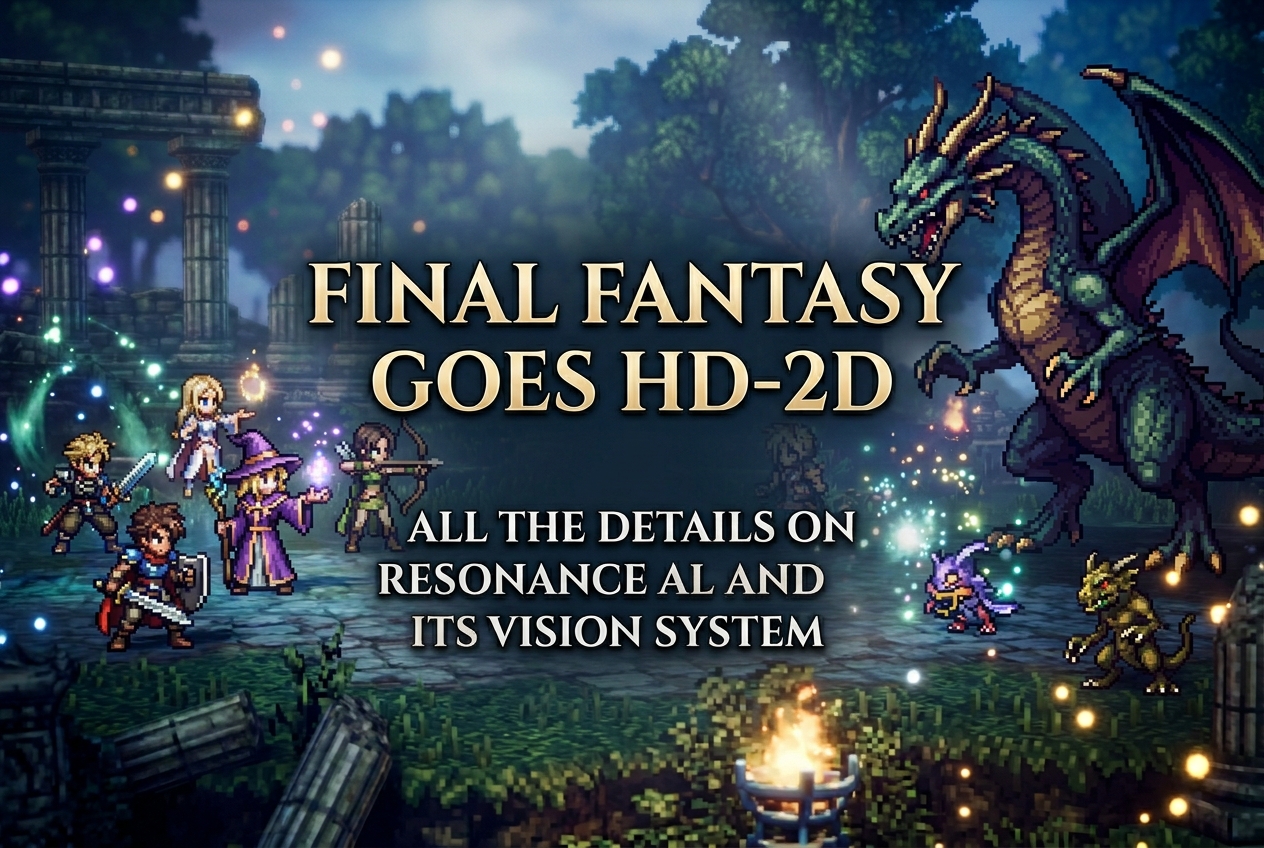
Square Enix revealed Final Fantasy Resonance during the June 2026 Nintendo Direct. The franchise’s first HD-2D entry features turn-based combat, a Vision system with classic FF heroes, and launches October 22, 2026.
Final Fantasy Resonance is the first game in the Final Fantasy franchise to use the HD-2D visual style, and it launches on October 22, 2026. Square Enix revealed the game during the June 2026 Nintendo Direct, confirming platforms as Nintendo Switch 2, Nintendo Switch, PlayStation 5, Xbox Series X|S, and PC via Steam and Microsoft Store. The Standard Edition is priced at $49.99 / £49.99 / €59.99, making it a mid-tier release rather than a full-price premium title.
What Is Final Fantasy Resonance Based On?
Resonance is built on the narrative foundation of Final Fantasy Brave Exvius, a mobile game that originally launched in Japan in 2015, accumulated over 40 million downloads worldwide, and shut down its servers in 2025 after a 10-year run. Square Enix has been clear that Resonance is not a port or a simple remake. The publisher describes it as a game that “extensively rebuilds and reimagines” the content from Brave Exvius’ first story arc.
The critical distinction is this: every gacha mechanic and microtransaction from Brave Exvius has been stripped out. Resonance is a one-time purchase console RPG with a new combat system, a new overworld, reworked dialogue, and overhauled visual presentation. Square Enix and co-developer LANCARSE Ltd. built it from the ground up as a console-quality experience, drawing comparisons to last year’s Octopath Traveler 0, which similarly adapted a mobile title into a well-received full RPG.
How Does the HD-2D Style Work in Resonance?
HD-2D is the visual approach Square Enix popularised through Octopath Traveler and continued with titles like Triangle Strategy and the Dragon Quest III HD-2D Remake. It blends pixel art characters and environments with modern lighting, depth-of-field effects, and dynamic camera work.
Resonance takes the style further. Its opening cinematic and key cutscenes use a cutting-edge production technique that renders 3DCG in pixel form, creating dynamic visuals that retain the charm of classic pixel art. Meanwhile, legacy Final Fantasy hero abilities and certain summon sequences are presented in full 3D graphics. The result is a hybrid visual experience that moves between HD-2D exploration, pixelised 3D cutscenes, and cinematic 3D sequences.
The Story: Rain, Crystals, and the Veritas of the Dark
The Kingdom of Grandshelt lives in peace under the protection of magical crystals. Rain, the young commander of an airship squadron and son of the missing king Raegen, is sent alongside his childhood friend and deputy commander Lasswell to investigate a weakening barrier at the Earth Shrine. Inside, they encounter the Veritas of the Dark, an armoured warrior of overwhelming power who shatters the Earth Crystal before their eyes.
Defeated and stranded, Rain and Lasswell return to find Grandshelt under siege. After rescuing the king, they set out on a journey to protect the world’s remaining eight crystals. They are joined by Fina, a mysterious amnesiac girl who emerged from the Earth Crystal and possesses white magic, archery skills, and the rare ability to communicate with espers. The voice cast includes Clifford Chapin as Rain, Alejandro Saab as Lasswell, Lizzie Freeman as Fina, and Ian Sinclair as the Veritas of the Dark in the English dub.
Turn-Based Combat Returns After Nearly 25 Years
Resonance marks the first mainline-adjacent Final Fantasy with fully turn-based combat since Final Fantasy X, released almost 25 years ago. Instead of the ATB (Active Time Battle) gauge, Resonance uses a timeline displayed at the top of the screen that shows the action order for both allies and enemies.
The core mechanic revolves around staggering. Every hit builds an enemy’s stagger gauge, and hitting elemental weaknesses accelerates the process. When a character successfully staggers an enemy, they earn an extra action in a bonus phase at the end of the turn. If all enemies are staggered simultaneously, a sweeping stagger triggers, granting every party member an additional action.
IGN’s hands-on preview described the system as “a turn-based twist on what we’ve seen in Final Fantasy XIII or VII Remake,” with strategy centred on reading weaknesses, managing turn order, and timing your staggers for maximum impact. The full game is estimated at 30-40 hours for the main story and 60-80 hours for completionists.
The Vision System: Classic Heroes as Equippable Power
Visions are the crystallised essences of characters you encounter throughout the story. Equipping a Vision to a party member boosts their stats and unlocks new abilities. Each character can equip only one Vision at a time, but abilities learned from previous Visions can still be slotted within a cost limit, even when a different Vision is active. This creates a flexible build system that Square Enix describes as a more accessible evolution of the classic Final Fantasy job system.
The headline feature is legacy Visions: iconic characters from across the mainline series who appear when you visit Vision Crystal Sanctums scattered around the world. Confirmed legacy Visions so far include:
- Warrior of Light (Final Fantasy I): earth, lightning, and light attacks; protective abilities
- Terra (Final Fantasy VI): high-damage fire, water, and ice magic
- Cloud (Final Fantasy VII): lightning and water attacks with critical-damage focus
- Zidane (Final Fantasy IX)
- Shantotto (Final Fantasy XI): repeated lightning, water, and dark magic
- Y’shtola (Final Fantasy XIV): fire and ice stagger spells plus HP restoration
During a sweeping stagger, one equipped Vision can unleash a Resonance attack, a powerful cinematic technique unique to that Vision. Choosing the right Resonance for the situation adds another layer of tactical decision-making.
Espers, Airships, and a World Full of Side Content
Espers are the classic Final Fantasy summons, and in Resonance only Fina can call them. When summoned, an esper fights alongside your party for three turns and delivers a devastating finishing move before departing. Unlocking new espers requires completing optional dungeons tucked into remote corners of the overworld. Siren and Ramuh are among those confirmed.
The overworld itself spans multiple continents divided by water. Gaining access to an airship as the story progresses opens up previously unreachable areas. Side content includes encounters with the wandering swordmaster Gilgamesh, a Colosseum filled with deadly monsters and matching rewards, the Chamber of Arms with formidable foes sealed within legendary weapons, and a showdown with Ultima Weapon. New side-quest scenarios also spotlight both the main cast and supporting characters from Brave Exvius.
Soundtrack by Elements Garden with 33 New Tracks
The music is composed and arranged by Elements Garden, led by Noriyasu Agematsu. The soundtrack includes the full Brave Exvius score alongside 33 newly recorded tracks created specifically for Resonance. Classic Final Fantasy leitmotifs are woven throughout, reinforcing the game’s mission to bridge the series’ past and present.
Editions, Pricing, and Pre-Order Bonuses
| Edition | Price (USD / GBP / EUR) | Contents |
|---|---|---|
| Standard | $49.99 / £49.99 / €59.99 | Base game |
| Digital Deluxe | $59.99 / £54.99 / €69.99 | Base game + Magitek Armor Key, Archwitch’s Grimoire, consumables |
| Collector’s | $209.99 | Base game + Deluxe content + Pixel Art Book + OST + FF TCG card |
Pre-ordering any edition includes the Magitek Airship and Squire Starter Pack, which contains a cosmetic airship skin, Knight’s Greatsword, EXP-boosting armour, and starter consumables. An early purchase bonus adds a Blessed Cuirass that increases gil earnings and a Mist Ether.
Supported Languages and Platform Details
On console (PS5, Switch 2, Switch), Resonance supports Japanese, English, French, German, and Spanish text. The Xbox, Windows, and Steam versions add Traditional Chinese, Simplified Chinese, and Korean. Voice acting is available in English and Japanese. The Steam version launches one day later on October 23. The CERO rating is C (ages 15 and up); Western ratings have not yet been announced.
Questions Players Are Already Asking
Is Final Fantasy Resonance a gacha game?
No. All gacha mechanics and microtransactions have been removed. It is a single-purchase, full console RPG with no in-app purchases.
Do I need to have played Brave Exvius?
No prior knowledge is required. The story is based on Brave Exvius’ first season but has been reworked with new dialogue, plotting, and visual direction. It stands on its own.
Who developed the game?
Square Enix and LANCARSE Ltd. are listed as co-developers. The producer is Keisuke Nakashima and the director is Hiroto Furuya.
How long is the game?
Approximately 30-40 hours for the main story. Completionists can expect 60-80 hours.
Which classic Final Fantasy characters appear?
Warrior of Light (FF I), Terra (FF VI), Cloud (FF VII), Zidane (FF IX), Shantotto (FF XI), and Y’shtola (FF XIV) are confirmed as equippable Visions. Tidus (FF X) and Clive (FF XVI) have also been referenced in coverage.
Will there be a Switch 2 version at launch?
Yes. The game launches on Switch 2 alongside every other platform on October 22, though pre-orders for the Switch and Switch 2 versions are not yet available in all regions.
Final Fantasy Resonance sits at a rare intersection: a turn-based Final Fantasy with HD-2D visuals, a proven narrative foundation rebuilt for console, and a celebration of the franchise’s history through the Vision system. Whether it delivers on the promise will become clear on October 22, 2026.