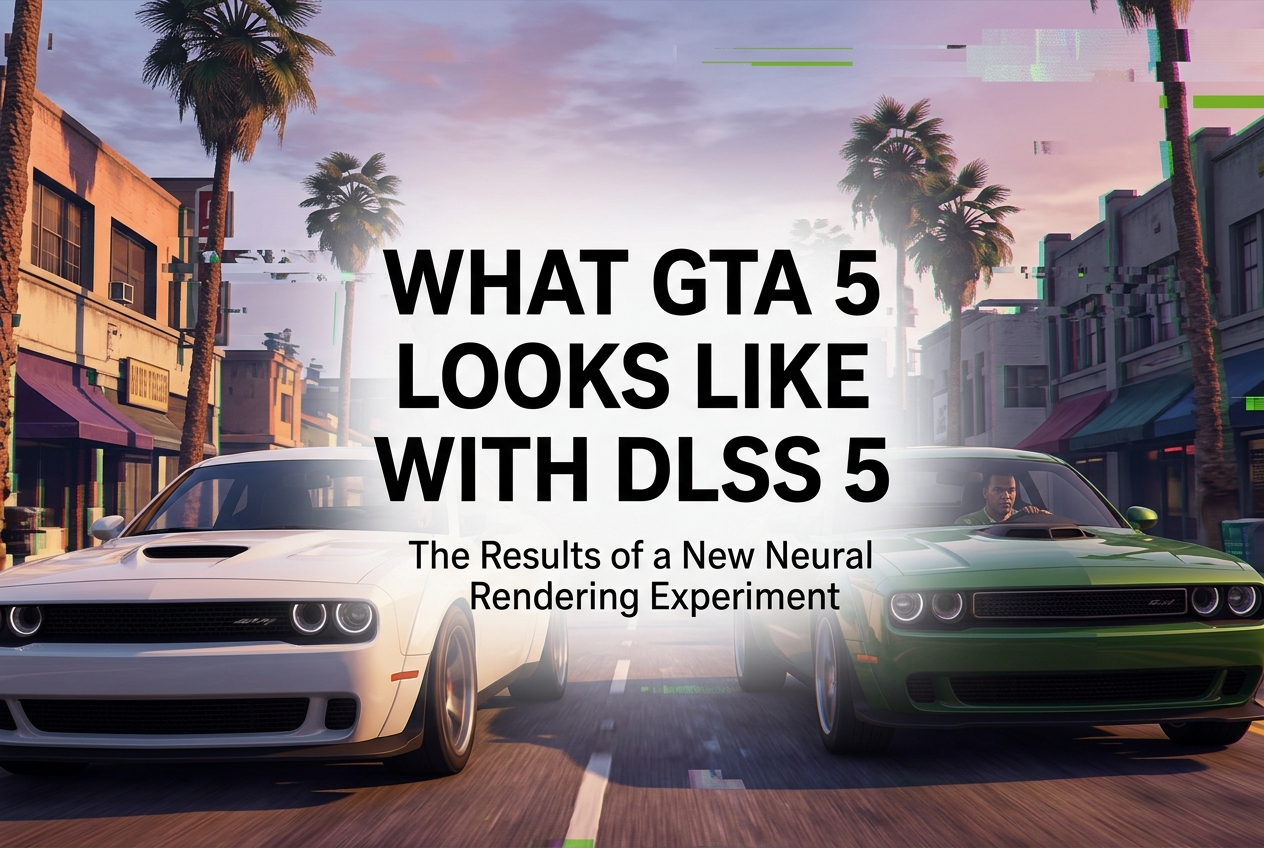
YouTuber Aillusory used AI tools to reimagine GTA 5’s “Franklin and Lamar” mission as it might look with NVIDIA DLSS 5 neural rendering. Characters gain photorealistic depth while backgrounds show instability. DLSS 5 launches in fall 2026 with a fundamentally new approach to game graphics.
YouTuber Aillusory published a concept video on June 12, 2026, reimagining Grand Theft Auto V’s iconic “Franklin and Lamar” mission through AI post-processing designed to simulate NVIDIA’s upcoming DLSS 5 technology. The result is a striking, imperfect, and deeply revealing look at where real-time game graphics are heading. GTA 5 first launched in 2013, yet over a decade later it remains the subject of cutting-edge graphical experiments.
DLSS 5 Is Not an Upscaler: It Redraws the Scene
NVIDIA unveiled DLSS 5 at GTC 2026, where CEO Jensen Huang described it as “the GPT moment for computer graphics.” That comparison is deliberate. Every prior version of DLSS had one core purpose: boost frame rates without losing too much visual quality. DLSS 5 takes a fundamentally different approach by shifting AI from upscaling into active participation in the rendering pipeline.
Technically, DLSS 5 ingests each frame’s colour buffers and motion vectors, then applies a neural rendering model that synthesizes photoreal lighting and material response. It reconstructs subsurface scattering on skin, adds fabric sheen, and simulates light interaction on hair. According to NVIDIA’s official press release, this process runs in real time at up to 4K resolution while maintaining frame-to-frame consistency.
The technology is exclusive to RTX 50 series GPUs built on the Blackwell architecture. Every card from the RTX 5060 to the RTX 5090 supports it, though RTX 40, 30, and older series are locked out entirely. The GTC demo ran on dual RTX 5090s, but NVIDIA confirmed that a single GPU will suffice at launch.
What Exactly Did Aillusory Do With GTA 5?
Aillusory chose the second story mission in GTA 5, which features close-up character shots of Franklin and Lamar, dynamic Los Santos street scenes, and transitions between bright daylight and deep shadow under bridges. It is essentially a stress test for any graphics technology.
An important distinction: this is not a native DLSS 5 integration into the GTA 5 engine. Aillusory applied AI-based post-processing on top of recorded gameplay footage to approximate what neural rendering might deliver. The result gives a directional glimpse of DLSS 5’s potential, not a pixel-accurate preview of its final output.
Where the AI Shines and Where It Breaks Down
The strongest results appear on character models. Franklin, Lamar, and other characters gain significantly more realistic skin with visible depth, and their facial features remain recognisable. Daytime street lighting looks convincing and noticeably closer to a cinematic standard. Clothing and environment textures occasionally reach a quality level that feels like a next-generation title.
The weaknesses are equally visible. Background objects glitch periodically, with rendering styles shifting within seconds during the same shot. Lighting toggles between cinematic and inconsistent without warning. Lamar looks distinctly off in certain frames, suggesting the neural network does not always recognise it is dealing with a known character model. As one viewer summarised: some characters look photorealistic while others are barely distinguishable from the original.
Why the Artefacts Do Not Invalidate the Technology
The visual instability in Aillusory’s video is a predictable consequence of AI operating on top of an already-rendered image without access to the engine’s scene data. In a native integration, the game engine feeds the neural network complete information: geometry, materials, light sources, and depth. The network will know what is in the frame rather than guessing.
NVIDIA also provides developers with detailed control tools. Studios can adjust the effect intensity, tune colour grading and saturation, and mask specific objects or areas to exclude them from DLSS 5 processing. This means the technology will not impose a uniform look across every game.
GTA 5’s Current DLSS Support: DLSS 4 Already Delivered Big Gains
GTA 5 Enhanced Edition received native DLSS 4 support in August 2025 as part of the Drift Week update. On RTX 50 series GPUs, the multi-frame generation feature delivers up to a 3.9x frame rate increase at 4K with ray tracing maxed out. At 1440p and 1080p, NVIDIA benchmarks show a 3.1x average boost, with some configurations hitting the game’s 500 FPS engine cap.
DLSS 4 introduced a transformer-based neural network (Preset K) that improved image clarity on fine details like wires, fences, and vehicle edges while using up to 30 percent less VRAM than DLSS 3. RTX 40 series cards support DLSS Frame Generation, but the full multi-frame tech remains exclusive to the RTX 50 series.
DLSS 5 support for GTA 5, however, is not on the horizon. The game does not appear on NVIDIA’s confirmed DLSS 5 title list, and Rockstar Games has made no announcement about it.
Which Games Will Get DLSS 5 First?
NVIDIA’s official confirmed list of launch-window DLSS 5 titles includes:
- Resident Evil Requiem
- Starfield
- Hogwarts Legacy
- Assassin’s Creed Shadows
- The Elder Scrolls IV: Oblivion Remastered
- Delta Force
- NARAKA: BLADEPOINT
- Phantom Blade Zero
- AION 2
- Where Winds Meet
- Black State
- CINDER CITY
- Sea of Remnants
Publisher support comes from Bethesda, CAPCOM, Ubisoft, Tencent, Warner Bros. Games, and others. Bethesda’s Todd Howard said the technology “brings the game to life” when applied to Starfield.
The Creative Debate: Enhancement or Overwrite?
DLSS 5 has divided developers. While Todd Howard praised it, independent developer Mike Bithell criticised the approach sharply, arguing that it risks overriding a game’s art direction. When a neural network starts “improving” visuals on its own terms, the original aesthetic vision can get lost.
This concern has concrete examples. In NVIDIA’s own demo footage, Resident Evil Requiem’s Grace Ashcroft character appeared noticeably altered with DLSS 5 enabled: fuller lips, heavier eye makeup, and an overall look closer to an AI-filtered photograph than the artist-intended design. The line between enhancement and transformation remains blurry, and NVIDIA’s developer-facing controls are the company’s direct answer to that tension.
The GTA 6 Question
The elephant in the room is GTA 6. Rockstar has not announced DLSS 5 support, and the technology itself is not shipping until fall 2026. But the timing is telling: GTA 6 is expected to arrive right in the window when neural rendering starts appearing in shipped titles. If GTA 6 receives native DLSS 5 integration rather than bolted-on post-processing, the visual gap between Aillusory’s concept video and the real in-game experience could be enormous.
What Players Usually Ask About DLSS 5
Which GPU do I need for DLSS 5?
Any RTX 50 series card (Blackwell architecture), from the RTX 5060 to the RTX 5090. RTX 40 series and older will not support DLSS 5’s neural rendering but can still use DLSS 4.
When does DLSS 5 launch?
NVIDIA has said fall 2026, with no exact date confirmed. The first batch of supported games will be limited.
Will GTA 5 get DLSS 5?
Not currently. GTA 5 is absent from NVIDIA’s confirmed title list, and Rockstar has not indicated plans to add it.
Is Aillusory’s video real DLSS 5?
No. The video uses AI-based post-processing applied to recorded gameplay. It is a concept demonstration, not a native engine integration.
Does DLSS 5 boost FPS like older versions?
DLSS 5’s primary goal is photorealistic image quality through neural rendering, not raw performance gains. Previous DLSS versions focused on FPS; DLSS 5 focuses on visual fidelity.
Can modders add DLSS 5 to older games?
NVIDIA has stated that DLSS 5 is being integrated into the RTX Remix and Streamline ecosystem. This opens the door for mod creators to apply neural rendering to legacy titles, potentially turning games like GTA 5 into something resembling a modern remaster.
The Bigger Picture
Aillusory’s GTA 5 experiment is not a product demo. It is a provocation that honestly shows both the promise and the instability of neural rendering when used outside controlled conditions. The photorealistic characters prove the concept works; the glitching backgrounds prove it needs engine-level integration to deliver consistently.
Fall 2026 will bring DLSS 5 into real, playable games. That is when we will find out whether neural rendering becomes a genuine paradigm shift or an impressive tech demo with unresolved artefacts. Based on what Aillusory’s video shows, combined with the backing of major publishers and NVIDIA’s developer tools, there is strong reason to lean toward optimism.