Steam’s biggest indie hit of 2026, Meccha Chameleon, reached 7 million copies sold in 12 days. Players are recreating the Mona Lisa in-game to hide from seekers.
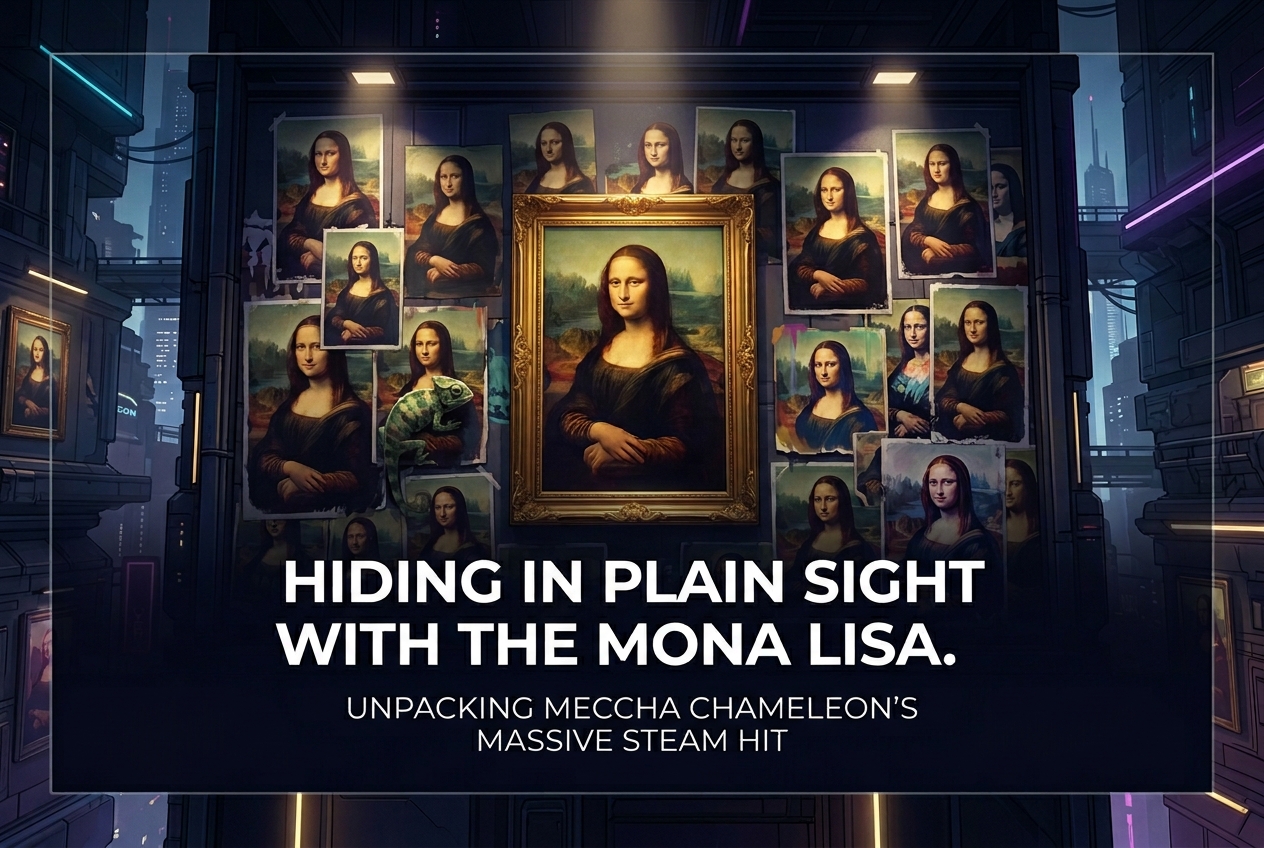
Meccha Chameleon sold 7 million copies within 12 days of its June 10, 2026 launch on Steam, making it the fastest-selling indie game of the year. Developed by Japanese creators lemorion_1224 and Haganeiro in roughly two months using Unreal Engine 5, the multiplayer hide-and-seek game peaked at 340,534 concurrent players on Steam according to SteamDB. Now, its community has taken camouflage to an entirely new level: players are recreating Leonardo da Vinci’s Mona Lisa inside the game to hide in plain sight.
What Is Meccha Chameleon?
Meccha Chameleon is an asymmetric multiplayer party game where players split into two teams: Hiders and Seekers. Hiders start as completely white, blobby bipedal characters and must paint their bodies to match the environment before Seekers are released. Seekers then hunt for Hiders before a timer expires. The game supports up to 24 players per lobby and runs on Epic Games’ Epic Online Services for its multiplayer backend.
Three elements determine success for Hiders: position, pose, and painting skill. Choosing a visually cluttered area, striking a pose that breaks the human silhouette, and applying layered paint with proper light-and-shadow sampling are the core mechanics. Using just one flat colour is the fastest way to get caught. The game also features an Infection mode where caught Hiders become Seekers, and a Double mode where everyone hides first, then everyone seeks.
The Mona Lisa Phenomenon
The moment that pushed Meccha Chameleon into a new tier of virality came from Instagram user artofmenevir, who used the in-game paintbrush to recreate a miniature Mona Lisa and blended into a wall inside the Art Gallery map. IGN reported that Seekers walked past the disguised player multiple times without detecting them. The clip exploded across social media, inspiring an avalanche of copycat art attempts.
Players on X (formerly Twitter) began posting their own masterpiece disguises: Edvard Munch’s “The Scream,” Van Gogh self-portraits, and even minimalist stick figures that blended perfectly with a children’s doodle wall. The Art Gallery map, designed by community creator Popunia, became the go-to stage for these experiments and is available for free through the Steam Workshop.
The game’s scoring system actively rewards this kind of boldness. Hiders earn more points the longer a Seeker looks in their direction without detecting them. As Beebom’s review explained, “Meccha Chameleon is a game about sending a message of dominance, and not about drawing.” Hiding in a distant corner scores almost nothing compared to recreating a famous painting on the most-viewed wall in the room.
How 7 Million Sales Happened Without Marketing
The sales trajectory was staggering. Meccha Chameleon launched with 20,000 concurrent players on day one, reached 90,000 by June 15, and set its all-time peak of over 340,000 on June 22. Copies sold hit 250,000 on June 11, 500,000 on June 12, one million on June 14, two million on June 15, three million on June 17, five million on June 20, and seven million on June 22.
No paid marketing drove these numbers. Sega producer Taira Nakamura called it “an unthinkable achievement for the game industry,” noting the lack of any promotional spend. The growth came entirely from word-of-mouth and short-form video content on TikTok, YouTube Shorts, and Instagram Reels. At a base price of $5.99 on Steam (with a 20% launch discount bringing it down to around $4.79), Wolf’s Gaming Blog estimated gross revenue in the ballpark of £37 million before platform cuts and taxes.
The game debuted first on the Japanese Steam sales chart, beating Forza Horizon 6 and Final Fantasy VII Remake Intergrade, and reached second place on the global Steam chart. On Steam, the game holds a “Very Positive” rating from over 17,000 reviews as of June 22.
Why the “Friendslop” Genre Keeps Winning
GamesRadar’s Anna Koselke described Meccha Chameleon as the latest “friendslop” hit, a term for accessible multiplayer games designed for groups of friends. The genre has produced several megahits recently, including titles like PEAK by Aggro Crab, which sold 10 million copies in its lifetime. Meccha Chameleon is on pace to challenge that record within weeks rather than years.
What sets Meccha Chameleon apart from other party games is the painting mechanic. Unlike traditional Prop Hunt games where players transform into preset objects, Meccha Chameleon hands players a full painting toolkit with eyedropper colour sampling, brush size control, HSV sliders, and metallic/textured surface options. Beebom’s reviewer compared the experience to Among Us but noted it works far better with random online players because communication happens through art rather than text chat.
The Osaka Map and Update 1.7
Alongside the 7-million-sales announcement, the developers released Update 1.7 featuring a new Japan-themed “Osaka” map. Automaton West reported that while the map is on the smaller side, co-creator lemorion said it may be expanded in the future. The same update added an in-game reporting feature to combat cheaters, including those using hacks to instantly reveal all Hiders or become unkillable.
The full list of official maps now includes Hide-and-Seek Mansion, Indoor Country, Sewer, Backrooms, Penguin Hotel, Sugarland, and Osaka. The Steam Workshop adds thousands of community-created maps on top of these, accessible through the “Maps” button on the game’s main menu.
How to Hide Like a Pro in Meccha Chameleon
Community consensus and wiki guides converge on a clear preparation order for Hiders:
- Pick your spot early: Lock in your hiding location within the first third of the preparation phase. Do not waste time wandering the map.
- Set your pose before painting: Crouch, lie flat, curl into a ball, or press against a wall. Your pose changes how light falls on your body, which affects what colours you need.
- Sample the base colour: Use the Eyedropper (Spoid) tool to pick the dominant colour of the surface you are blending into.
- Add shadow and highlights: Sample both the lit and shadowed sides of the material. Block-fill large areas first, then add texture lines and details.
- Check from the Seeker’s perspective: Use the free camera during prep to inspect your disguise from the angle Seekers will approach.
- Freeze completely: Once the Seeker phase starts, do not move at all. Even the best paint job is useless if you twitch.
The golden rule, repeated across every community resource: never use a single flat colour. Real surfaces always have light-to-shadow gradients, and a flat-coloured character stands out immediately.
Seeker Strategies: How to Spot Hidden Players
For Seekers, systematic coverage beats random sprinting. Wiki guides recommend starting with a perimeter sweep, then working inward through natural chokepoints like doors and furniture gaps. Key tells to watch for include colour streaks on the body that do not match the surface, limbs poking past object edges, poses that do not match nearby items, and micro-movements from impatient Hiders.
Comparing symmetry is another strong tactic. Real environment objects are perfectly consistent, while painted players often miss details on their second pass. In Infection mode, tagging easy targets first to grow the Seeker team is the recommended opening play.
Conspiracy Theories and Community Drama
The game’s explosive success attracted conspiracy theories. Some online users claimed the developers paid streamers before launch or had “wealthy backers,” pointing to the server costs required for 200,000+ simultaneous players. Co-creator Haganeiro dismissed these rumours, explaining that the game uses Epic Games’ free Epic Online Services for its multiplayer infrastructure, which significantly reduces server overhead.
Things Players Usually Want to Know
Is Meccha Chameleon available on console or mobile?
The game is currently a Steam (PC) exclusive. It is also playable on Steam Deck and other handheld PCs. There is no official announcement of a console or mobile port. Apps with similar names on Google Play are not the same game.
How much does Meccha Chameleon cost?
The standard price on Steam is $5.99 USD. A 20% launch discount reduced this to approximately $4.79. Regional pricing may vary.
How do I install Workshop maps?
Click the “Maps” button on the bottom right of the main menu to open the Steam Workshop directly. Browse or search for a map, click “Subscribe,” and it downloads automatically. The new map will appear in your map selection when creating a server.
Can I play solo or with randoms?
Public servers support matchmaking with random players. You can also create a private server to explore maps alone and practice hiding spots without pressure before jumping into public games.
What Comes Next for Meccha Chameleon
With 7 million copies sold in under two weeks and a development team that has responded to every sales milestone with free content updates, Meccha Chameleon shows no signs of slowing down. The Osaka map is already live, more official maps are expected, and the Steam Workshop ecosystem continues to expand daily. PC Gamer’s Elie Gould noted the game has “the potential to become one of the giants in the friendslop genre,” and the sales numbers suggest that potential is already being realised.
For a $5.99 indie game built in two months by two people, Meccha Chameleon has rewritten the rules on what a viral Steam launch can look like in 2026. When players start painting the Mona Lisa just to flex on Seekers, you know the game has tapped into something bigger than hide-and-seek.