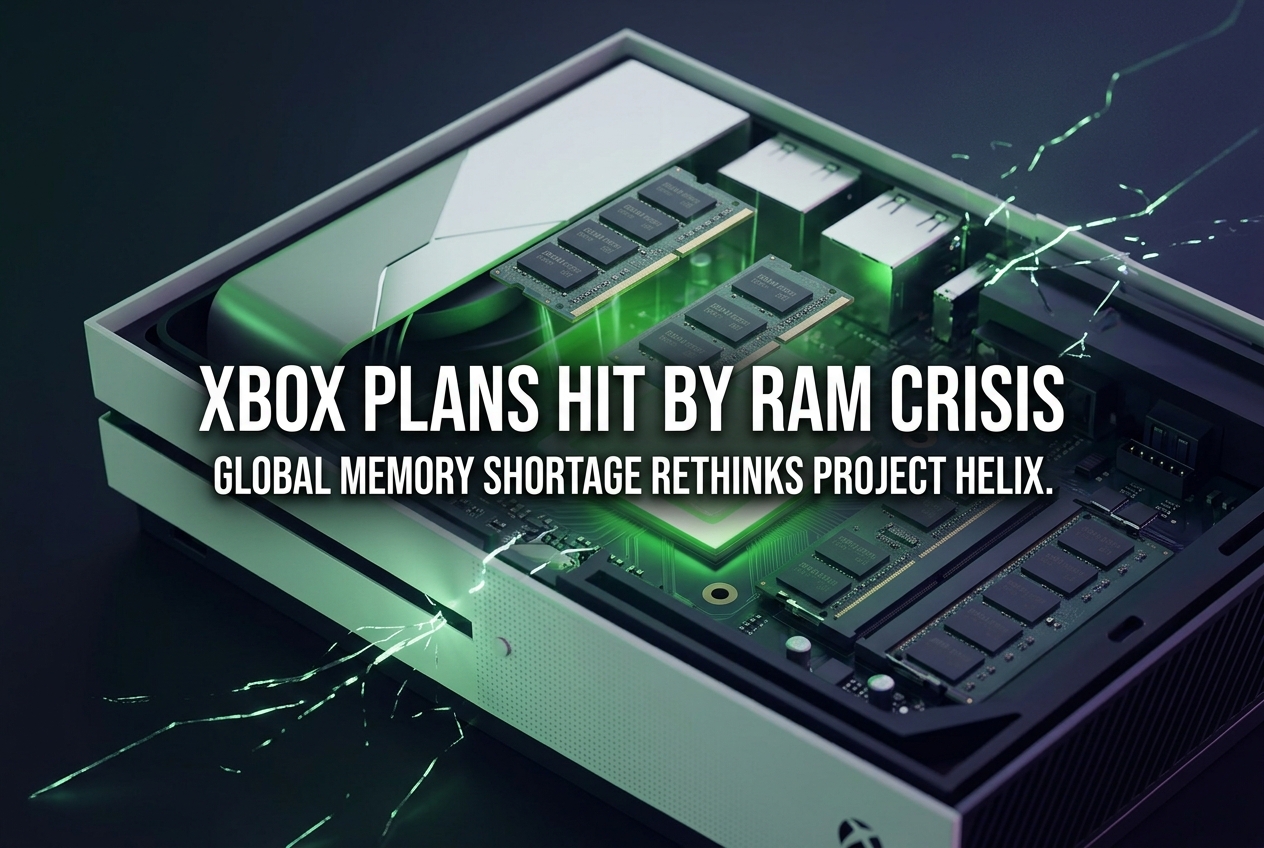
The AI-driven global memory shortage dubbed RAMageddon is forcing Microsoft to overhaul Project Helix’s hardware design, pricing model, and launch window as DRAM costs soar across the industry.
Microsoft is overhauling the hardware strategy, pricing model, and launch timeline for its next-generation Xbox console, codenamed Project Helix, in direct response to a global memory chip shortage the industry calls “RAMageddon.” Xbox CEO Asha Sharma confirmed the severity of the situation in an April 2026 interview with Game File, stating: “Memory costs will impact pricing, will impact availability.” IDC projects that AI data centres will consume roughly 70 percent of global memory chip production in 2026, leaving consumer electronics manufacturers scrambling for what remains.
What Is RAMageddon and Why Does It Matter for Gaming?
The crisis stems from explosive demand for memory chips driven by artificial intelligence infrastructure. Companies such as OpenAI, Google, Microsoft itself, and Meta are pouring hundreds of billions of dollars into AI data centres that require enormous quantities of High Bandwidth Memory (HBM) and DRAM. According to TrendForce, HBM demand is set to grow 70 percent year-on-year in 2026, with its share of total DRAM wafer production climbing to 23 percent from 19 percent the previous year.
The knock-on effect on consumer hardware is severe. Reuters reported in January 2026 that console sales are projected to fall 4.4 percent this year. Counterpoint warned that memory prices could surge a further 40 to 50 percent quarter-on-quarter. Some DRAM types jumped 75 percent in price between December and January alone, according to Bloomberg data cited by Donanım Haber. IDC’s analysis expects 2026 DRAM and NAND supply growth to land at roughly 16 percent and 17 percent respectively, both below historical norms.
Microsoft’s “Radically Different” Console Strategy
The Verge reported in June 2026 that Xbox strategy lead Matthew Ball acknowledged the company is investigating “significantly different” business models for its console hardware. “We are diligently working to reconsider every aspect of Helix,” Ball stated. “We are acutely aware of the necessary changes we must implement as a company to ensure it remains affordable and adaptable.”
Asha Sharma reinforced this in a Fortune interview: “We are currently facing a hardware crisis; the entire industry is.” The key changes Microsoft is pursuing include:
- Standard M.2 SSD support: Instead of the expensive proprietary Xbox Expansion Cards used in the Xbox Series S/X, Project Helix is expected to feature an open M.2 NVMe slot. This would let owners buy affordable off-the-shelf drives from Samsung, Kingston, or Western Digital, following the approach Sony adopted for the PS5.
- AI-powered upscaling with FSR Diamond: Co-developed with AMD, FSR Diamond brings next-generation neural rendering, ML-based upscaling, multi-frame generation, and advanced Ray Regeneration. This technology reduces the raw memory and GPU workload by constructing sharper images from lower internal resolutions.
- New compression techniques: Sharma specifically mentioned the need for “new techniques for compression.” Reports point to DirectStorage integration with Zstandard (Zstd) compression algorithms and potential neural texture compression, both designed to reduce memory bandwidth demands.
- Flexible pricing models: An internal Xbox memo stated: “Xbox will be built to be affordable, personal, and open. We will offer flexible pricing so it’s easy to get started and keep playing.” This hints at subscription-supported pricing tiers or hardware instalment plans.
What Are the Expected Project Helix Specs?
Microsoft officially revealed Project Helix at GDC 2026, confirming a multi-year co-engineering partnership with AMD built around a custom System-on-Chip. Leaked specifications point to a hybrid 11-core design pairing Zen 6 and Zen 6c CPU cores with an RDNA 5 GPU featuring 68 Compute Units and an NPU rated at 110 TOPS for AI-driven rendering tasks.
Memory is the most fluid specification. Early leaks discussed 24 to 32 GB of GDDR7, while more recent reports from sources such as Moore’s Law is Dead push the range to 36 to 48 GB. The final figure reportedly hinges on RAM pricing at the time manufacturing decisions are locked in, likely early 2027. For context, Xbox Series X shipped with 16 GB of GDDR6, so even the conservative estimate represents more than a twofold increase.
Storage is expected at 2 TB NVMe SSD as the base configuration, with estimated read speeds of 10 to 14 GB/s designed to synchronise with DirectStorage compression. Game sizes routinely exceed 150 GB in the Unreal Engine 5 era, making the capacity upgrade a practical necessity.
How Much Could Project Helix Cost?
Pricing is the elephant in the room. Leaks have suggested a retail price around $1,000, driven in part by an estimated $550 GPU unit cost alone. Microsoft’s former Xbox president Sarah Bond previously described the next-generation console as “a highly premium, top-tier curated experience,” though that messaging came before the worst of the memory crisis.
Under Sharma’s leadership, the tone has shifted toward accessibility. The company is actively exploring alternative business models, distribution partnerships, and tiered hardware configurations to bring the consumer price down. However, no official price has been announced, and any leaked figure should be treated as speculative until Microsoft confirms retail details.
When Will Project Helix Launch?
Sharma declined to commit to a timeline: “We’re not ready to share a launch timeline right now. The world’s pretty dynamic.” Microsoft confirmed at GDC 2026 that alpha development kits will begin shipping to developers in 2027. AMD CEO Lisa Su separately indicated that the custom SoC is on track to support a 2027 timeline.
However, development kits for the Xbox Series X were reportedly not widely available until early 2020, and the console launched in November of that year. If a similar pattern holds, a late 2027 or 2028 consumer launch is plausible. Analysts and industry insiders increasingly point to 2028 as the most likely window, with some suggesting the memory crisis could push it even later.
Every Console Maker Is Affected
The memory crisis is an industry-wide emergency, not an Xbox-specific problem:
- Sony: Bloomberg sources indicate Sony is considering pushing the PlayStation 6 debut to 2028 or even 2029. CFO Lin Tao said existing inventory can cover the first half of 2026 but acknowledged future uncertainty. Analyst David Gibson predicted Sony might pass cost increases onto consumers.
- Nintendo: President Shuntaro Furukawa told investors that the company is “closely monitoring” the RAM situation and has not ruled out a Switch 2 price increase. Analytics firms predict a 2026 price hike driven by memory costs and tariffs.
- Valve: The Steam Deck OLED went intermittently out of stock across most regions due to memory and storage shortages. The 256 GB LCD model was permanently discontinued. Steam Machine and Steam Frame launches were delayed as Valve revisited pricing.
Major PC OEMs including Lenovo, Dell, HP, Acer, and ASUS have warned of 15 to 20 percent price increases. IDC’s pessimistic scenario projects the global PC market could contract by up to 8.9 percent in 2026, with average selling prices rising 6 to 8 percent.
What Does This Mean for Gamers Right Now?
The practical effects are already being felt:
- Current consoles are getting more expensive: Microsoft raised Xbox hardware prices twice in 2025. Sony increased PS5 pricing in multiple markets. Further adjustments are likely if memory costs persist.
- Next-gen hardware will arrive later: Both Xbox and PlayStation next-generation launches are shifting from 2027 targets to 2028 or beyond.
- Launch prices will be higher: Industry predictions place next-gen consoles in the $700 to $1,000 range, well above the $499 launch prices of the current generation.
- Software and subscriptions gain importance: Microsoft has already lowered some Game Pass tier prices. The company’s internal memo emphasised monetising the install base through software and services to offset hardware cost pressures.
The Hybrid Console Vision Stays Alive
One of Project Helix’s most ambitious features is its hybrid console-PC architecture. Reports from Windows Central describe a device that runs both Xbox console titles and PC games natively, with access to Steam, Epic Games Store, GOG, and Battle.net through an optional Windows desktop mode. Microsoft’s official GDC announcement confirmed the platform will “play your Xbox and PC games.”
This vision appears intact despite the memory crisis, but the crisis will directly determine at what price point and memory configuration Microsoft can deliver it. A 36 GB model could serve as an accessible entry point, while a 48 GB configuration would position Helix more aggressively as a premium PC alternative. The final call will likely come in early 2027 when manufacturing commitments are locked.
Sharma’s commitment remains firm: “My number one focus is to build a great console to play great games, including your PC games.” The question is no longer whether Project Helix will arrive, but in what form and at what cost the AI-driven memory crisis will allow it to reach players.
Key Questions Gamers Are Asking
When will Project Helix be available to buy?
Microsoft has not announced a consumer launch date. Developer kits ship in 2027, making a late 2027 or 2028 retail launch the most likely scenario based on current timelines.
How long will the memory shortage last?
New DRAM fabrication facilities take three to five years to build. Most analysts expect the supply crunch to persist through at least 2028, with some projections extending beyond that date.
Will current Xbox consoles get more expensive?
Microsoft already raised prices twice in 2025, citing macroeconomic conditions. Continued memory cost pressure makes further adjustments a realistic possibility.
Is the PS6 delayed too?
Bloomberg reported that Sony is considering pushing the PS6 to 2028 or 2029. Sony’s CFO confirmed the company is monitoring the situation and may need to adjust its pricing strategy depending on how long shortages persist.
Why is AI causing a memory shortage?
AI data centres require massive amounts of HBM and DRAM for training and running large language models. Projects like OpenAI’s Stargate initiative have reportedly secured preliminary agreements covering nearly 10 percent of global wafer supply, diverting production capacity away from consumer electronics.