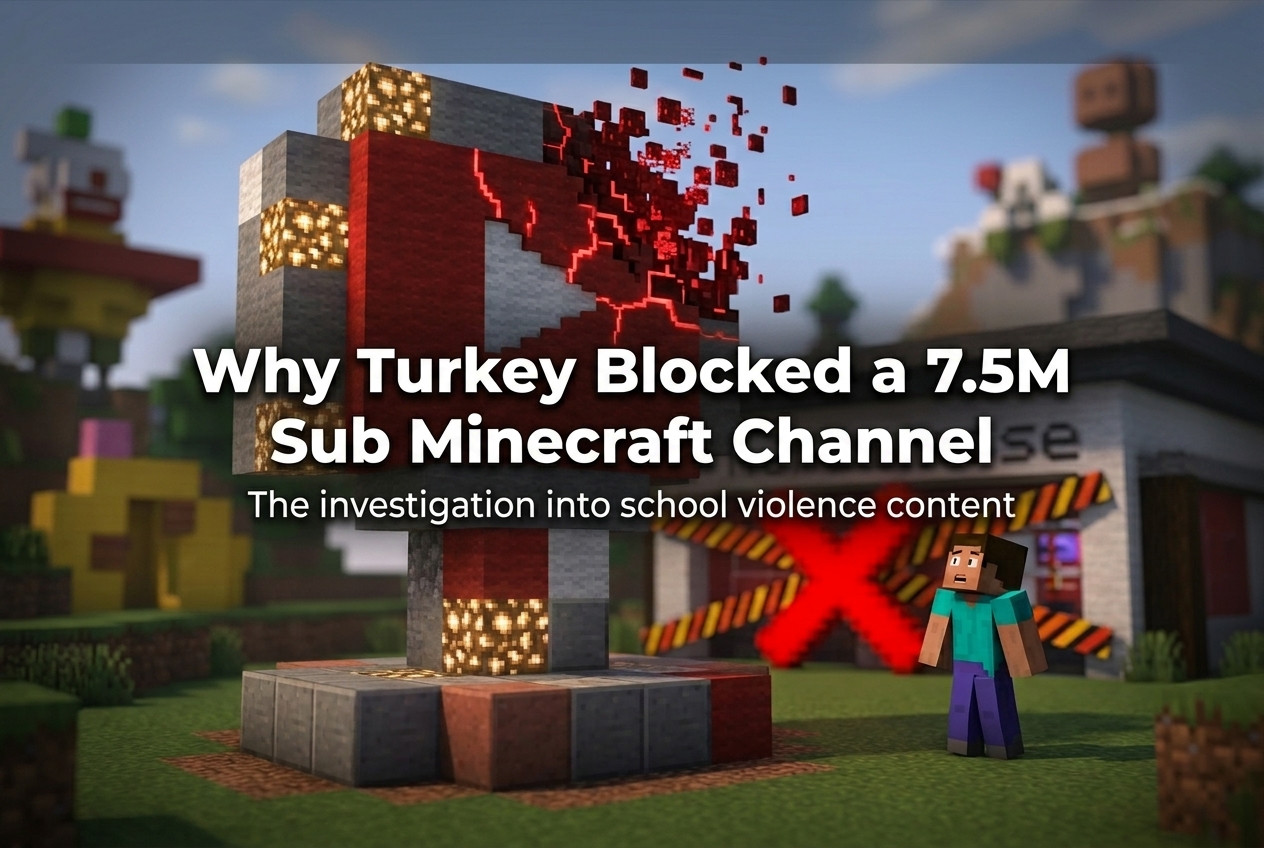
A Turkish court ordered access to the Minecraft Parodileri YouTube channel blocked after Istanbul prosecutors launched a criminal investigation into content allegedly glorifying school violence. The channel had over 7.5 million subscribers.
Turkish authorities have blocked access to Minecraft Parodileri, a YouTube channel with over 7.5 million subscribers, following a criminal investigation launched by the Istanbul Chief Public Prosecutor’s Office. The channel, which produced Minecraft-themed parody content primarily aimed at younger audiences, was found by prosecutors to contain material allegedly inciting violence and glorifying criminal acts connected to real school attacks in Turkey.
Why Was the Channel Blocked?
The Istanbul Chief Public Prosecutor’s Office examined the channel’s content and concluded that several videos encouraged school-aged children to commit violent acts. Prosecutors determined that the content effectively legitimized criminal behavior, prompting an immediate ex officio investigation. A simultaneous access block was ordered and enforced, cutting off Turkish users from the channel entirely.
The investigation centers on two specific articles of the Turkish Penal Code:
- Article 214: Public incitement to commit a crime. Prosecutors argue the channel’s videos explicitly pushed young viewers toward acts classified as criminal offenses.
- Article 215: Praise of a crime and a criminal. The content is alleged to have portrayed violent actors and their actions in a positive light.
The Connection to School Attacks in Turkey
The case did not emerge in isolation. The investigation is being viewed as part of a broader security operation launched after tragic school attacks in the Turkish provinces of Kahramanmaraş and Şanlıurfa. Turkish authorities have been examining digital content that may have played a role in radicalizing or emboldening young individuals to act violently. The Minecraft Parodileri channel, despite its seemingly entertainment-focused format, became part of that scrutiny due to its content framing violent scenarios in ways prosecutors considered dangerous for its predominantly child and teenage audience.
How the Legal Process Worked
The decision followed a clear procedural chain:
- Istanbul’s Chief Public Prosecutor’s Office reviewed the channel’s content and initiated a criminal investigation.
- Prosecutors filed a formal request for an access block with the Istanbul Duty Criminal Court of Peace.
- The court granted the request and issued an access restriction order.
- The order was enforced, preventing users in Turkey from accessing the channel through standard connections.
This is the standard legal mechanism Turkey uses for platform content restrictions, handled through the Information and Communication Technologies Authority (BTK), which forwards court orders to platforms like YouTube for enforcement at the network level.
Is Minecraft Itself Affected?
No. This decision has nothing to do with Minecraft as a game, its developer Mojang Studios, or the broader global Minecraft community. The block is specific to one Turkish YouTube channel that used a Minecraft-themed format. Minecraft itself remains one of the world’s most widely played and educationally endorsed games, with hundreds of millions of players globally. Parents, schools, and gaming communities across Europe and beyond continue to recommend it as a creative and constructive platform.
What This Means for Gaming Content Creators
This case sends a clear signal to content creators working in gaming spaces, particularly those who produce content targeting children and teenagers. Even when content is wrapped inside a familiar gaming aesthetic like Minecraft’s blocky visuals and parody format, the underlying message is what regulators examine. If that message is found to incite violence or glorify criminal acts, it can trigger serious legal consequences regardless of the entertainment framing around it.
Turkey has been progressively tightening its framework for regulating digital content in recent years. This case demonstrates that gaming-themed YouTube channels are not exempt from that scrutiny, especially when their content intersects with real-world violent events.
Does the Block Remove the Channel Permanently?
Not necessarily. The current order restricts access from within Turkey, but the channel has not been permanently deleted from YouTube globally. Users outside Turkey, or those using VPN services, can still reach the channel. The long-term outcome depends on how the ongoing criminal investigation develops and whether further court orders follow.
Things Worth Knowing About This Case
Is this the first time a gaming YouTube channel has been blocked in Turkey?
It is relatively uncommon for a gaming-specific channel to face this level of legal action in Turkey, which makes this case notable. Most previous access restrictions in Turkey involved news outlets, social media profiles, or politically sensitive content. A channel in the gaming space reaching 7.5 million subscribers crossing into criminal investigation territory marks a significant moment for the Turkish digital content landscape.
Can the channel be unblocked?
Yes, in principle. If the investigation concludes without sufficient grounds for further action, or if a court later determines that the content does not meet the legal threshold for the alleged offenses, the access restriction could be lifted. For now, the block remains in place while the legal process continues.
What responsibility does YouTube have in this situation?
YouTube, as a platform operating in Turkey, is subject to Turkish law and court orders. When a competent Turkish court issues an access restriction order, BTK relays that to the platform, which then implements geo-based content blocking for users in Turkey. YouTube does not independently evaluate or challenge these orders in most cases.
Why does content targeting children carry higher legal risk?
Content directed at minors is held to a stricter standard across most legal systems, and Turkey is no different. When prosecutors determine that a channel’s primary audience includes children and that the content may influence their behavior toward violence, the threshold for intervention is lower. This is consistent with broader child protection principles embedded in Turkish law and international content regulation frameworks.