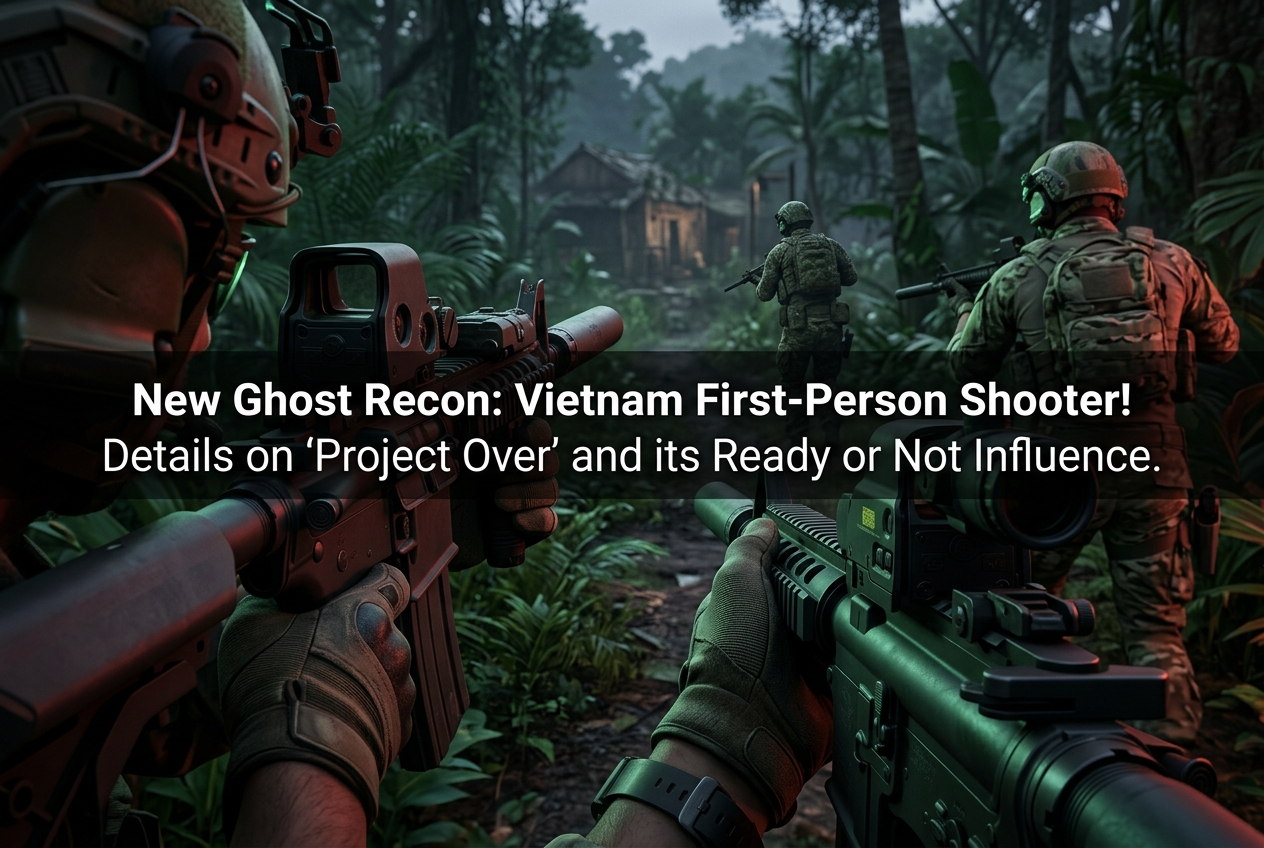
Ubisoft’s next Ghost Recon game, codenamed Project Over, is a radical departure for the franchise. Set in Vietnam with first-person gameplay inspired by Ready or Not, here is everything we know about the tactical shooter reboot.
Ubisoft is preparing Ghost Recon for the most dramatic transformation in the franchise’s 25-year history. Codenamed “Project Over,” the next mainline entry will reportedly be the series’ first fully first-person game, set primarily in Vietnam during a fictional conflict called the Naiman War. Drawing heavy inspiration from VOID Interactive’s Ready or Not and the rebooted Call of Duty: Modern Warfare titles, the new Ghost Recon aims to abandon the open-world action formula of Wildlands and Breakpoint in favour of something far grittier and more tactical. With the franchise having sold over 40 million copies lifetime, Ubisoft’s bet on a complete reinvention carries serious stakes.
Why Is Ghost Recon Changing Direction?
Ghost Recon Breakpoint launched on 4 October 2019 and underperformed badly. Ubisoft ended live service support in April 2022, marking a quiet end for a game plagued by aggressive microtransactions, unwanted RPG mechanics, and a design that drifted too far from the series’ tactical identity. By contrast, 2017’s Wildlands was a commercial hit, moving 1.6 million console units in its first week and eventually reaching over 10 million players.
The gap left by Breakpoint’s failure has lasted years. Ubisoft even cancelled Ghost Recon Frontline, a battle royale spin-off, after overwhelmingly negative player feedback. Multiple credible insiders now report that the publisher is taking a fundamentally different approach. According to Tom Henderson of Insider Gaming, Ubisoft CEO Yves Guillemot confirmed during the July 2024 shareholders meeting that a new Ghost Recon game is in active development.
What Does the Ready or Not Inspiration Mean?
Ready or Not is a tactical first-person shooter developed by Ireland-based VOID Interactive, fully released in December 2023 on PC. It serves as a spiritual successor to the classic SWAT series, prioritising grounded realism, slow-paced decision-making, and tense squad coordination over fast-paced action. The game has been critically well received and commercially successful, particularly after its console launch.
According to prominent Ubisoft leaker RogueTX, the next Ghost Recon directly draws from Ready or Not’s squad mechanics. Gameplay footage sent privately to Insider Gaming, under the condition it would not be made public, was described as resembling Ready or Not and Modern Warfare in feel. This signals a game where charging into firefights is punished, planning is essential, and every engagement carries real consequences.
Vietnam Setting and the Fictional Naiman War
The game’s setting has been one of the most discussed details since leaks began surfacing. Initial reports referenced a generic Asian location, but subsequent insider information, including from the Twitter account xj0nathan, has narrowed the primary setting to modern-day Vietnam. The narrative framework involves a fictional conflict known as the Naiman War, described as an extremely brutal confrontation with war crimes and massive civilian casualties.
Dense jungle terrain, rural villages, rivers, and urban fringes are expected to dominate the map design. Vietnam’s climate and vegetation will reportedly shape gameplay directly. Rain, humidity, and thick foliage will affect both visibility and movement rather than serving as cosmetic decoration. Combined with modern military hardware and a present-day geopolitical framing, the tone leans far more grounded than the fictionalised conflict zones of earlier Ghost Recon titles.
First-Person Perspective: The Biggest Break in Series History
Since its debut in 2001, Ghost Recon has been synonymous with third-person gameplay. Project Over changes that entirely. The shift to a first-person camera fundamentally alters how players interpret space, threat, and consequence. Situational awareness narrows, information becomes limited, and combat becomes more intimate and less forgiving.
Insiders describe the gameplay tone as “brutal and unsettling rather than empowering.” Missions are structured around uncertainty. Players reportedly enter environments without full knowledge of enemy numbers, layouts, or potential outcomes. Engagements escalate quickly with few safety nets once things go wrong. Rather than rewarding constant aggression, the design reportedly favours restraint, positioning, and tactical patience.
Unreal Engine 5: A Major Technical Shift
Previous Ghost Recon titles, including Wildlands and Breakpoint, were built on Ubisoft’s proprietary AnvilNext 2.0 engine. Project Over is reportedly being developed on Unreal Engine 5, marking a significant departure from Ubisoft’s usual approach. Interestingly, the original 2001 Ghost Recon also ran on an Unreal Engine variant, making this something of a return to roots on the technical side.
The move to Unreal Engine 5 offers access to superior lighting systems, enhanced physics, and better cross-platform development tools. However, transitioning an entire franchise to a new engine introduces its own challenges, and multiple reports suggest this shift is one factor contributing to potential delays in the release schedule.
Stripped-Down UI and Mission Design Philosophy
Reports consistently indicate that Project Over will feature a significantly more limited user interface compared to earlier entries. Fewer on-screen indicators will force players to rely more on environmental cues, audio, and team coordination. The era of minimap markers and constant objective prompts appears to be ending for Ghost Recon.
Mission variety reportedly focuses on grounded objectives: clearing hostile compounds, navigating populated villages, securing high-value targets, extracting under pressure, and operating in low-light conditions. Choices made during missions are said to affect subsequent operations, adding a layer of consequence that Wildlands and Breakpoint largely lacked. Weather and foliage function as tactical elements rather than visual filler.
Red Storm Shutdown and Release Date Uncertainty
In March 2026, Ubisoft shut down game development at Red Storm Entertainment, the studio that originally created Ghost Recon, laying off over 100 employees as part of broader cost-cutting measures. This decision raised serious concerns about Project Over’s development, as some of those affected were reportedly working on the game.
The original target was a fall 2026 release, with an internal alpha planned for late 2025. Tom Henderson had reported a roughly 12-month timeline from alpha to launch. However, current indications suggest the release may have slipped into 2027 or even Ubisoft’s next fiscal year. Ubisoft’s investor call scheduled for 20 May 2026 could provide updated timelines. The announcement of Assassin’s Creed Black Flag Resynced on 23 April 2026 with a 9 July release suggests Ubisoft may follow a similar compressed marketing window for Ghost Recon once the game is ready.
Where Ghost Recon Has Been
The original Ghost Recon launched in November 2001, developed by Red Storm Entertainment. Together with Rainbow Six, SWAT 3, and Operation Flashpoint, it helped define the tactical shooter genre. PC Gamer US awarded it Game of the Year for 2001, and IGN gave it a 9.3 out of 10 on PC.
Over two decades, the series evolved substantially. Ghost Recon 2 (2004) and the Advanced Warfighter sub-series (2006-2008) shifted toward more action-oriented console gameplay. Future Soldier (2012) introduced a near-future setting. Wildlands (2017) brought the franchise into open-world territory with strong commercial results. Breakpoint (2019) attempted to continue that formula but was widely considered a misstep, and its failure left the franchise dormant for years.
What Should Players Expect?
All available details come from unofficial sources. Ubisoft has not publicly announced Project Over beyond the CEO’s acknowledgement of a new Ghost Recon being in development. Consistent reporting from Tom Henderson, ComicBook, Tech4Gamers, and other outlets paints a coherent picture, but specifics could change during development. Players should treat these details as credible but unconfirmed until an official reveal.
The emerging profile of this game suggests a genuine reinvention. A Ready or Not-influenced tactical core, Vietnam’s dense and punishing atmosphere, a first-person perspective designed to increase tension, and Unreal Engine 5 powering the visuals could together produce the most distinctive Ghost Recon entry in years. If Ubisoft delivers on this vision, Project Over has the potential to re-establish the franchise among the best tactical shooters on the market.
The Questions Most Players Are Asking
Which platforms will the new Ghost Recon launch on?
Current reports point to PC, PlayStation 5, and Xbox Series X/S. There is no indication of last-generation console support, which aligns with the Unreal Engine 5 development choice.
Will the game still be open world?
This remains unclear. Some reports suggest Ubisoft is moving away from the open-world model entirely, while others describe a more restrained and focused world design. Expect less checklist-driven exploration and more environments built to serve tension and tactical gameplay.
Is co-op multiplayer confirmed?
No official confirmation exists, but insiders consider cooperative play almost certain given Ghost Recon’s squad-based identity. Early descriptions focus more on player positioning and decision-making than on micromanaging AI teammates.
When will the game release?
The original window was fall 2026, but delays related to the engine transition, studio restructuring, and layoffs at Red Storm have pushed expectations toward late 2026 or early 2027. Ubisoft’s upcoming investor communications may clarify the timeline.
Will it still feel like Ghost Recon?
The franchise has reinvented itself before, moving from a first-person military sim in 2001 to a third-person open-world game by 2017. Project Over appears to circle back toward the original game’s ethos of realism and consequence, albeit with modern design sensibilities. Long-time fans who missed the tactical roots should find more to appreciate than in recent entries.