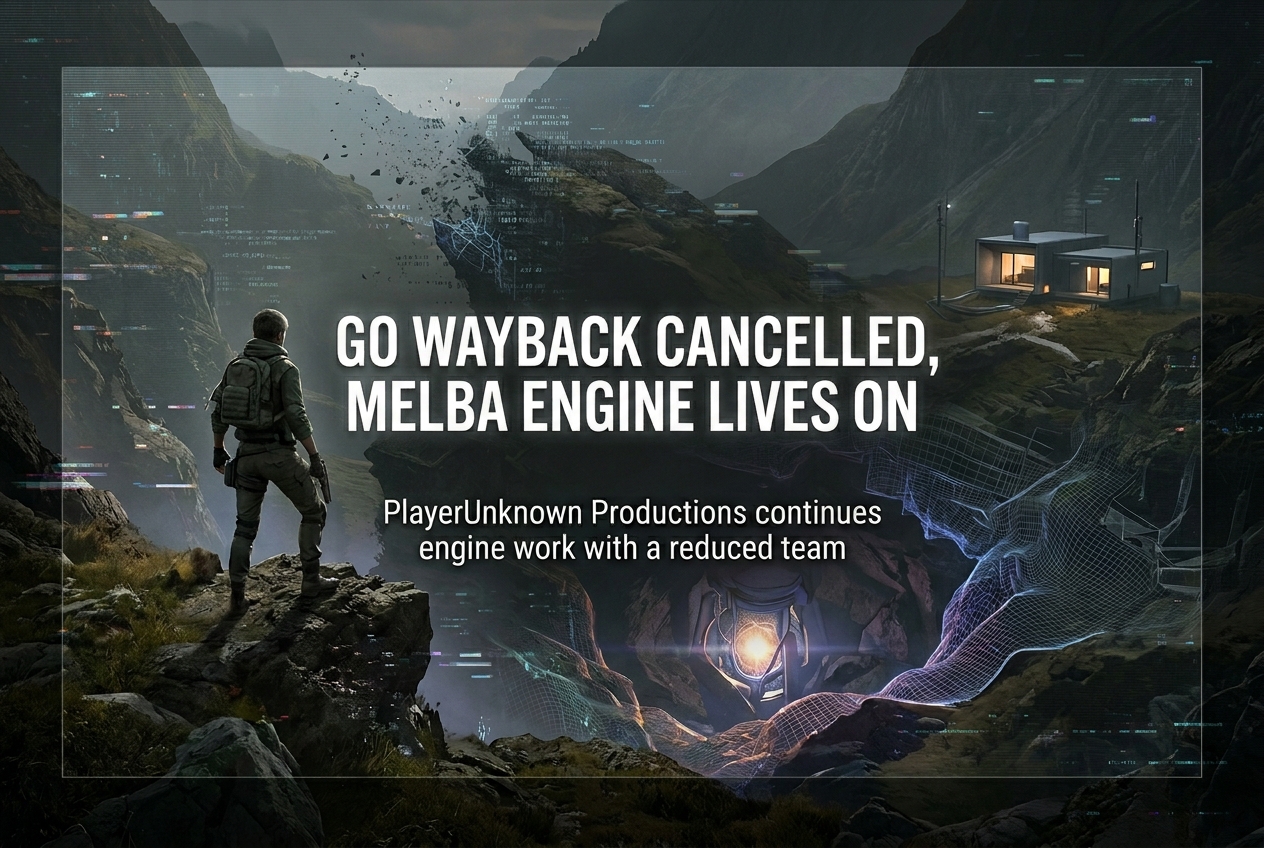
PUBG creator Brendan Greene has announced layoffs at PlayerUnknown Productions and halted development on Prologue: Go Wayback after just six months in early access. The survival roguelike will go free-to-play while the studio continues its Melba engine work with a reduced team.
Brendan Greene, the creator of PUBG and pioneer of the battle royale genre, announced on June 3, 2026 that his Amsterdam-based studio PlayerUnknown Productions is laying off staff and halting development on Prologue: Go Wayback. The survival roguelike launched in early access on November 20, 2025, and managed a peak concurrent player count of just 182 on Steam before falling into single digits within a week of release.
Why Is PlayerUnknown Productions Downsizing?
The core issue is money. Greene stated on X that he has “reached the limits of how far I can continue to fund this journey in its current form.” The studio had been simultaneously developing its proprietary terrain-generation engine called Melba and using that engine to build Prologue: Go Wayback. Running two parallel development tracks, a dedicated research team for Melba and a separate game development team, proved financially unsustainable for an independently funded studio.
Melba uses machine learning to generate realistic terrain in real time within Unreal Engine 5. The technology was designed to power massive virtual worlds, ultimately leading to Greene’s grand vision: an Earth-scale multiplayer platform called Project Artemis. But the research costs of building a custom engine from scratch consumed resources faster than the studio could sustain.
What Happens to Prologue: Go Wayback?
Active development is over. The studio is preparing a final update that will add new items, paths, and trails for exploration, then push the game out of early access entirely. After that update, Prologue: Go Wayback will become free-to-play on both Steam and the Epic Games Store. It will remain available and playable, but no further content updates or patches are planned.
The studio has said it “hopes to return to Go Wayback at a future point in time,” but this reads more as an optimistic note than a concrete plan. With the studio shrinking to a skeleton crew focused on Melba, a return to active game development would require new funding or a significant shift in the studio’s trajectory.
Are Refunds Coming for Existing Buyers?
Prologue: Go Wayback sold for $20 during its early access period. Greene stated that the team is “investigating offering refunds” to players who purchased the game on Steam and the Epic Games Store. However, no firm commitment has been made yet. More details are expected “over the coming weeks” through Steam announcements and the studio’s Discord channel. For now, anyone who paid for the game is in a holding pattern.
What Is the Melba Engine and Why Does It Matter?
Melba is PlayerUnknown Productions’ in-house terrain-generation engine. It uses machine-learning models trained on real Earth data to procedurally generate massive, realistic landscapes in real time. Instead of shipping pre-made map files to players, Melba creates worlds locally on the player’s machine. This approach was meant to solve one of gaming’s biggest technical challenges: creating truly vast open worlds without enormous storage requirements.
The studio released a free tech demo called Preface: Undiscovered World on Steam in December 2024 to showcase Melba’s capabilities. That demo let players explore an “Earth-scale world generated in real-time.” Despite the downsizing, Greene confirmed that Melba development will continue with a smaller team. The engine remains the technological foundation the studio was built around.
Is Project Artemis Still Happening?
That is the biggest unanswered question. Project Artemis was described as the studio’s “ultimate goal”: a massively multiplayer sandbox platform spanning approximately 500 million square kilometres, roughly the surface area of Earth. Greene envisioned it as a space where millions of players could build, explore, and create their own stories within a living, breathing digital world.
Prologue: Go Wayback was the first of a planned three-game roadmap leading to Artemis. The second game was supposed to test AI agents and NPC interactions. The third, Artemis itself, would combine everything into a planet-scale multiplayer experience. With Go Wayback now shelved and the studio reduced in size, the path to Artemis looks far longer and more uncertain. Greene did not mention Artemis at all in his downsizing announcement.
How Did Brendan Greene Get Here?
Greene, born March 29, 1976 in Ireland, created the battle royale concept through his DayZ mod work and later consulted on H1Z1’s battle royale mode. In 2017, he launched PlayerUnknown’s Battlegrounds (PUBG) through South Korean publisher Krafton, which became a global phenomenon and effectively created the battle royale genre as a mainstream category.
In 2019, Greene stepped away from active PUBG development and moved to Amsterdam. By 2021, he formally separated from Krafton to make PlayerUnknown Productions fully independent, with Krafton retaining a minority stake. His stated goal was to push the boundaries of open-world scale using new technology. Five years later, that ambition has collided with financial reality.
Does This Affect PUBG: Battlegrounds or PUBG Mobile?
No. PUBG: Battlegrounds is developed and maintained by Krafton, which is a separate entity from PlayerUnknown Productions. Greene has not been involved in PUBG’s day-to-day development since 2019. The game continues to receive regular updates and has an active 2026 roadmap. PUBG Mobile is similarly unaffected.
Another Studio Caught in the Industry Layoff Wave
PlayerUnknown Productions is far from alone. According to the 2026 State of the Game Industry report, 33 percent of US game industry workers said they had been laid off in the past two years. Half of those surveyed reported that their current or most recent employer conducted layoffs within the last 12 months. AAA studios were hit hardest, with two-thirds of respondents at large studios reporting layoffs, while indie studios saw roughly one-third affected.
Greene’s case is a particularly stark example of the indie studio struggle: ambitious technology development without the safety net of a major publisher’s budget. When the self-funded runway runs out, even a developer with one of the biggest names in gaming history has limited options.
Questions Players Are Asking
Is Prologue: Go Wayback shutting down completely?
Not completely. The game will remain on Steam and Epic Games Store as a free download after a final update. However, there will be no further development, bug fixes, or content additions. The studio has expressed hope of returning to the project someday, but nothing is confirmed.
Will I get a refund if I bought Go Wayback?
The studio says it is investigating refund options but has not confirmed a process yet. Updates will be shared through Steam and the studio’s Discord in the coming weeks.
Is Project Artemis cancelled?
There has been no official cancellation announcement. However, Greene did not mention Artemis at all in the restructuring statement. With the studio operating at reduced capacity and focused on Melba engine research, the timeline for Artemis is entirely unclear.
How many people lost their jobs?
The studio did not disclose the number of employees affected. It only stated that the team is being restructured to a “smaller team” and that supporting affected employees is an immediate priority.
Does this have any connection to PUBG?
None. PUBG: Battlegrounds is developed by Krafton independently. Greene left PUBG development in 2019 and formally separated from Krafton in 2021. The downsizing at PlayerUnknown Productions has no impact on PUBG or PUBG Mobile.