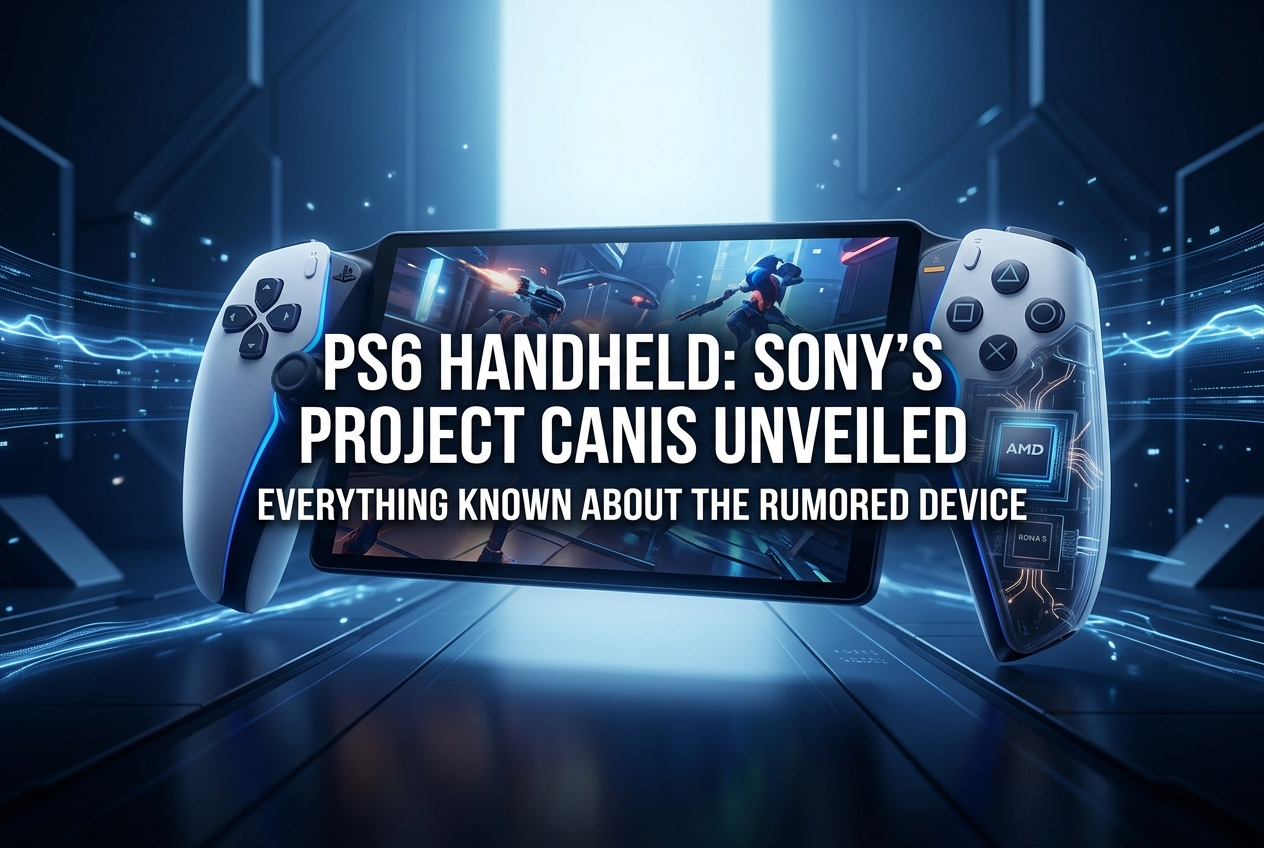
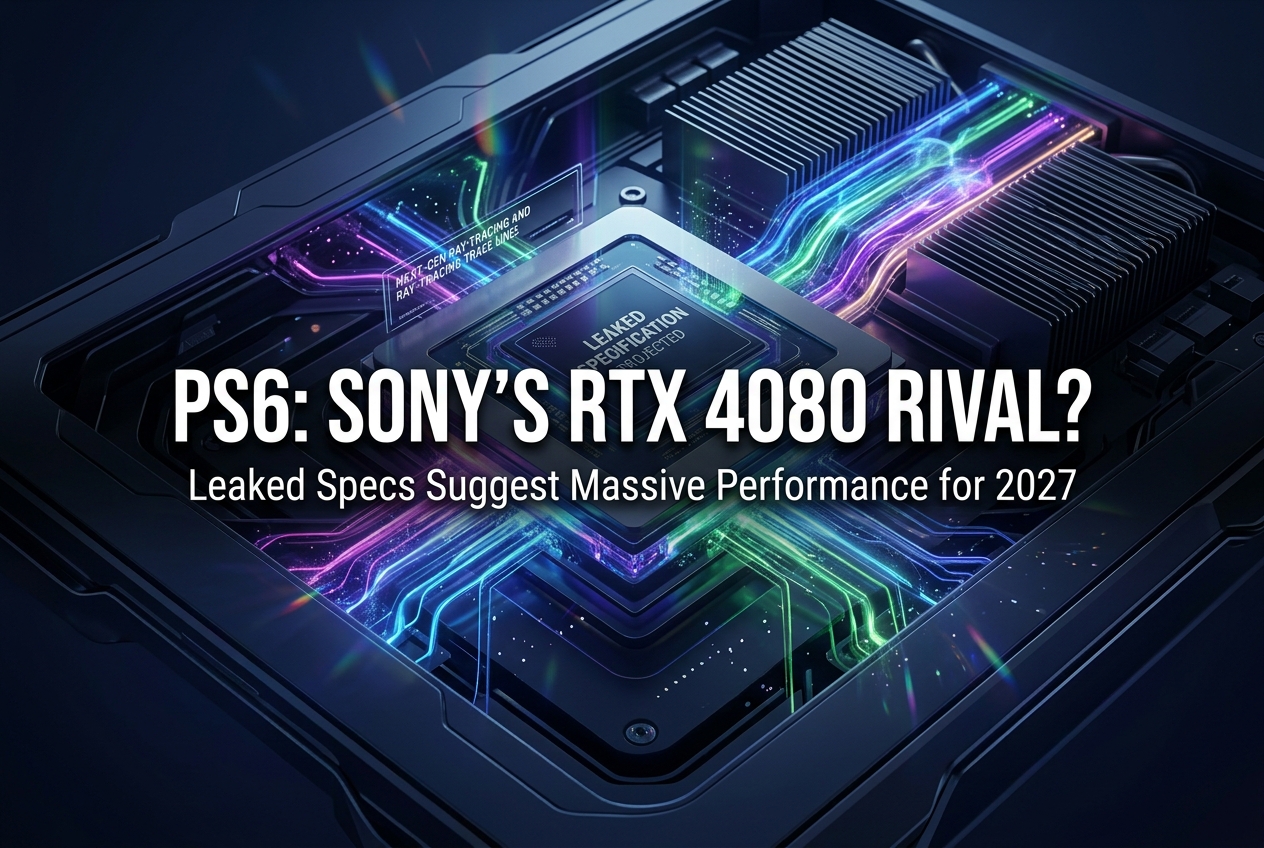
Leaked performance specs for the PlayStation 6 suggest Sony’s next console could match RTX 4080-level GPU power. Here’s what the leaks actually mean, how realistic the comparison is, and what PS6 could deliver for gamers.
Leaked documents and industry sources suggest the PlayStation 6 could deliver GPU performance comparable to NVIDIA’s RTX 4080, making it the most powerful home console ever described before launch. Sony has not confirmed any PS6 specifications, but the volume and consistency of leaks circulating in early 2026 have pushed the conversation into serious territory.
What the PS6 Leaks Actually Claim
The most discussed leaks point to an AMD-designed GPU built on RDNA 4 architecture, with raw compute performance estimated between 33 and 36 teraflops. For reference, the PS5 shipped with approximately 10.28 teraflops, meaning PS6 would represent roughly a three-times leap in raw GPU throughput. The RTX 4080, which launched at around 1,200 USD, operates in a similar ballpark for rasterization performance.
The technical claims circulating across developer communities and hardware analysis channels include:
- GPU performance in the 33-36 TF range based on RDNA 4 architecture.
- A dedicated machine learning accelerator enabling DLSS or FSR-style upscaling natively on the console.
- RAM capacity of 28-30 GB, split between system and GPU workloads.
- SSD bandwidth meaningfully exceeding the PS5’s already impressive 5.5 GB/s throughput.
- Full hardware ray tracing support as a core design pillar rather than an optional toggle.
How Fair Is the RTX 4080 Comparison?
Comparing a console GPU to a discrete PC graphics card is always more complicated than a teraflop number suggests. Consoles run on deeply optimized, unified hardware where the CPU, GPU, and memory bandwidth work together as a single system. The PS5 demonstrated this clearly: its 10.28 TF figure consistently delivered results that surprised PC gamers with higher-spec rigs, because console optimization removes the overhead that desktop systems carry.
If PS6 achieves 33-36 TF on a similarly unified design, the effective output for players could feel competitive with cards well above the RTX 4080 in certain workloads. The more honest framing is not that PS6 equals an RTX 4080, but that Sony is targeting a user experience at that tier, delivered at a console price point. That distinction matters for managing expectations while still being genuinely exciting.
When Is PS6 Coming Out?
Sony has not set an official PS6 release date. Industry analysts and sources close to Sony’s internal roadmap consistently point toward late 2027 or early 2028. The PlayStation 5 launched in November 2020, and Sony’s historical console cycle of seven to eight years aligns with that window. Developer kits would need to be distributed and scaled meaningfully for that timeline to hold, and early signals suggest that process is underway.
The restructuring at Sony Interactive Entertainment following Jim Ryan’s departure has added some internal uncertainty, but hardware planning cycles at Sony’s scale tend to run independently of leadership transitions. The RDNA 4 supply chain and chip design decisions would already be locked at this stage if a 2027 launch is the target.
PS5 to PS6: How Big Is the Generational Jump?
The PS4 to PS5 transition delivered roughly a five-times improvement in GPU compute power, and it produced a generation that still feels genuinely next-gen several years later. A three-times improvement from PS5 to PS6 is a smaller multiplier on paper, but three times the GPU headroom translates into dramatically different visual outcomes at 4K.
The most tangible upgrades gamers can expect from the leaked spec profile:
- Native 4K at high frame rates: The performance vs. quality mode trade-off that defined PS5 gaming could largely disappear.
- Ray tracing as default: Rather than a feature toggled on in select scenes, lighting and reflections could be ray-traced throughout entire games.
- AI-assisted upscaling: A machine learning block in the chip could enable the console to punch above its native resolution with much cleaner results than current FSR.
- Near-instant loading: Even faster SSD bandwidth makes the PS5’s already quick load times feel like a floor, not a ceiling.
- 8K capability: Likely a marketing-tier checkbox, but possible for select titles or media applications.
Sony and AMD: Why the Partnership Matters
Sony has built every PlayStation since the PS4 around AMD silicon, and that partnership has deepened with each generation. The PS5’s custom “Oberon” SoC showed what a console-optimized AMD chip can do beyond raw performance numbers, particularly with the PS5’s I/O complex and its direct memory access architecture.
RDNA 4, which AMD has already deployed in its RX 9000 consumer GPU series, brings significant efficiency improvements and better ray tracing performance per compute unit compared to RDNA 3. A custom PS6 implementation of RDNA 4 would give Sony the ability to tune power envelope, memory bandwidth, and clock speeds specifically for console workloads, which typically differ significantly from the random-access usage patterns of a general-purpose desktop GPU.
Backwards Compatibility and the Game Library
Sony made backwards compatibility a headline feature of the PS5, and there is every reason to expect PS6 to continue supporting both PS4 and PS5 titles. The shared AMD architecture across all three generations makes this significantly easier to implement than cross-architecture compatibility problems that plagued earlier console transitions.
For first-party content, Sony’s major studios including Guerrilla Games, Naughty Dog, Insomniac Games, and Santa Monica Studio are understood to be in various stages of next-gen development. Given that these studios produced some of the best-looking games of the PS5 generation, expectations for PS6 launch-window titles are high.
What PS6 Could Cost
The PS5 launched at 499 USD for the disc edition and 399 USD for the digital version in November 2020. Given component cost trajectories and Sony’s competitive positioning against Microsoft’s next Xbox, the PS6 is most commonly estimated in the 499-599 USD range for the standard edition. A digital-only variant would likely sit lower.
In Europe, Sony has historically priced PlayStation hardware at a slight premium to the US dollar equivalent. UK and eurozone pricing for PS5 was 449 GBP and 499 EUR respectively at launch. PS6 European pricing would depend heavily on exchange rates at the time of announcement, but expect a similar structural premium over the base US price.
Things Players Are Already Asking
Is PS6 actually more powerful than an RTX 4080? On raw teraflops, if the 33-36 TF figure holds, it is in that neighborhood. But effective gaming performance on a console with purpose-built software will differ from a discrete GPU running a general-purpose OS. The honest answer is: comparable tier, not identical output.
Will PS5 games run on PS6? Almost certainly yes, based on Sony’s current backward compatibility policy and the architectural continuity of AMD’s RDNA roadmap. Official confirmation will come closer to launch.
Is it worth buying a PS5 now or waiting for PS6? If the PS6 is still 18–24 months away, buying a PS5 now gives you access to one of the strongest game libraries in PlayStation history and plenty of time to enjoy it before upgrading becomes a real consideration. If you already own a PS5 and are thinking about its future value, it’s a good idea to monitor second-hand prices and demand across different platforms to decide the best time to sell.
How does PS6 compare to the next Xbox? Microsoft has been quieter about its next hardware cycle, but both companies are believed to be targeting similar performance tiers. The console war at the spec level tends to be less decisive than software ecosystems, subscription value, and exclusive game quality.
The Bigger Picture: What These Leaks Signal
Whether or not every leaked spec holds up to final silicon, the consistent pattern emerging from PS6 leaks points to a Sony that is not playing it conservative. RTX 4080-tier performance in a closed-box console would represent a step change not just in visual fidelity, but in what game developers can target as a minimum platform baseline.
For developers, a 33+ TF console with fast storage and dedicated ML hardware opens design possibilities that simply are not viable today. For players, it means games that no longer need to compromise between looking great and running smoothly. That combination has not fully arrived yet, and PS6 could be the generation that finally delivers it.
Until Sony makes an official announcement, the smartest approach is to follow reliable hardware analysis sources, keep an eye on AMD’s roadmap updates, and remain cautious about any leaked specifications without clear sourcing. When the time comes to consider upgrading, tracking second-hand market trends across different platforms can help you better understand how prices shift as a new console launch approaches.