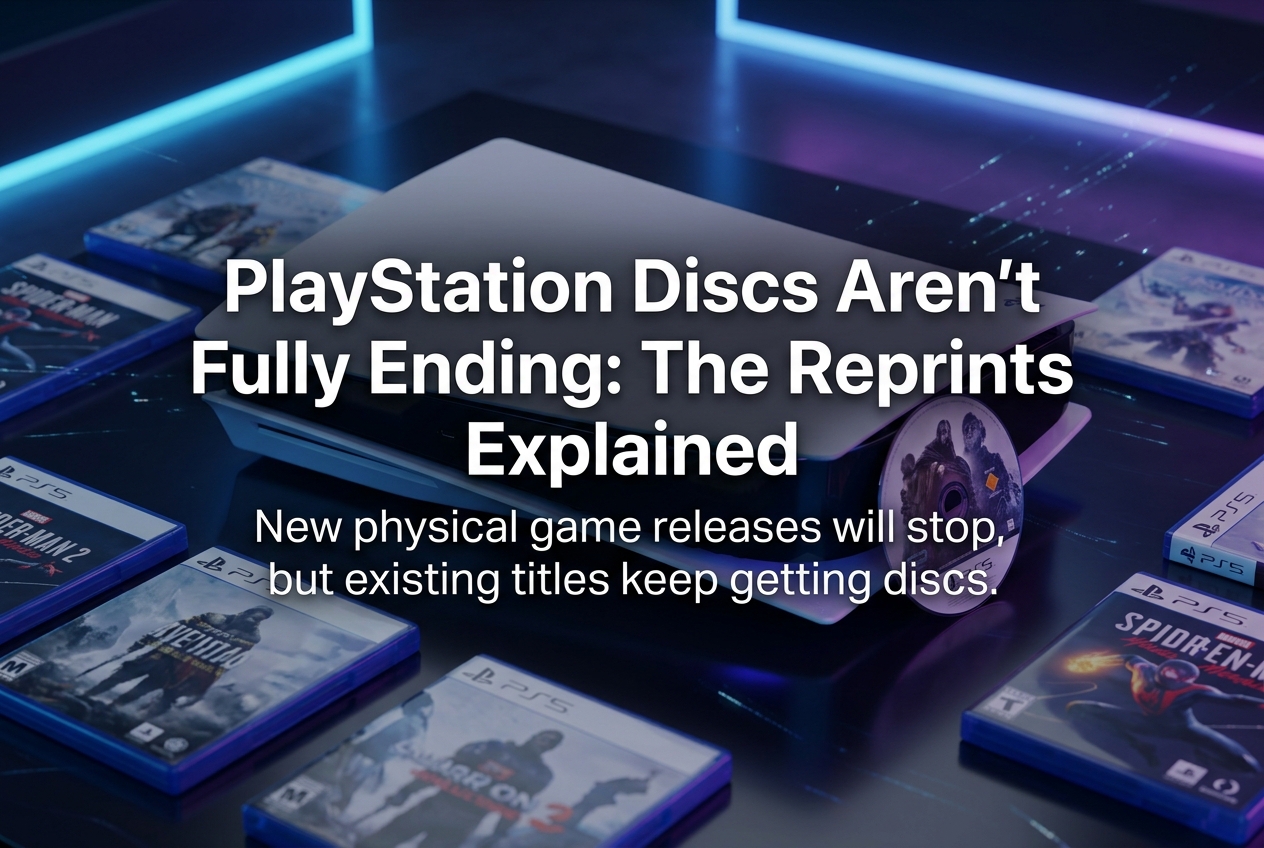
Sony confirmed that physical disc production for new PlayStation games ends in January 2028. However, publishers can still reorder discs for titles released before the cutoff. From the Austria factory pivot to the digital ownership debate, here is the full picture.
Sony Interactive Entertainment officially announced on 1 July 2026 that physical game disc production for all new PlayStation releases will end starting January 2028. However, internal communications obtained by GameFile journalist Stephen Totilo reveal a critical nuance: publishers will still be able to place reorders for existing PlayStation disc games released before the cutoff. With around 80 percent of PlayStation full-game software sales already digital in fiscal year 2025, the shift has been years in the making, but it is not quite the total wipeout many feared.
What Did Sony Actually Announce?
The official PlayStation Blog post was direct: “As consumer preferences and the broader entertainment industry continue to shift away from physical discs to digital, physical game disc production for all new games releasing on PlayStation consoles will be discontinued starting January 2028.” After that date, every new title will be sold exclusively through the PlayStation Store and at retailers in digital formats, likely as a download code inside a box rather than a traditional disc.
Crucially, the announcement stated this transition “has no impact on games that already released, or will be releasing, prior to January 2028 in disc format.” If you own a physical PS5 game today, nothing changes for you. You can still play, resell, lend, and collect those discs for years to come.
Can Publishers Still Print Discs After 2028?
Yes, but only for games that were already on the market before the January 2028 deadline. According to Sony’s private messaging to developer and publisher partners, obtained by Stephen Totilo, the company confirmed that partners “will still be able to place re-orders for existing PlayStation disc games.” There will be adjustments to the ordering process, but the core option remains: if a popular pre-2028 title sells out, publishers can request additional print runs.
Sony also mentioned it will “provide publishers with the opportunity to release new games at retail using digital codes,” though no specifics on the format of those codes have been shared. Whether it will be a card, an empty box with a redemption code, or a new type of physical token is still unclear.
This concession is strictly temporary. Once the disc manufacturing infrastructure winds down fully, the window for reprints will inevitably close as well. The Verge noted that this could trigger a rush of unfinished games hitting shelves in late 2027, just so studios can secure their eligibility for future reorders.
Sony’s Last Disc Factory Is Already Being Repurposed
Sony DADC’s plant in Thalgau, near Salzburg, Austria, was the company’s last wholly owned disc manufacturing facility. According to Austrian public broadcaster ORF Salzburg, Sony DADC president Dietmar Tanzer confirmed the plant currently produces 600,000 discs every day, with half of that output dedicated to PlayStation software. By 2028, production volume is expected to drop to just 10 percent of current levels.
All 300 employees at the facility are being retrained to work on Sony’s Micro Optics technology, producing optical microlenses for sensors and headsets instead of Blu-ray discs. This pivot signals that Sony’s decision is not a negotiating stance or a trial balloon. The physical infrastructure for disc production is being actively dismantled.
What GTA 6 Tells Us About the Industry’s Direction
Rockstar Games confirmed that GTA 6, launching on 19 November 2026 for PS5 and Xbox Series X|S, will not include a game disc in its physical edition. Instead, boxed copies will contain only a digital download code. Rockstar framed the decision partly as a measure to prevent pre-release piracy and leaks.
When the biggest entertainment launch in history ships without a disc, the message to the rest of the industry is unmistakable. Reports suggest a separate disc-based physical edition may follow later, potentially in late 2026 or 2027, as a limited production run. But the precedent is set: digital-first is now the default even for blockbuster titles.
Why the Digital Ownership Debate Has Erupted
Sony’s announcement reignited long-standing concerns about what players actually own when they buy a digital game. PlayStation’s terms of service are explicit: “When you order or purchase a product from PlayStation Store, you buy a personal license to use that product for private, non-commercial use. That license is not transferable.”
Several recent events amplified this anxiety:
- Deleted film libraries: Sony informed European and UK PSN users that hundreds of previously purchased Studio Canal films will be permanently removed from their libraries starting 1 September 2026, with no refund or store credit offered.
- 30-day DRM controversy: After the March 2026 PS5 firmware update, users discovered that newly purchased digital games required an online license check within 30 days. Sony described it as a “one-time online check,” but concerns about offline access persisted. Independent testing suggested the restriction applied primarily during the first 14 days after purchase.
- PS3 and PS Vita store closures: On the same day as the disc announcement, Sony confirmed the PlayStation Store on PS3 and PS Vita will close in stages, starting in select Latin American markets in August 2026 and completing globally by July 2027.
Consumer groups in multiple European countries have signalled legal challenges, arguing that eliminating physical alternatives could entrench Sony’s dominant position in digital distribution and lead to higher prices with fewer consumer choices.
What Does This Mean for PS6?
Industry analysts widely interpret Sony’s move as preparation for the next-generation console. The PS5 Pro already shipped without a built-in disc drive, offering only an optional detachable unit. Leaks and rumours about the PS6 suggest a similar approach: a digital-only base model with a detachable disc drive available separately for backward compatibility.
The timing aligns neatly. If disc production for new games ceases in January 2028 and the PS6 launches around the same period, Sony could debut its next console in a fully digital ecosystem from day one. Analysts from Ampere Analysis noted that when the PS4 launched in 2013, only 13 percent of game sales were digital. By 2025, that figure had surged to nearly 80 percent.
A Practical Timeline for Players
Here is what to expect during the transition:
- Now through late 2027: New PS5 games continue to ship on disc as usual. Players who want physical copies have roughly 18 months of normal availability.
- January 2028: All new PlayStation game releases become digital-only. No new title will receive a disc pressing.
- Post-2028: Publishers can still reorder disc copies of pre-2028 games as long as Sony’s manufacturing capacity remains active, but no new game will be eligible.
- July 2027: PS3 and PS Vita stores close globally. Previously purchased content remains downloadable “for the foreseeable future,” though no firm end date has been given.
How the Shift Affects Gamers in Practice
The end of physical discs reshapes several aspects of the gaming experience. The secondhand market for new releases will effectively cease to exist on PlayStation after 2028. Lending a game to a friend or trading in a finished title at a retailer becomes impossible with digital licenses. Price competition could also weaken without physical retail providing a floor.
On the other hand, digital distribution offers undeniable conveniences: instant access at launch, no risk of disc damage, no storage space needed for cases, and the ability to switch between games without swapping media. Sony’s fiscal year 2025 data showed 317.9 million total software units sold across PS4 and PS5, with an overwhelming majority purchased digitally. The market has already voted.
With PlayStation moving decisively into a digital future, players who want digital game codes, in-game currency, or account services across popular titles can explore trusted platforms built for gamers. The transition may feel abrupt, but it reflects a reality that has been building for over a decade.