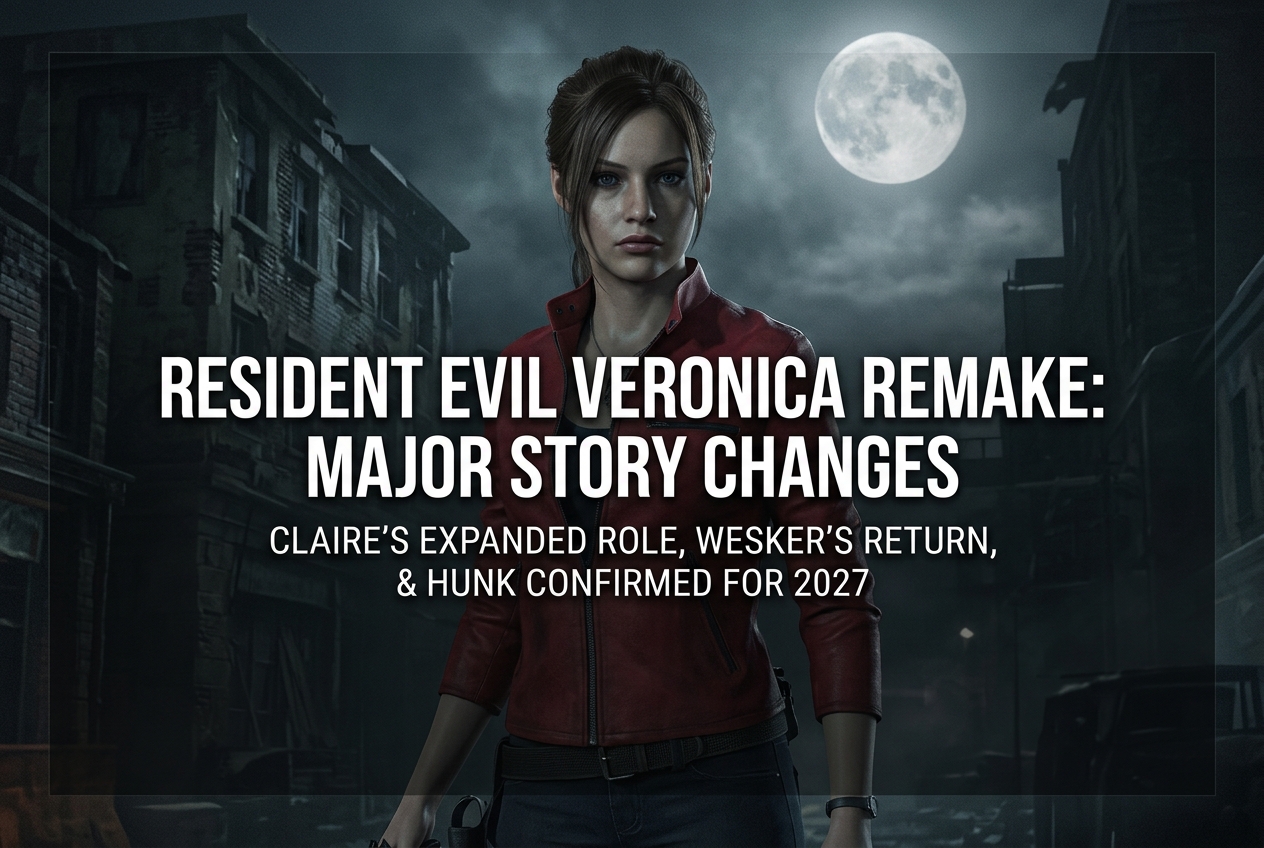
Capcom has confirmed Resident Evil Veronica will feature a restructured storyline to better connect with the broader series timeline. From Claire Redfield’s expanded role to Wesker’s reimagined boss fight and HUNK’s surprise return, here’s everything revealed so far about the 2027 remake.
Capcom officially announced Resident Evil Veronica at Summer Game Fest 2026, confirming a full remake of the 2000 Dreamcast classic for a 2027 release on PS5, Xbox Series X|S, Nintendo Switch 2, and PC via Steam. Producer Yoshiaki Hirabayashi has confirmed the remake will restructure the original story to ensure it fits cleanly within the series’ modern timeline, making this potentially the most heavily remixed Resident Evil remake to date.
Why Capcom Dropped “Code” from the Title
The remake is simply called Resident Evil Veronica, not Code: Veronica. According to Hirabayashi, the development team views Code Veronica as equally important as any numbered entry in the series. Recent mainline titles have used single-word subtitles (Village, Requiem), and Veronica now follows that naming convention. The change signals Capcom’s intent to position the game as a core part of the franchise rather than a side story, which is how many players historically perceived it.
Why the Story Is Being Changed
Hirabayashi explained to multiple outlets, including Famitsu and VGC, that the Veronica remake’s narrative is being restructured so players can “clearly feel how all of these titles are part of one cohesive series.” Since the original released 26 years ago, the franchise has expanded considerably with entries like RE4, RE5, RE6, and RE Requiem, all of which reference events from Code Veronica. Capcom wants those connections to feel intentional rather than retrospective.
When asked whether the remake would implement “bold changes” similar to the RE2 remake, Hirabayashi broadly confirmed it would. However, he emphasized that the team’s priority is “putting the players’ memories first, and then rebuilding the game on top of that.” Changes will serve narrative cohesion, not novelty.
Claire Redfield Takes Centre Stage
The original Code Veronica split its narrative between Claire and Chris Redfield. The remake shifts the balance decisively toward Claire. Hirabayashi framed this as a direct parallel to Leon’s journey: “We were able to deliver the experience of playing as Leon in the Raccoon City incident with Resident Evil 2 and then continue his story with Resident Evil 4. One of the key motivations behind remaking Veronica was that we also wanted to tell the story of Claire after the events in Raccoon City.”
Set just three months after RE2, Veronica shows a Claire who has been changed by the Raccoon City incident but hasn’t transformed into someone unrecognizable. Hirabayashi described her as someone whose “experiences haven’t left her the exact same person that she was in RE2” while noting she hasn’t become a government agent in three months. Gameplay-wise, expect something closer to an evolved RE2 remake feel rather than RE4’s more action-oriented approach.
A Completely Reimagined Opening
The original game opened with Claire infiltrating Umbrella’s Paris facility, getting caught, and being shipped to Rockfort Island within minutes. The remake takes a very different approach. The reveal trailer shows Claire arriving at Chris’s apartment in Paris, searching for her brother. Details found in the apartment, including a portrait linked to the Spencer Mansion, suggest Chris has been using it as a base for his secret investigation into Umbrella’s European operations.
According to insider reports compiled from sources like Dusk Golem, Claire subsequently visits Umbrella’s Paris headquarters disguised among a group of tourists, attempts to steal information, gets caught, and is transported to Rockfort Island. The opening is now fully playable and introduces stealth mechanics as a tutorial. This shifts the tone from action-first to character-driven, grounding Claire’s motivations before the horror begins.
HUNK’s Unexpected Return
One of the trailer’s biggest surprises was the appearance of HUNK, the masked Umbrella operative who was never shown in the original Code Veronica. He was only briefly mentioned in a file from Resident Evil: The Darkside Chronicles. In the remake, reports suggest HUNK is directly involved in Claire’s capture and escort to Rockfort Island, giving him an expanded lore role that could deepen the player’s understanding of Umbrella’s internal operations.
Wesker Gets a Bigger Role and Chris’s Finale Changes
Albert Wesker’s return from apparent death was one of Code Veronica’s most significant plot revelations, directly feeding into RE5’s storyline. The remake expands his presence further. His paramilitary group, the H.C.F. (Hive/Host Capture Force), is being elevated to a central narrative element rather than a background faction.
The most dramatic structural change involves the Chris vs. Wesker confrontation. In the original, this was a cutscene where Wesker easily overpowered Chris. The remake transforms it into a full interactive boss fight that occurs much earlier in the game. Chris is left seriously injured, which removes him from the finale entirely. As a result, Claire fights the final boss, Alexia Ashford, on her own. According to reports, Wesker’s separate fight against Alexia from the original has been cut, reinforcing Claire’s position as the definitive protagonist.
Steve Burnside and Character Overhauls
Steve Burnside’s characterization in the original game hasn’t aged well. His boyish crush on Claire manifested as behaviour that many players found uncomfortable even in 2000. Capcom is reworking him significantly: he still has feelings for Claire, but they’re communicated through socially awkward curiosity rather than creepiness. Having grown up on Rockfort Island, Steve is now framed as someone fascinated by the outside world, which contextualizes his behaviour differently.
Rodrigo, the security guard who releases Claire from her cell early in the original, has been given a role expansion similar to Luis Serra in the RE4 remake. He becomes a more active ally who provides information about the island’s history and the Ashford family’s dark past. The Ashford family’s connections to Nazism, which were only lightly implied in the original, will also be addressed more directly in the remake.
Rockfort Island Goes Semi-Open World
On the gameplay side, the most notable shift is Rockfort Island becoming a semi-open world environment. Claire will find and repair a motorcycle early in the game, allowing free traversal across the island. The gore system from the RE2 remake returns with significant overhauls, and insider reports indicate the game features some of the most viscerally detailed zombies in the series, inspired by the island’s bombardment and prisoner-of-war camp aesthetic.
Crucially, nothing has been cut. Every enemy, location, and major event from the original remains, but the chronology has been heavily remixed. In Dusk Golem’s words, it’s “the remake with the most things changed or happening differently than you may remember, but every enemy, location, major event is there, and much even expanded.”
Is It First-Person or Third-Person?
The debut trailer’s opening section was shown in first-person, which led some viewers to speculate the game might switch perspectives like Resident Evil Requiem. Hirabayashi shut this down clearly: Resident Evil Veronica is a fully third-person game. The first-person perspective in the trailer was a deliberate creative choice to maintain the surprise of Claire’s reveal at the end. There will be no option to switch to first-person gameplay.
How Veronica Connects to the Wider Series
Code Veronica sits at a critical junction in Resident Evil’s chronology. Set three months after RE2 and RE3, it continues both Redfield siblings’ stories while introducing Wesker’s superhuman transformation, the T-Veronica virus, and the broader scope of Umbrella’s global conspiracy. These elements directly feed into RE5’s Ouroboros arc, Chris’s long-term character development, and narrative threads that persist through to RE Requiem.
Capcom’s stated goal is to make these connections feel organic rather than retroactive. The RE2 remake serves as a direct jumping-off point for Veronica’s story and gameplay design, and the team is also drawing on feedback from Requiem to inform usability and game feel. Hirabayashi noted they are “looking at where the universe is in Requiem and finding ways to reflect that and connect that to the remake.”
Release Window and Development Details
Resident Evil Veronica is targeting a 2027 release, with multiple reports suggesting a Q1 2027 launch window. The game is being directed by Kazunori Kadoi and Yasuhiro Anpo, the same directors behind the RE2 and RE4 remakes, with Hirabayashi producing. Development reportedly started in late 2022 at Capcom Division 1 and is said to be running ahead of schedule, originally planned for 2028 but moved forward due to smooth progress.
The Steam page is live but sparse, with no pricing or firm date. Capcom has indicated that more details, including gameplay footage, will be shared in the coming months. With one of the series’ most narratively important chapters getting what may be its most ambitious remake treatment yet, 2027 is shaping up to be another landmark year for Resident Evil.