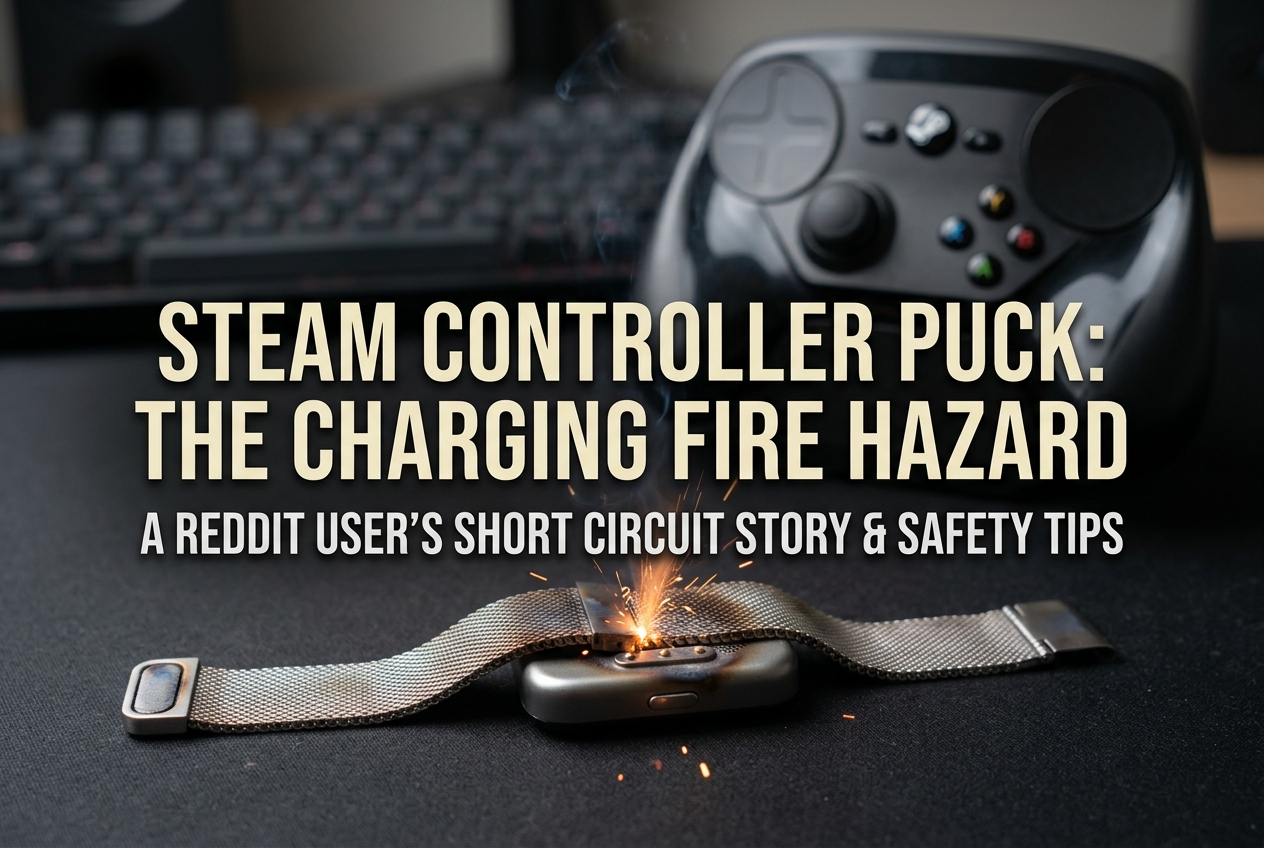
A Reddit user reported that their metallic smartwatch strap caused a short circuit when it touched the Steam Controller’s charging puck, nearly starting a fire. Here’s the full story, Valve’s official safety warnings, and practical tips to avoid it.
The 2026 Steam Controller launched on May 4 at $99 / €99 / £85, and its magnetic charging Puck has been praised as one of the smartest design choices in the package. But a Reddit user recently revealed a potential fire hazard: their metallic smartwatch strap accidentally touched the Puck’s exposed charging pins and caused a short circuit that left the device “sizzling.” The incident, reported by TechRadar on May 21, 2026, has sparked a design debate about exposed contact points on gaming peripherals.
What Exactly Happened?
The Redditor was charging their smartwatch near the Steam Controller Puck when the metallic watch strap touched the Puck’s exposed contacts at what they described as the “exact wrong angle.” The metal bridged the charging pins, creating a short circuit. The Puck started sizzling immediately. No actual fire broke out, but the user said it was close enough to warrant a public warning.
The Redditor acknowledged the incident was ultimately their own fault. Other users in the thread quickly pointed out that Valve does warn about this exact scenario in the Steam Controller’s included safety booklet. Still, the ease with which it happened caught many by surprise.
What Does Valve’s Safety Manual Say?
Valve’s official 2026 Steam Controller product guide includes a dedicated section on magnetic parts with a clear warning. The manual states: “The wireless adapter/charging puck and Controller each contain a magnet. Magnetic parts may attract metallic items. To reduce the potential risk of sparks and resulting property damage or possible injury, make sure that the wireless adapter and charging puck and Controller are free of metallic objects before connecting.”
The manual also notes that magnetic interference can disrupt certain medical devices and that magnetically sensitive items like credit cards should not be placed near the Puck. These warnings are thorough on paper, but the reality is that most users never open the safety booklet that comes in the box.
How the Charging Puck Works
The Steam Controller Puck is a small rectangular accessory included in every box. It connects to a PC via a USB-C cable and serves a dual purpose: it acts as a 2.4 GHz wireless receiver and a magnetic charging dock. When you place the Steam Controller on top of the Puck, magnets snap it into place and charging begins automatically.
Valve designed the Puck to solve what BoilingSteam called the “two dongle problem,” combining the wireless receiver and charging cable into a single device. Kotaku’s review noted that Valve engineers confirmed the Puck is designed not to overcharge and to keep the battery healthy long-term. GamersNexus latency testing showed the Puck connection at 21.6 ms average, nearly identical to a wired connection at 19 ms. It supports up to four Steam Controllers simultaneously on its 2.4 GHz connection.
The system is genuinely convenient. Multiple reviewers mentioned that dropping the controller onto the Puck after a gaming session became second nature. But because the Puck stays powered and connected to your PC essentially all the time, the exposed contact pins remain live whenever the USB cable is plugged in.
Could Valve Have Designed This Better?
The Reddit thread raised a legitimate design question. Several users pointed out that the Xbox Elite Series 2 controller features a similar exposed pin charging dock, but Microsoft added a raised ridge around the pins. This ridge makes it significantly harder for stray metallic objects to make accidental contact with the charging contacts.
Another suggestion from the community was implementing a “handshake” protocol: the Puck would only deliver power when it detects the correct device attached, rather than sending current through any metal that bridges the pins. This approach would eliminate the short circuit risk entirely, though it would add complexity and potentially cost to the design.
Valve has not issued an official statement about the incident. TechRadar reported reaching out to the company but had not received a response as of publication.
Why Reading the Manual Is Not Enough
Even users who do read safety manuals face a practical problem: other people in the household will not. A housemate, partner, child, or visitor could set a metallic keychain, bracelet, or watch down next to the Puck without any awareness of the risk. The Puck’s magnet actually attracts metallic objects toward it, which makes this scenario more likely than it might seem.
Given the Steam Controller’s impressive 35+ hour battery life (GamersNexus measured up to 73 hours in a joystick-only test), the Puck will likely remain plugged in and on your desk around the clock. That creates a persistent exposure window that a one-time manual reading cannot address.
Practical Safety Tips for Steam Controller Owners
- Keep the Puck area clear of metallic objects. Watches, rings, coins, paper clips, keys, and metallic phone cases should stay away from the Puck at all times.
- Unplug the Puck when not charging. If the USB cable is disconnected, the exposed pins carry no current and pose zero risk. This is the simplest and most effective precaution.
- Position the Puck deliberately. Place it in a spot on your desk that is not a general dumping ground for everyday carry items. A corner or dedicated controller stand works well.
- Inform everyone who shares the space. A quick heads-up to housemates about the magnetic, always-on charger takes seconds and could prevent a serious incident.
- Actually read the safety booklet. It is a short document and specifically covers magnetic risks, battery safety, and operating temperature ranges (10 to 35 degrees Celsius).
Is the Steam Controller 2026 Otherwise Safe?
The charging Puck incident is a narrow, specific risk rather than a sign of broader safety problems. The 2026 Steam Controller has been widely praised for its build quality and repairability. It uses standard Torx T6 screws with no security fasteners, and the 8.39 Wh Li-ion battery sits in a removable tray rather than being glued in. iFixit has confirmed that replacement parts will be available, making long-term maintenance straightforward.
The TMR (Tunnel Magnetoresistance) thumbsticks measure input through small magnets rather than physical contact, which drastically reduces the risk of stick drift over time. Multiple reviewers, including The Verge and TechRadar, highlighted this as a major durability advantage over traditional controllers like the DualSense.
At $99 in the US and €99 in Europe, it sits above a standard DualSense (around €75) or Xbox controller (around €65) but well below the DualSense Edge at $199. The controller is available through the Steam Store in the US, UK, Canada, EU, Australia, Japan, South Korea, Hong Kong, and Taiwan.
How Common Is the Exposed Pin Problem in Gaming Hardware?
Magnetic charging systems are increasingly common across consumer electronics, from Apple’s MagSafe to various controller docks. The core risk with any exposed-pin magnetic charger is the same: a conductive object bridging the contacts will create a short circuit. The difference lies in how manufacturers mitigate that risk through physical barriers, electronic safeguards, or both.
Microsoft’s raised ridge on the Xbox Elite Series 2 dock is a simple but effective physical solution. Some laptop manufacturers use flat magnetic connectors that sit nearly flush, reducing the surface area available for accidental contact. Valve chose a clean, minimal magnetic snap design that prioritizes convenience but leaves the pins more exposed than some competitors.
The takeaway is not that magnetic charging is dangerous. The takeaway is that any device with exposed powered contacts requires users to keep the surrounding area free of metallic objects, and manufacturers should consider whether additional safeguards are warranted.
The Parts Most People Get Curious About
Can the Puck actually start a fire?
A short circuit caused by a metallic object bridging the pins can generate enough heat to sizzle and potentially ignite nearby flammable materials. The Redditor’s incident did not result in actual flames, but the risk is real if the contact is sustained or if the short occurs near paper, fabric, or other combustible items.
Does Bluetooth charging avoid this risk?
There is no Bluetooth charging. The Puck is the magnetic charging dock. You can connect the Steam Controller via Bluetooth for gameplay, but charging still requires either the Puck or a direct USB-C cable connection. Using USB-C directly to the controller eliminates Puck-related risks entirely.
Has Valve responded to the incident?
As of May 22, 2026, Valve has not issued a public statement about this specific Reddit report. TechRadar reached out for comment but did not receive a response at the time of their article’s publication.
Is this a recall-level issue?
No recall has been announced, and the risk is documented in Valve’s official safety manual. Recalls typically apply to defects the manufacturer failed to disclose, not to hazards that are warned about in included documentation. However, design improvements like a raised ridge or electronic handshake protocol would meaningfully reduce the risk for future revisions.