
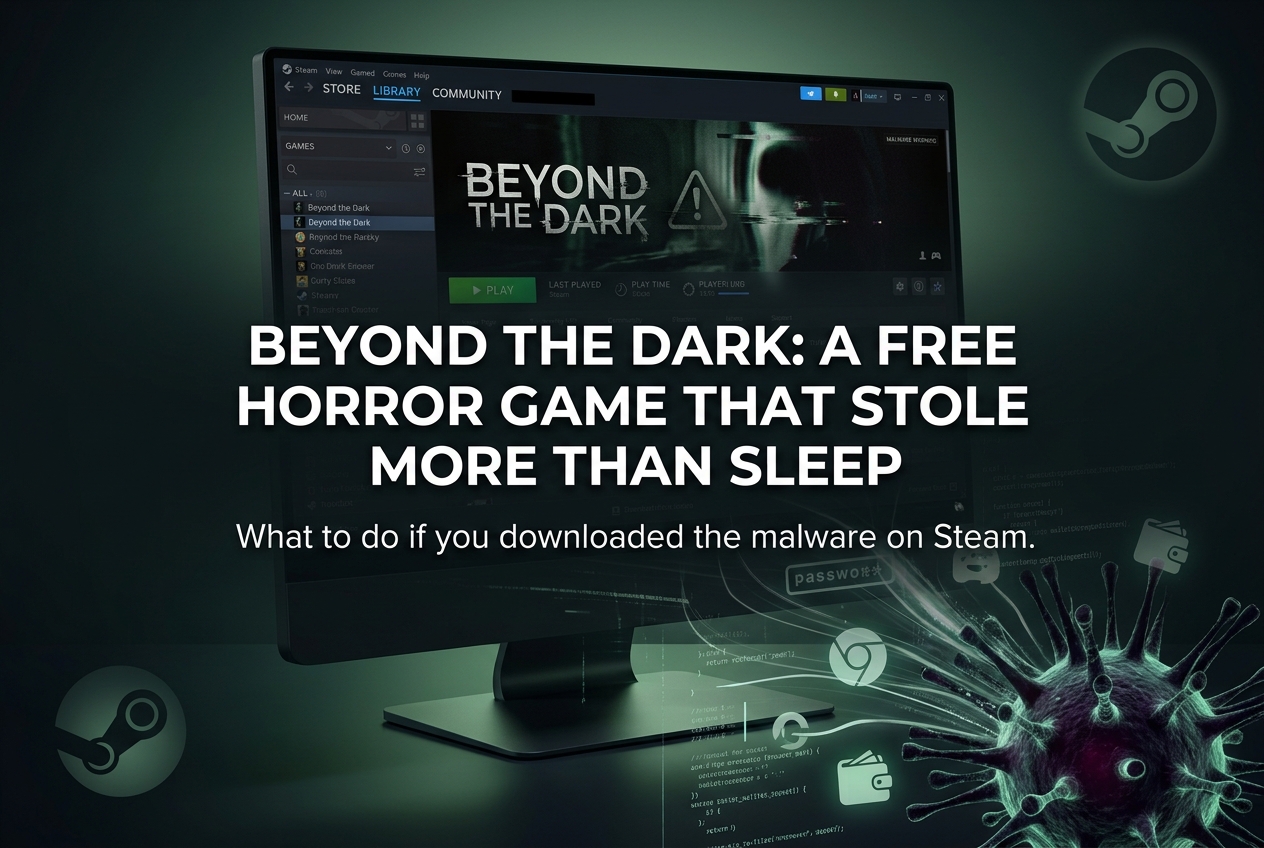
Beyond the Dark, a free-to-play horror game on Steam, was secretly stealing passwords, browser data, and cryptocurrency wallet credentials. Valve removed it after YouTuber Eric Parker exposed the malware, but anyone who downloaded it needs to act immediately.
Beyond the Dark, a free survival horror game available on Steam, was hiding data-stealing malware inside a legitimate-looking Unity engine file. Technology YouTuber Eric Parker published a detailed breakdown on May 18, 2026, exposing how the game silently harvested passwords, browser data, and cryptocurrency wallet credentials. Valve removed the game from Steam shortly after the video went live, but anyone who downloaded and launched it should take immediate steps to secure their system.
How Did a Malware Game Get on Steam?
The game was not built from scratch by the attacker. According to PCGamesN, Beyond the Dark originally existed on Steam as a completely different title called Rodent Race, which had a listed release date of December 28, 2024. Starting around May 4, 2026, a malicious actor hijacked the original developer’s Steam account and gradually replaced everything: the name, screenshots, store description, and the actual game files.
Steam reviews the initial submission of every game before it goes live. However, patches and updates to existing games do not go through the same level of scrutiny. This loophole allowed the attacker to transform an approved title into something entirely different without triggering any automated review flags. The store page even included a disclaimer noting that “all game art and logos” were AI-generated, a detail that should have raised concerns.
What Did the Malware Actually Do?
Parker analyzed the game on a properly isolated virtual machine and found that the malicious payload was embedded inside a file called UnityPlayer.dll. Because this is a standard Unity engine component, it blended in perfectly with the rest of the game files, making detection far more difficult.
The malware performed the following actions once the game was launched:
- Connected to a remote command-and-control (C2) server
- Scanned for cryptocurrency-related Chrome extensions, including MetaMask
- Collected browser data, cookies, and saved passwords
- Downloaded additional malware packages from external servers based on what it found
- Targeted cryptocurrency wallet credentials specifically
The game itself frequently crashed on launch, but the malicious component continued running silently in the background regardless. One viewer who reported the issue to Parker said the malware stole their rare Roblox items, suggesting its data-harvesting capabilities extended beyond just crypto wallets.
Valve Removed the Game But Stayed Silent
After Parker’s video gained traction, Valve pulled Beyond the Dark from the Steam store on May 19, 2026. The game’s store page now shows a notice that it is “no longer available on the Steam store.” However, Valve issued no public statement explaining the removal or warning affected users, a contrast to its handling of earlier incidents like PirateFi in February 2025, where the company directly emailed players and recommended full system reformats.
A Growing Pattern: Steam Malware Games and the FBI Investigation
Beyond the Dark is not an isolated case. It is the latest in a series of malware-laden games that have appeared on Steam over the past two years. In March 2026, the FBI’s Seattle Division publicly announced an investigation into multiple Steam titles that distributed information-stealing malware between May 2024 and January 2026. The FBI identified the following compromised games:
- PirateFi (February 2025): Distributed the Vidar infostealer; up to 1,500 downloads
- BlockBlasters (July-September 2024): Added a cryptodrainer via a patch in August 2024; approximately $150,000 stolen from 261 accounts
- Chemia: Contained HijackLoader and Vidar, plus a custom tool called Fickle Stealer developed by the threat actor EncryptHub
- Lampy, Lunara, Tokenova, Dashverse/DashFPS: Additional titles linked to the same campaign
Researchers linked the broader campaign to a threat actor known as EncryptHub. The FBI is still seeking victims and has asked affected users to reach out via [email protected]. The shared tactic across all of these games was the same: upload a clean or functional game first, then inject malicious code through a post-launch update.
What Should You Do If You Downloaded Beyond the Dark?
If you installed and launched Beyond the Dark at any point, you should take these steps immediately:
- Delete the game completely from your Steam library and local files
- Run multiple full antivirus scans using trusted software like Malwarebytes or Bitdefender
- Change all passwords for email, Steam, social media, and any accounts saved in your browser, using a clean device
- Check your cryptocurrency wallets for unauthorized transactions and move remaining funds to a fresh wallet on a different device
- Consider a full OS reinstall for maximum certainty that no residual malware remains
- Revoke your Steam API key at steamcommunity.com/dev/apikey and deauthorize all other devices in Steam Guard settings
How to Protect Yourself From Malware on Steam
Steam remains significantly safer than downloading games from unofficial sources, torrents, or anonymous file-sharing platforms. Valve operates within a regulated infrastructure and can remove malicious titles, cooperate with law enforcement, and notify affected users. However, no automated review system is perfect, especially when attackers exploit the gap between initial approval and post-launch updates.
Here are practical steps to reduce your risk:
- Enable Steam Guard: Two-factor authentication through the Steam mobile app is your most important line of defense for account security
- Be cautious with unknown free games: Free-to-play titles with very few reviews, recent release dates, and generic descriptions can be red flags
- Check review dates against release dates: Beyond the Dark showed a December 2024 release date but almost all reviews were from 2026, a clear inconsistency
- Watch for AI-generated assets: Low-quality, generic-looking artwork and descriptions that feel machine-generated should prompt extra caution
- Keep real-time antivirus active: A reliable security solution with real-time protection can catch malicious processes even if they come from a Steam game
- Report suspicious games: Community reporting played a critical role in getting Beyond the Dark taken down
Valve’s Update Verification Problem
The core issue enabling these attacks is Steam’s relatively light verification of post-launch updates. When a game first appears on the store, Valve reviews it before granting access. But once a title is approved, developers can push patches that modify the executable files, add new DLLs, and change the store page without going through the same review process. Attackers have exploited this repeatedly: hijack an existing developer account, push a “patch” that is actually a complete game replacement with embedded malware, and enjoy a window of days to weeks before detection.
With over a thousand new games landing on Steam every month, the scale of the challenge is immense. However, the increasing frequency of these incidents, now drawing FBI attention, suggests that Valve may need to rethink how it handles large-scale changes to existing store listings. Pattern detection for complete asset replacements, mandatory re-review for games that change their name and genre, or enhanced DLL scanning could all be potential improvements.
Common Questions Players Are Asking
I downloaded Beyond the Dark but never launched it. Am I at risk?
Based on Eric Parker’s analysis, the malware activated when the game was executed. If you only downloaded the files without running the game, your risk is significantly lower. However, running a full antivirus scan is still recommended as a precaution.
Are Steam games generally safe to download?
Yes. Steam is far safer than unregulated download sources. Valve has the infrastructure to detect, remove, and investigate malicious content and cooperates with law enforcement. These malware incidents, while concerning, represent a very small fraction of the tens of thousands of games on the platform. The key risk factor is newly published or recently updated free games from unknown developers.
How does this relate to the FBI investigation?
The FBI’s Seattle Division has been investigating a broader campaign of malware-laden Steam games since at least March 2026. The investigation covers titles published between May 2024 and January 2026, including PirateFi, BlockBlasters, and Chemia. Beyond the Dark uses the same attack pattern but appeared in May 2026, potentially extending the timeline. The FBI has asked victims to contact [email protected].
Did Valve warn users who downloaded the game?
As of the latest reports, Valve removed Beyond the Dark from Steam but did not issue an official statement or send direct email warnings to affected users. This differs from the PirateFi incident in February 2025, where Valve proactively emailed users recommending full system scans and even OS reformats.
Staying safe in the digital gaming ecosystem means staying informed, keeping your security tools updated, and approaching unknown free titles with healthy skepticism.